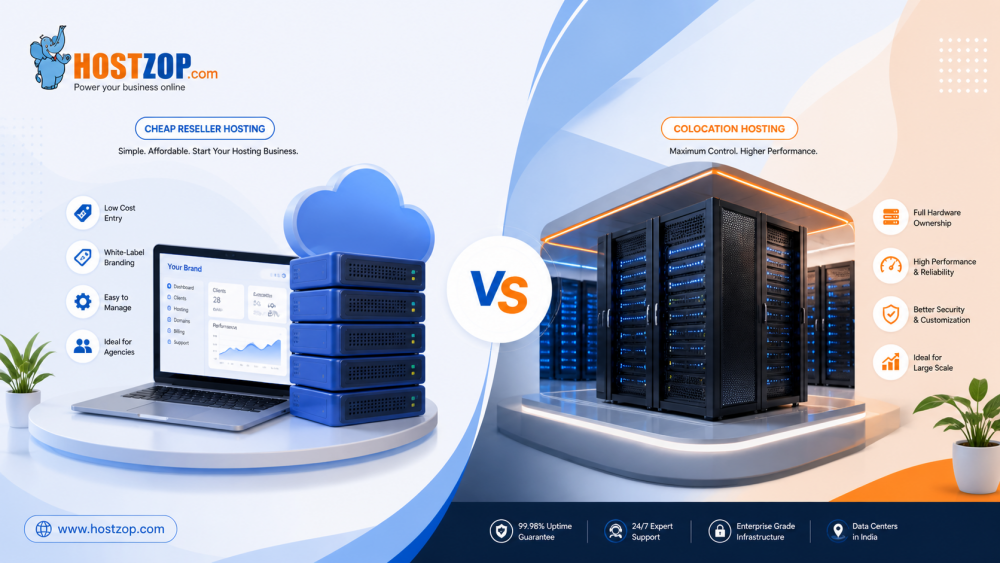
By 2026, the ecosystem of web agencies in India can no longer be limited to the creation of websites alone. Agencies are transforming into a complex digital service provider delivering hosting, maintenance, SEO, SaaS integrations, security management and performance optimization under a single commercial umbrella. This metamorphosis has posed a paradigm shift infrastructure question to agencies interested in being profitable and scaled: Is the better long run strategy to begin with cheap reseller hosting, or to invest in colocation hosting providers?
In the case of web agencies, it is not just a matter of hosting choice. A business architecture option, it defines margins, brand authority, complexity of operations, and client retention.
Modern Web Agency Landscape.
By 2026, Indian agencies increasingly want to provide services to a variety of clients; including companies in different formats (startups), eCommerce stores, educational institutions, law firms, healthcare platforms) and different sizes (enterprise-level). All clients are requesting (in order) speed, uptime, security and technical reliability from their agency services. As a result, agencies can no longer be judged through design aesthetics but the agencies are judged on the basis of infrastructure competence.
This has driven the hosting service, which was initially a peripheral service, to become a strategic source of revenue.
The Difficulty Is To Select The Right Model.
Cheap reseller hosting provides a solution that is pragmatic as a gateway to many agencies. To other aggressive scale-based users, colocation hosting providers offer an infrastructure ownership channel with potentially better margins.
Cheap Reseller Hosting: Quick Start, Low-Risk.
With emerging agencies or small development studios in the business of reseller hosting, low cost reseller hosting is a quick and economical way to venture into the reseller hosting market.
The model enables the agencies to acquire server resources with a larger provider and resell them under their brand. In essence, it turns the agencies into white-label hosting providers without having to invest in hardware.
Key Advantages:
- Low startup cost
- Minimal technical overhead
- White-label branding
- Fast deployment
- Predictable recurring revenue
This can be invaluably beneficial to agencies whose primary concern is client acquisition, but not infrastructure management.
The hosting can be bundled with web design, maintenance and SEO by an agency, generating a recurring monthly revenue and avoiding the need to procure a server, cooling systems, bandwidth agreements and hardware redundancies.
This Democratizes The Hosting Of Entrepreneurship.
Disadvantages Of Low-cost Reseller Hosting.
Nonetheless, the temptation of being affordable maskses some strategic limitations.
Common Challenges:
- Limited hardware control
- Shared infrastructure dependency
- Reduced customization
- Provider-based restrictions
- Margin ceilings
Simply put, although cheap reseller hosting is commercially available, it may lack the sovereignty that agencies may eventually find themselves in need of.
Enterprise security, or traffic-intensive environments, which agencies might have to deal with performance bottlenecks or branding constraints that agencies cannot afford.
Dependency can turn out to be a liability at scale.
Colocation: Ownership, Control & Enterprise Positioning
In the case of larger, or growth-stage agencies, a different paradigm is presented with the involvement of colocation hosting providers.
Colocation: In colocation, physical server hardware is owned by the consumer but data center space, bandwidth, power, and environmental controls are rented to the consumer by specialized providers.
This model offers:
Strategic Benefits:
- Full hardware ownership
- Greater customization
- Better long-term margins
- Stronger brand autonomy
- Enterprise-grade scalability
To agencies that handle dozens or even hundreds of client sites then colocation can turn hosting into a secondary income stream to the agency and as a core infrastructure business.
It is especially persuasive insofar as agencies which serve:
- High-traffic eCommerce
- SaaS startups
- Government projects
- Financial platforms
- Custom enterprise software
The Hidden Complexities Of Colocation
But colocation is not a naive upgrade.
It requires:
- Hardware procurement
- Technical expertise
- Server administration
- Disaster recovery planning
- Security hardening
- Capital expenditure
In contrast to low-end reseller hosting, colocation brings around significant operational complexity.
In many agencies this may result in a dichotomy; greater potential of profitability, but much more complexity.
Therefore, colocation hosting services are usually very suitable to agencies who have already tested recurring hosting needs, and also have the technical maturity to manage their infrastructure efficiently.
Comparison Of Costs: Entry Vs Expansion.
Cheap Reseller Hosting:
- Low monthly expense
- Minimal setup costs
- Lower technical barriers
- Lower profit ceiling
Colocation:
- Increased initial hardware expenses.
- Rack space and bandwidth costs.
- Greater maintenance responsibility
- Increased potential of long-term margin.
Practically, low-cost reseller hosting is the best option when trying out the hosting market.
Agency-level, technical complexity, and client size become sufficiently interesting to warrant a more aggressive infrastructure investment.
Branding Implications
Brand perception matters.
In reseller hosting, agencies are able to deploy hosting services in a short time, but a reliance on back-end performance can constrain the perceived technical power.
Under colocation, the agencies can position themselves to be infrastructure-first providers, which increases their credibility among the enterprise clients.
This is a slight difference but commercially powerful.
SMBs may be attracted to a web agency selling websites.
A web agency under colocation hosting companies can become a full service digital infrastructure company.
The Hybrid Evolution Path
In the case of most Indian agencies, the wisest course of action is one that is phased:
Phase 1:
Start with cheap reseller hosting
Phase 2:
Scale using VPS or semi-dedicated ecosystems.
Phase 3:
Migrate to colocation hosting companies.
This model is staged to reduce financial risk, but maintain scalability.
Hostzop frequently reiterates that agencies cannot afford to promise infrastructure before they legitimize hosting demand. The growth must be evolutionary and not impulsive.
What Model Wins In 2026?
There is no universal victor.
Choose Cheap Reseller Hosting If:
- You are a new or mid-size agency.
- Your risk aversion is to the low-risk side.
- You are in need of repeat business in a short period of time.
- You do not have resources to manage the server.
Choose Colocation If:
- You handle huge client bases.
- You need complete customization.
- You want to have maximum margin control.
- You have technical operational operational maturity.
Final Perspective
Hosting is no longer a value-added feature that web agencies can add as an optional feature, hosting has become a strategic differentiator in the rapidly maturing digital economy of India.
The cheap reseller hosting is accessible, agile, and the low-risk model of monetizing through hosting is ideal in agencies that are entering hosting.
Colocation hosting providers, in turn, symbolize the infrastructural sovereignty, high positioning, and higher profitability in the long term of agencies that are willing to scale beyond the status of intermediaries.
The best course of action cannot be to take either one over the other immediately in 2026 by most agencies.
It is knowing when to begin lean, when to scale on a strategic basis, and when to change a reseller mindset to infrastructure ownership.
Since, in the world of web commerce, the cleverest agencies do not just construct websites.
They build ecosystems.