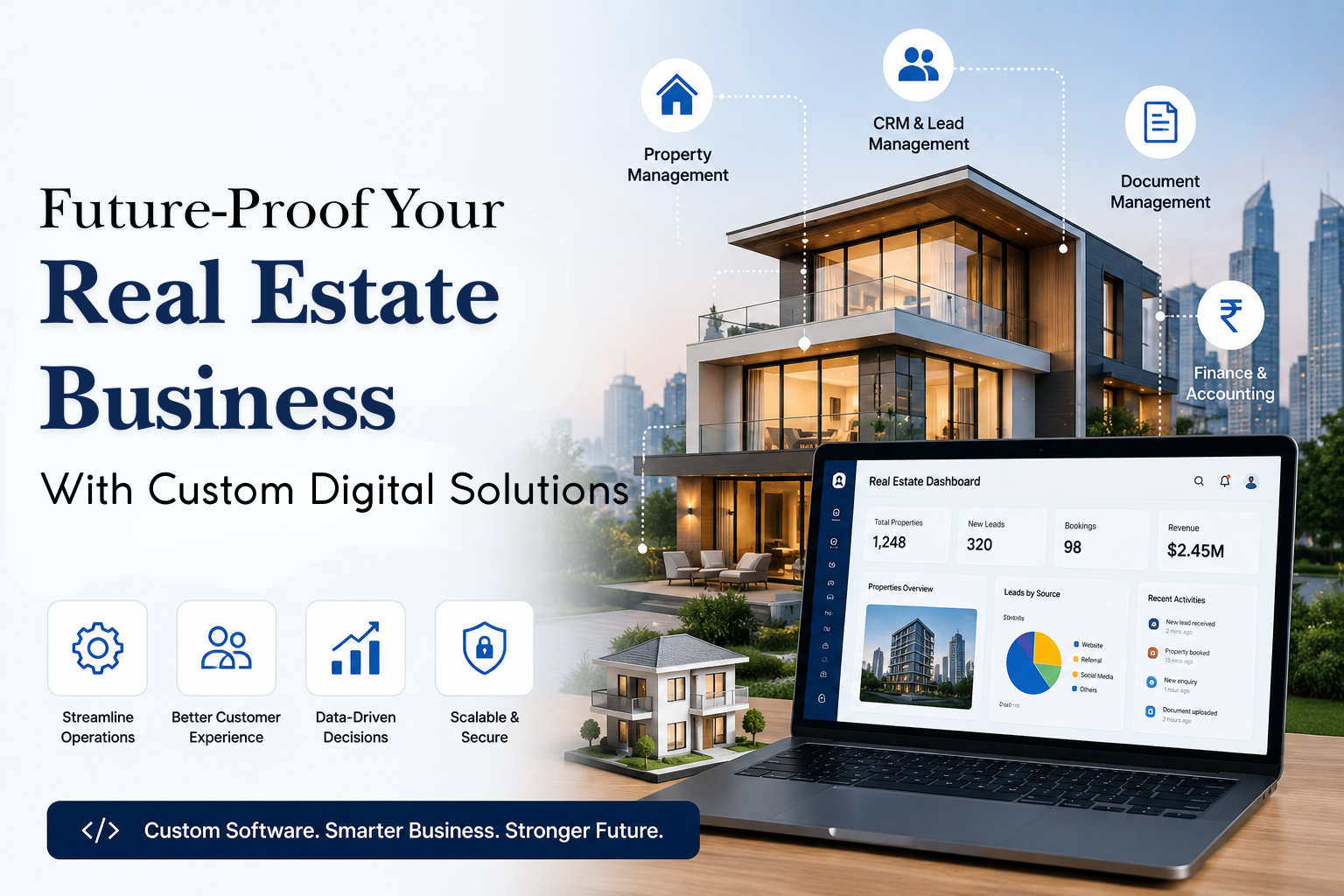
The real estate business is becoming more and more data-driven. Property managers, brokers, developers and investors are expected to handle huge amounts of information, while providing faster and more personalized experiences to clients.
Traditional tools like spreadsheets and disconnected software systems often can’t meet the demands. And that’s why many real estate companies have started using custom software for real estate businesses that fit their specific workflows and future needs. These modular software assists you strengthen operations, automate repetitive tasks and enhance visibility into business performance.
Why Generic Software Doesn’t Work
Basic operations can be assisted by off-the-shelf platforms, but they are designed for the general public, not to cater to your specific business needs.
Real estate enterprises face the following problems-
- Customization options are limited
- Multiple systems complex integration
- Scattered data in different platforms
- Scaling problems as the portfolios grow
- Sensitive customer information security issues
All these problems are solved with real estate IT solutions. It fits in with your existing workflows, rather than you having to bend your business around the software.
Key Areas Where Custom Software Adds Value
1. Centralized management of properties
It’s much simpler to handle several properties when you have all the information in one system.
Custom property management platforms can assist businesses with-
- Lease and contract tracking
- Maintain Process Requests
- Check billings and payments
- Access property records instantly
This means less manual work and more operational visibility across the whole portfolio.
2. Better Intelligence in Client Relationship Management
Every property sale begins with a lead. But, tracking your leads with spreadsheets or stand-alone applications can be inefficient.
A custom CRM system can help firms in-
- Leads to follow from various sources
- Automation of follow-up
- Set up customer interactions
- Track conversion performance
This makes client relationships easier, and means you can spend more time on managing clients, and less time on admin.
3. Automation and smart processes
Automation is one of the biggest benefits of custom software.
Instead of doing repetitive activities manually, corporations can easily automate them-
- Book an Appointment
- Client notices
- Generate a report
- Reminders for payments
- Workflow approvals
Automation can boost productivity and reduce the risk of human error.
Custom Software vs Standard Solutions
| Custom Software | Generic Software |
| Built around business needs | Designed for a broad market |
| Highly scalable | May become restrictive as business grows |
| Seamless integration options | Limited compatibility |
| Greater flexibility | Fixed features |
| Long-term operational value | Often requires multiple workarounds |
For growing real estate businesses, flexibility and scalability often become decisive advantages.
The Growing Importance of Mobile Access
Real estate professionals today don’t usually work from one location. Agents, property managers and investors are increasingly requiring information while travelling, meeting with clients or conducting site visits.
Custom mobile applications can offer:
- Instant access to property information
- Manage appointments
- Client communication tools
- Real-time updates & notifications
Such versatility improves the response capability and enhances the overall customer experience.
Data-Driven Decision Making
Real estate companies create valuable data on a daily basis. The trick is to make that information useful.
Tailor-made software can provide dashboards and reporting tools that help organizations track:
- Occupancy Ratio
- Revenue performance
- Cost of maintenance
- Lead conversion statistics
- Effectiveness of the team
Centralized data that is accurate gives leaders the confidence to make better, more informed decisions.
The Development Process Behind Custom Software
A successful software project is done in a structured manner:
Planning and research
Business goals, pain points and processes are significantly analyzed.
Design & User Experience
Wireframes and user journeys are created with the purpose of making the system simple to use and functional.
Development and Integration
The software is developed and integrated to the platforms and business systems.
Testing And Optimization
Prior to deployment, performance, security and functionality are checked.
Continuous Support
The software improves and gets updated as per the requirement of the business.
To Sum It Up
Real estate is increasingly becoming a business of technology, efficiency and data-driven decision making. Companies that are left with fragmented systems often face operational bottlenecks that prevent them from scaling up.
Property management, customer relationships, reporting and automation are combined in a unified environment, providing a practical solution with real estate software development. Rather than having to shape their business processes around generic tools organizations can adopt technology that’s designed to their needs.
For real estate firms looking to grow, become more operationally efficient and improve the customer experience, custom software is no longer just a technology upgrade – it’s a strategic investment in long-term growth.