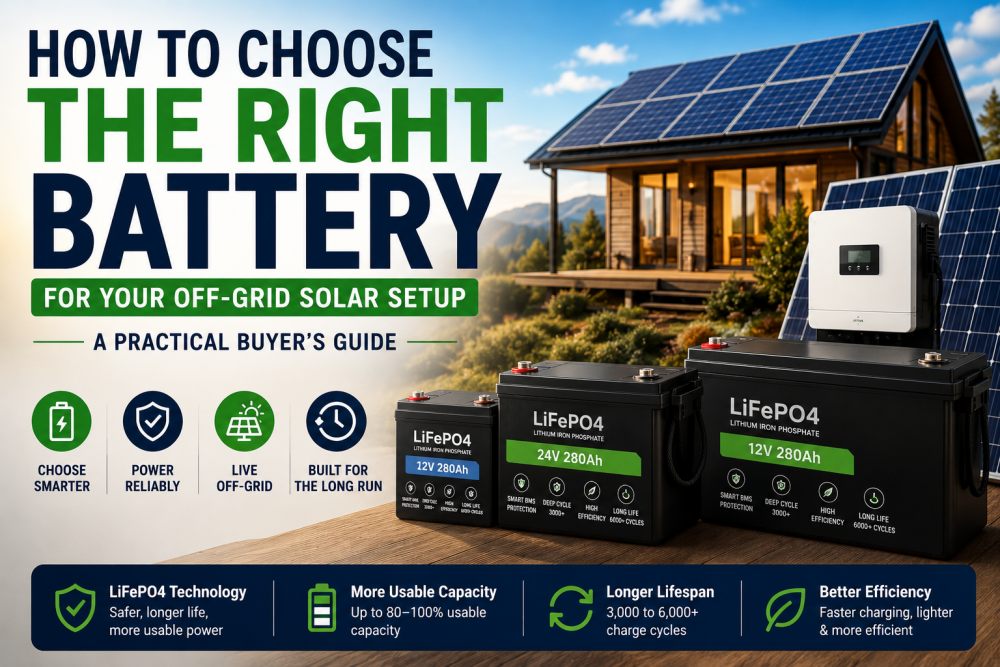
So you’ve decided to go off-grid or you’re upgrading your existing solar setup. Great move. But now comes the question that trips up most beginners and even some experienced DIYers: which battery should I actually buy?
The battery is not just another component. It is the backbone of your entire off-grid system. It stores what your solar panels generate, and it decides how long you can run your fridge, lights, router, or air conditioner when the sun goes down. Get it right, and your system will serve you reliably for a decade. Get it wrong, and you will be spending money on replacements within a couple of years.
This guide cuts through the confusion. By the end, you will know exactly what to look for – and where to find it.
Step 1: Understand Why Battery Choice Matters So Much
Most people focus on solar panels first. But panels are only half the story. On a cloudy day, or after sunset, your stored energy is all you have. A battery that cannot hold enough charge – or that degrades quickly – is the weak link that breaks an otherwise solid system.
The good news is that battery technology has improved dramatically. Modern LiFePO4 (Lithium Iron Phosphate) battery kits are safer, lighter, longer-lasting, and far more efficient than the lead-acid and AGM batteries that dominated the market just five years ago.
Step 2: Know Your Battery Options
Here is a plain-English breakdown of the three main battery types available today:
Lead-Acid (Flooded)
The cheapest upfront option. However, they are heavy, require regular maintenance, and you can only safely use around 50% of their stated capacity. They typically last 300–500 cycles – meaning frequent and costly replacements.
AGM (Absorbed Glass Mat)
A sealed, maintenance-free version of lead-acid. Slightly better, but the same core limitations apply: limited usable capacity, shorter lifespan, and significant weight compared to lithium alternatives.
LiFePO4 (Lithium Iron Phosphate) – The Modern Standard
LiFePO4 batteries offer up to 80–100% usable capacity, last 3,000 to 6,000+ charge cycles, charge significantly faster, and weigh roughly half as much as lead-acid equivalents. They are also thermally stable – far less likely to overheat or catch fire compared to other lithium chemistries.
For any serious off-grid setup – whether it is a caravan, a home, a boat, or a remote cabin – LiFePO4 is the clear choice when you factor in long-term performance rather than just the sticker price.
Step 3: Calculate How Much Battery Capacity You Need
Battery capacity is measured in amp-hours (Ah) or kilowatt-hours (kWh). Here is how to work it out in four simple steps:
- List your appliances and daily usage hours. A 12V compressor fridge, for example, draws roughly 40–50Ah per day.
- Add up all appliances to get your total daily energy consumption in Ah or Wh.
- Decide your autonomy: how many days without sun should your system cover? Most setups plan for 1–3 days.
- Divide by usable capacity: 0.8 for LiFePO4 (80% depth of discharge) or 0.5 for AGM (50%).
Not a fan of spreadsheets? LiFePO4 OZ offers a free Solar Battery Estimator that does all of this automatically – just enter your appliances and it tells you what size system you need. You can also use their Ah to kWh Converter to quickly translate between units.
Step 4: Pick the Right Voltage – 12V, 24V, or 48V?
The voltage of your battery bank needs to match the rest of your system. Here is the practical guide:
12V Systems
Best for caravans, camper trailers, smaller boats, and portable solar rigs. A popular starting point is the 12V 280Ah LiFePO4 Battery Kit, which delivers 3.58kWh of storage and includes a Smart BMS – a complete, ready-to-build solution.
24V Systems
Ideal for larger caravans, motorhomes, or small off-grid cabins. Higher voltage means lower current draw through your wiring, which increases efficiency and reduces heat. The 24V 280Ah LiFePO4 Kit (7.17kWh) is a strong match for this use case.
48V Systems
Designed for homes, farms, and high-demand off-grid installations. The 48V 280Ah Kit (14.34kWh) delivers enough storage to run a full household for a day on a single charge.
Step 5: Never Skip the BMS
A Battery Management System (BMS) is the electronic brain that protects your battery from overcharging, over-discharging, short circuits, and temperature extremes. Without one, even a premium battery can be permanently damaged in a single incident.
The good news: all LiFePO4 OZ battery kits include a Smart BMS – so there is no need to source one separately or worry about compatibility.
Step 6: Think About the Full System, Not Just the Battery
The battery does not work alone. A complete off-grid setup also includes:
- A solar charge controller (MPPT) to regulate power from your panels into the battery safely
- An inverter to convert stored DC power into 240V AC for household appliances
- A DC-DC charger if you want to top up your battery while driving – essential for caravans and 4WDs
- Accessories including cables, busbars, fuses, and battery boxes to complete the installation safely
If you want everything in one bundle, the Off-Grid Solar Kits from LiFePO4 OZ package the key components together – saving you the time of sourcing each part individually.
Step 7: Calculate Total Cost of Ownership, Not Just the Price Tag
A LiFePO4 battery costs more upfront than AGM – but that number changes entirely when you look at cost per cycle over time.
LiFePO4 batteries built with Grade A EVE cells (as used by LiFePO4 OZ) are rated for 3,000 to 6,000+ charge cycles and come with a 5-year cell warranty, with free shipping Australia-wide. An AGM battery in the same daily-cycling application will likely need replacing every 2–3 years. Do that maths across 10 years, and LiFePO4 is almost always the more economical path.
LiFePO4 OZ also offers flexible payment options through Zip (buy now, pay later) and Humm (pay weekly) – so you can invest in a quality system without the full upfront cost all at once.
Where to Buy Quality LiFePO4 Batteries in Australia
If you are based in Australia, LiFePO4 OZ is a dedicated specialist supplier – not a generalist retailer that happens to stock batteries on the side. They carry a comprehensive range including LiFePO4 battery kits, individual cells, BMS units, inverters, solar charge controllers, and complete off-grid kits – all shipped from Yatala, QLD with free shipping Australia-wide on orders over $35.
Their blog is also worth bookmarking, with guides like the LiFePO4 vs AGM comparison and the Caravan Battery Sizing Guide – making it easy to educate yourself before you spend a dollar.
Final Thoughts
Choosing the right battery for your off-grid solar setup does not have to be complicated. Know your energy needs, choose LiFePO4 for long-term performance, match your voltage to your system, and work with a supplier who actually knows the product they are selling.
Do those four things and your off-grid system will run reliably – whether you are parked in the Australian outback, sailing the coast, or simply living free of the grid at home.
Ready to size your system? Start with the free Solar Battery Estimator at LiFePO4 OZ, then browse their full range of battery kits to find the right fit for your setup.