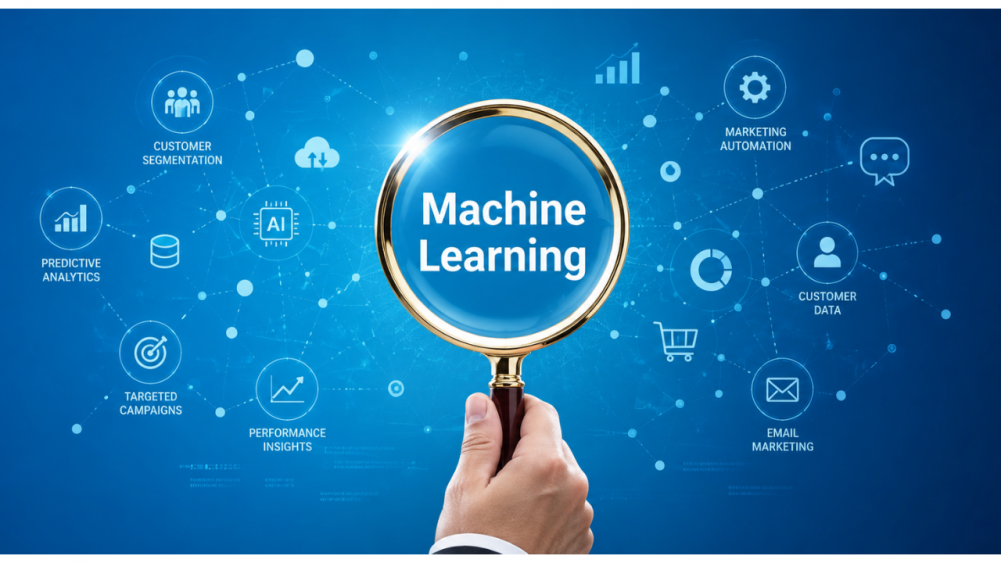
Introduction
Marketers in the B2B space have seen significant shifts in the past few years. In earlier times, decision-making would revolve around making certain assumptions based on little data about customers and manually-managed campaigns. Nowadays, companies can access large amounts of data about their customers, and what challenges them is no longer obtaining this information but learning how to put it into action. And here comes machine learning into play.
By using machine learning, companies would become capable of identifying patterns in how their customers act, allowing them to make predictions about what would happen in the future and make forecasts on the basis of those predictions. That being said, marketers would be saved from going through a tedious process of testing various marketing strategies.
According to a report published by HubSpot, the majority of B2B companies rely in some way on artificial intelligence for improving at least one aspect of their sales and marketing processes. The reason behind this shift is simply the desire to enhance targeting, personalization, and ROI.
What Machine Learning Means in B2B Marketing
Machine learning falls under the field of artificial intelligence, where machines learn from experience and improve over time. In the marketing world, this will entail analyzing customer behavior, campaigns, website usage, and sales among other metrics, in order to enhance decision-making.
A B2B software firm, for instance, can employ machine learning algorithms in identifying the customers who have a high tendency to ask for a demo. Alternatively, a different organization can employ machine learning to recommend customized content for various audiences.
As opposed to regular automation tools, machine learning keeps evolving as it gains experience from additional data points.
This has become especially valuable in ML in sales, where teams need to focus on leads with the highest probability of conversion.
Predictive Lead Scoring
One of the most common use cases of machine learning in B2B marketing is predictive lead scoring.
In many companies, sales teams receive hundreds or even thousands of leads every month. Manually identifying serious buyers can take a lot of time. Machine learning solves this by analyzing previous customer data and identifying patterns associated with successful conversions.
The system evaluates factors such as:
- Website visits
- Email engagement
- Industry type
- Company size
- Buying behavior
- Content downloads
Based on this information, leads are ranked automatically.
According to research shared by Autobound, businesses using predictive lead scoring have reported noticeable improvements in conversion rates and sales efficiency.
For companies investing in ML in sales, predictive lead scoring often becomes one of the first practical AI implementations.
Personalized Email Campaigns
Email marketing remains a very important mode of B2B communications; however, mass email marketing is losing its efficiency.
Machine learning technology will be able to provide personalization services in B2C business by identifying customer preferences and behavior. For example, instead of emailing everyone the same thing, ML would suggest:
- Personalized subject lines
- Relevant content
- Product recommendations
- Ideal send times
For instance, if the prospect regularly checks out information on cloud security, the system might prioritize the sending of cybersecurity-related emails in the future.
Personalization is known to increase engagement since the customer will be served with information that he or she likes rather than general marketing messages.
Customer Segmentation
The standard segmentation techniques use criteria that include company size and location. Artificial intelligence takes a step further and finds unique connections that can be missed by humans.
It may be the case when one set of users is more engaged in webinar sessions, and the other prefers product comparisons.
Artificial intelligence helps to develop more effective communication strategies for different segments of customers.
It also enhances the efficiency of advertisements because companies will be able to reach the appropriate audiences.
Account-Based Marketing (ABM)
ABM targets high-value accounts rather than lead generation in its core. Machine learning is used to support ABM by identifying firms that demonstrate serious interest in purchases.
AI tools are capable of analyzing behavior in searches, history of interaction, as well as other activities, in order to choose the right accounts for conversion. Such an approach allows marketing and sales professionals to target their efforts more wisely.
As seen from industry-wide discussions and reports, AI-powered ABM strategies have become more widespread nowadays due to higher personalization capabilities and lower efforts needed to conduct research manually.
Companies that use professional machine learning development services also create custom ABM solutions for specific target industries.
Chatbots and Conversational Marketing
AI-driven chatbots for B2B businesses have become commonplace among many organizations. Unlike previous rule-based chatbots, machine learning chatbots become smarter with each interaction they engage in.
They are able to respond to frequently asked questions, guide people to specific pages, book meetings, qualify leads, and much more. A quicker customer experience is ensured, and there are no more delayed responses.
If the company operates in multiple time zones, the benefits provided by conversational AI are numerous, too.
Predictive Analytics and Forecasting
Forecasting has always been difficult in B2B marketing because customer journeys are often long and involve multiple decision-makers.
Machine learning helps businesses improve forecasting accuracy by analyzing historical sales data, engagement trends, and market behavior.
This can help organizations:
- Estimate future revenue
- Predict campaign performance
- Identify sales opportunities
- Optimize marketing budgets
Research available through arXiv highlights how machine learning models can improve forecasting accuracy compared to traditional methods.
SEO and Content Optimization
Search engine optimization is also being influenced heavily by machine learning.
Modern SEO strategies involve more than keyword placement. Search engines now evaluate user behavior, relevance, engagement, and content quality.
Machine learning tools help marketers identify:
- Content gaps
- Search trends
- High-performing keywords
- User intent
- Competitor opportunities
A recent report fromSEOProfy showed that many B2B marketers are already using AI tools for content research, topic generation, and optimization.
This doesn’t replace human creativity, but it does make research and strategy development more efficient.
Challenges Businesses Still Face
Although machine learning offers major advantages, implementation is not always simple.
Data quality problems are one of the prevalent challenges. AI algorithms need quality and structured data to work properly. Incomplete or old customer data will result in inaccurate predictions.
Compatibility may also pose a problem. Older systems may not be compatible with new AI systems.
Another important challenge relates to the cost involved in setting up AI technology. Custom development may require some investments in terms of equipment, software, and qualified personnel. That’s why most firms collaborate with agencies that provide machine learning services.
Privacy and responsible AI usage may become another significant challenge, particularly when dealing with customers’ personal information.
The Future of Machine Learning in B2B Marketing
Machine learning is expected to become even more integrated into daily marketing operations over the next few years.
Businesses are already moving toward:
- Hyper-personalized customer experiences
- AI-generated marketing insights
- Predictive customer journeys
- Intelligent sales forecasting
- Automated campaign optimization
But generative AI also impacts the way that B2B firms generate their content, engage customers, and help their sales teams.
Nevertheless, human intervention will still be necessary for this technology to work successfully. Machine learning can increase efficiency, while strategy and relationships are still necessary components of B2B marketing.
Conclusion
The use of machine learning is not restricted to big tech organizations anymore. Today, businesses from various sectors apply AI-based solutions to help with better targeting, process automation, and smart marketing decisions.
Whether it’s predictive lead scoring and personalization of email campaigns, forecasting, or SEO optimization, its applicability is expanding fast. Companies that have already invested in machine learning sales and advanced marketing intelligence solutions experience benefits such as higher efficiency, improved customer involvement, and better revenues.
Meanwhile, the need for efficient machine learning development services only grows as companies try to find solutions suitable for their needs.
With increased competition becoming data-based, ML is expected to be adopted by companies as a standard practice in marketing activities.