Just a few years ago, a solid brand implied a unique logo design, well-organized website, and consistent messaging through all the available channels. The current state of affairs is completely different.
Nowadays, brands benefit from powerful solutions capable of generating content, analyzing customers’ behavior, organizing campaigns, and communicating with customers in a way that would be hard to imagine even five years ago. Consequently, many companies start relying on automation to build their presence online.
However, customers themselves also become choosier. Polished marketing alone is not enough for them anymore. What they want is authenticity, transparency, but most importantly, the human touch – the chance to get acquainted with the faces standing behind the company and its products.
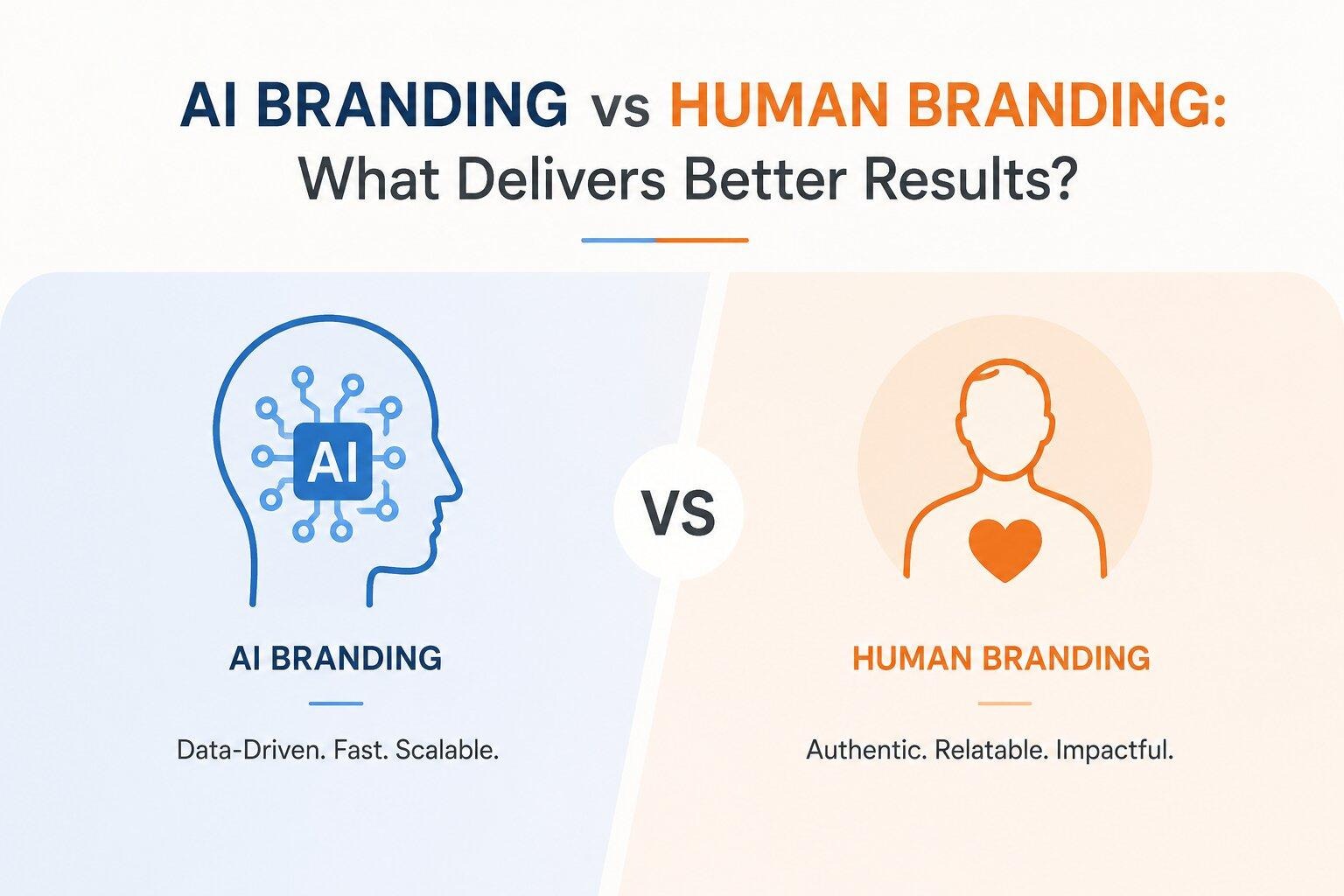
All these considerations raise an interesting question, one worth discussing among marketers and business owners alike: is there any way AI Branding can produce better outcomes compared to Human Branding?
The point is that there is no one-size-fits-all answer. Each concept is effective under certain conditions. Analyzing these conditions can help in building an efficient branding strategy.
What Is AI Branding?
AI Branding entails the application of artificial intelligence as well as automation tools in order to enhance the branding development processes. Instead of depending solely on manual approaches to conduct processes, companies resort to technology as a way of increasing efficiency.
Some of them include:
- Content creation and optimization
- Audience research
- Consumer behavior analysis
- Marketing automation
- Communication personalization
- Performance tracking
For example, through AI, an eCommerce business can find out what products shoppers want, the types of content they prefer, and when to anticipate their purchases.
Productivity
The main strength of AI Branding is that it allows for increased productivity levels. Even a small group of marketers can do much in a shorter time than ever before.
Benefits of AI Branding
Rapid Action
Processes that would take hours can be done in minutes. From planning content to researching your audience, AI makes it possible for businesses to do things quickly.
Effective Data Processing
With the ability to sift through customer data efficiently, AI can detect trends that would otherwise be overlooked by humans. Brands can then make smarter decisions.
Enhanced Scalability
Whether you have a hundred or a million customers, it is easier to scale when using AI in your marketing efforts.
Personalized Marketing
More and more customers want their experience to be personalized. With the help of AI, brands can personalize their email campaigns and other types of content.
Challenges of AI Branding
Though AI Branding has many strengths, there are still certain disadvantages that it has.
While technology can observe human behavior, it is not capable of feeling genuine human emotions. Technology can create content, but it cannot replace experience, human stories, and perspectives.
Here comes Human Branding into play.
What Is Human Branding?
The approach of Human Branding is centered around creating a brand for people rather than a system. It emphasizes skill, experience, value, and relationships.
While traditional branding seeks ways to make everything automated, Human Branding seeks to find a way to create real connections with the audience.
The examples of Human Branding are:
- Content by founder
- Personal branding
- Behind-the-scenes content
- Customer success stories
- Thought leadership
- Community engagement
Human Branding functions due to the natural tendency of people to believe other people more than brands.
When a customer learns about the person standing behind the brand, he gets much closer to them as opposed to being related to a faceless corporation.
Benefits of Human Branding
Enhanced Trustworthiness
Trust is one of the most important elements in decision making. Human Branding assists in establishing credibility through experiences and communications.
Higher Emotional Engagement
Stories tend to linger in people’s minds better than any marketing messaging. An emotional story leaves an impact unlike a marketing campaign.
Brand Distinctiveness
Products and services could be easily replicated. Experiences, values, and perceptions cannot be duplicated.
Loyalty
Loyalty is easier to achieve if people have an emotional connection with a brand.
Challenges of Human Branding
Human Branding is a process that needs consistency and work. Trust cannot be built in one day.
Relationships can’t be instantly scaled like automation. Companies need to commit themselves into developing interactions and communication.
AI Branding vs Human Branding: Side-by-Side Comparison
| Factor | AI Branding | Human Branding |
| Speed | Excellent | Moderate |
| Scalability | Excellent | Limited |
| Cost Efficiency | High | Moderate |
| Emotional Connection | Low | Very High |
| Trust Building | Moderate | Excellent |
| Customer Loyalty | Moderate | High |
| Brand Authenticity | Moderate | Excellent |
| Long-Term Impact | Good | Excellent |
Human vs AI Branding: Which Creates More Trust?
In regards to trust, the Human Branding method clearly has the upper hand.
Consider the case of two marketing companies that offer similar services.
The first one produces content daily but rarely mentions its personnel, whereas the second one writes posts about clients’ accomplishments, thoughts, conclusions drawn, and experiences of the founders.
It seems that the majority of consumers will be more attracted by the latter company since they will be able to establish a relationship with them.
Companies grow into something more human and earn trust in return.
It is no wonder then that Human Branding often succeeds in sectors where credibility and personal connections play a crucial role.
Conclusion: The Future of Branding Is a Balanced Approach
It is important to note that there is no rivalry between the two – they should rather be used together. AI enables organizations to save time, analyze consumer behavior, and optimize their marketing campaigns effectively. However, Human Branding brings the element of credibility, authenticity, and emotion that customers appreciate most.
A combination of intelligent technology and authentic human experiences is what makes companies successful and enables them to grow sustainably. By 2026, an effective approach will involve utilizing the power of technology to ensure that the brand remains human nonetheless.