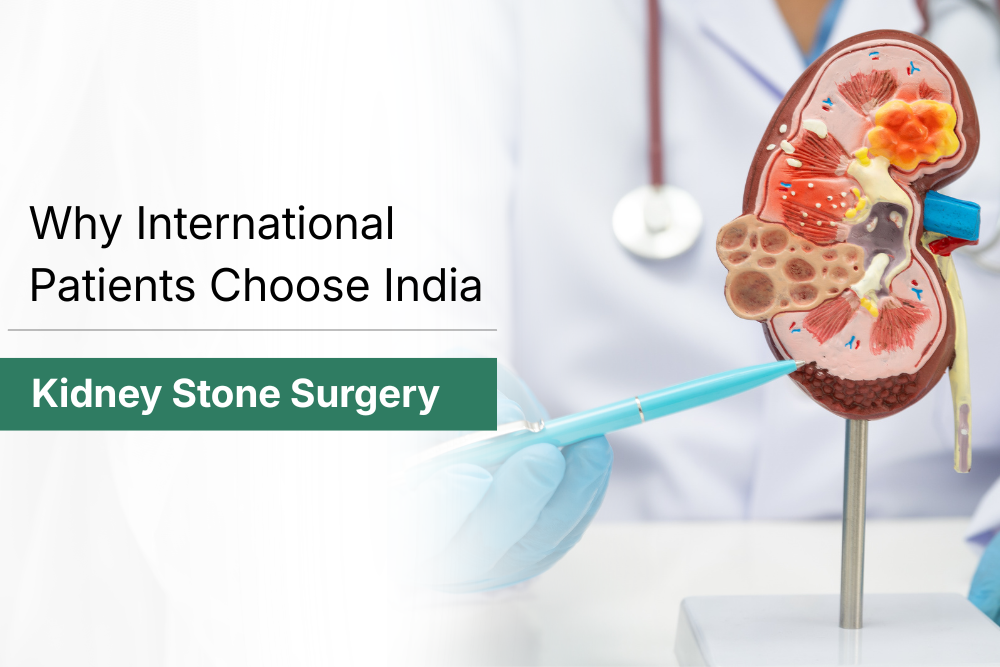
Kidney stones, or urolithiasis, are among the most frequently encountered urogenital disorders around the world. While some kidney stones (smaller) may be passed through normal urination, larger kidney stones typically require surgical intervention to avoid significant discomfort, blockage of urine flow, possible infection or permanent kidney damage.
As a result of an increased demand for more advanced but economical treatment options, there has been a rapid increase in the number of individuals who are voluntarily travelling to India for kidney stone surgery.
Thousands of international patients each year are choosing to seek quality urological care in India and are successfully treated for their kidney stones using the latest laser technologies and by highly skilled surgeons.
Understanding Kidney Stone Surgery
Crystallisation of mineral deposits in the kidney leads to the formation of kidney stones. Treatment for kidney stones may involve medication and dietary changes, as well as minimally invasive surgery (as determined by the relative size and location of the stones, as well as the chemical makeup of the particular kidney stone).
Commonly used kidney stone treatment options in India include:
- Laser Kidney Stone Surgery (Laser Lithotripsy)
- Ureteroscopy (URS)
- Retrograde Intrarenal Surgery (RIRS)
- Percutaneous Nephrolithotomy (PCNL)
- Mini-PCNL
- Extracorporeal Shock Wave Lithotripsy (ESWL)
The type of surgical procedure performed depends on several factors, including the size and location of the kidney stones, the patient’s overall health, and the number of prior treatments for related issues.
Affordable Treatments with no Compromise in Quality
Affordability is one of the reasons that international clients come to India for medical treatment. Often, kidney stone surgery in the Western world can be very expensive to receive; this is due to:
- Hospital costs
- Surgeon’s fees
- Diagnostic tests
- Post-operative care
However, the same advanced procedures can be performed in India for a fraction of the cost.
Even though the cost of treatments may be lower in India than in developed countries, patients receive advanced facilities, doctors trained in the USA, and quality care. Therefore, the combination of quality and low cost makes India one of the prime destinations for medical tourism from Africa, the Middle East, Southeast Asia, and many other countries.
Highly Experienced Urologists
Many skilled urologists with extensive experience treating both simple and complex kidney stone cases in India.
Many specialists receive training from internationally recognised institutions and perform a high volume of stone procedures each year. This experience allows them to manage challenging cases, including:
- Large kidney stones
- Multiple stones
- Recurrent stone disease
- Complex urinary tract anatomy
- Stones in patients with other medical conditions
For international patients, access to experienced surgeons provides confidence and reassurance throughout the treatment journey.
Access to Advanced Laser Technologies
Hospitals in India providing kidney stone treatment are equipped with the latest and most advanced technologies.
- These advanced technologies include Holmium laser systems, flexible ureteroscopes, digital imaging technologies and all types of advanced endoscopic equipment.
- Advanced technologies allow surgeons to ensure the removal and/or fragmentation of stones with a very high degree of precision.
- Also, when combined with less invasive techniques, surgical results improve, and patient discomfort decreases.
Laser lithotripsy has also been used very successfully for its ability to break stones into small fragments that can pass out of the body on their own. Because many facilities use advanced technology, patients in India may expect care that is comparable to or equal to that provided in other countries.
Short Waiting Times
Short wait times for kidney stone surgery vary from country to country. Patients will also have to endure long waiting times before they receive the kidney stone surgical procedure. Longer wait times may add to patients’ suffering and may increase their risk of developing additional complications.
India can provide far shorter wait times for consultations, diagnostics, and treatment of kidney stones. Many hospitals can complete evaluations and treat patients within just a few days of their arrival.
Patients with severe symptoms or those travelling from another country with limited time will appreciate this efficiency.
Comprehensive International Patient Services
India’s healthcare providers understand the individual needs of patients from outside the country and offer dedicated support to meet them.
Some services that hospitals offer:
- International patient coordinators
- Visa assistance
- Currency exchange service
- Airport transfer service
- Hotel accommodation arrangements
- Language interpretation services
- Customised treatment packages
- Teleconsultation before and after their treatment
These services are designed to simplify the process of obtaining treatment and help to alleviate the emotional stress associated with travelling for medical purposes.
High success rates and positive outcomes
The overall success of a patient receiving treatment for kidney stones can be evaluated based on complete stone clearance, symptom relief, and prevention of recurrence of the original stones.
Indian hospitals frequently perform the most advanced procedures for removing kidney stones and have a proven record of delivering exceptional patient outcomes. Precision-guided surgical techniques and modern imaging systems are used to effectively remove kidney stones while preserving the patient’s renal function. Patients have reported significantly improved symptom relief and quality-of-life post kidney stone treatment.
Personalised Treatment Planning
All kidney stone cases are different; thus, there is no one-size-fits-all treatment plan. Specialists in India consider the following before developing a personalised treatment plan for a patient:
- Sizing and location of the stone
- How old is the patient
- How well the patient’s kidneys are functioning
- If the patient has any previous kidney stones
- If the patient has any restrictions on their lifestyle
A personalised approach improves treatment outcomes and helps reduce the risk of developing stones again in the future.
Future Kidney Stone Prevention
The successful treatment of kidney stones does not stop at removing the stone. Most hospitals in India provide patients with dietary guidance, fluid intake recommendations, metabolic evaluation, and ongoing guidance on preventing future stone formation.
Some preventative strategies are:
- Increasing fluid consumption
- Changes to the patient’s diet
- Controlling the amount of calcium and oxalate consumed by the patient
- Treating underlying metabolic disease
- Periodically checking with a doctor
Utilising these preventative methods will support kidney health in the long term and reduce the risk of the patient needing to re-treat for stones in the future.
Conclusion
India’s strong reputation as a global leader in kidney stone surgery stems from its combination of high-quality medical facilities, highly trained urologists, ample resources to support patients, and cost-effective treatment options. For international patients undergoing minimally invasive kidney stone surgery in India, wait times are shorter, care is more individualised, and success rates are higher than in other parts of the world.
Patients seeking different types of treatment, such as laser removal of kidney stones, retrograde intrarenal surgery (RIRS), percutaneous nephrolithotomy (PCNL), etc., can receive world-class care at a fraction of the cost they would incur if they chose to undergo surgery in another country. The emphasis on patient safety, quality of care during hospitalisation, and long-term prevention contributes to India’s reputation as a popular destination for kidney stone surgery for patients from across the world.