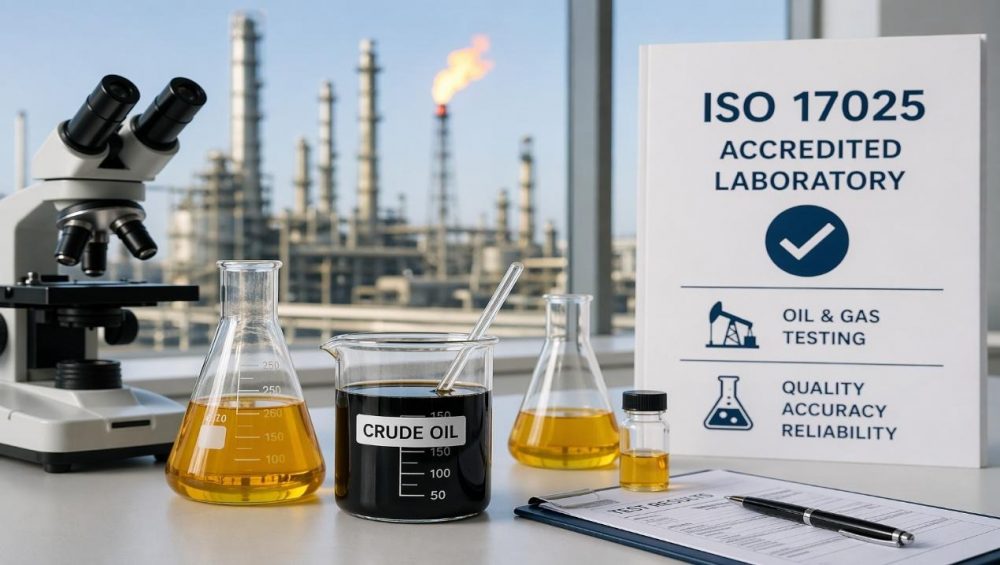
If you look at Oman’s economy, oil and gas is obviously one of the main pillars. But what most people don’t really think about is the role laboratories play behind the scenes.
Every batch of oil, every gas sample, before anything moves forward—gets tested. And honestly, if those results are even slightly off, it can create problems down the line. Not always immediately, but eventually—quality issues, safety risks, even financial loss.
That’s exactly why standards like ISO 17025 exist.
So, what is ISO 17025 really?
At its core, ISO 17025 is about one simple thing:
Can a laboratory actually be trusted?
It’s not just about having equipment or running tests. It’s about whether the lab can consistently produce results that are accurate—and more importantly, repeatable.
Because in industries like oil and gas, “almost correct” is not good enough.
Why it matters more in Oman’s oil and gas sector
In theory, any lab can run a test. But in practice, companies rely heavily on those results to make decisions.
For example, deciding whether a product meets export standards, or whether it’s safe to use. If the lab report is wrong, everything built on that decision becomes risky.
That’s where ISO 17025 makes a difference. It puts a system in place so results are not just produced—but produced properly.
Also, there’s a practical side to it. International companies usually don’t want to deal with non-accredited labs. It just creates extra verification work. So accreditation indirectly opens doors as well.
What does the standard actually look at?
It’s not just testing procedures.
It goes deeper into how the lab operates overall. Things like:
- Are the methods being used actually valid?
- Is the equipment calibrated regularly, or just assumed to be correct?
- Do the people running tests really understand what they’re doing?
- Are results recorded properly, or just noted casually?
In oil and gas labs, this can involve everything from crude oil testing to checking chemical composition and environmental samples.
The real benefits (beyond just certification)
A lot of labs think of ISO 17025 as just another certification to get. But the real value shows up in day-to-day work.
For one, it reduces mistakes. Not completely, but noticeably.
Then there’s trust. Clients feel more comfortable when they know there’s a proper system behind the results.
And internally, things become more organized. Fewer shortcuts, clearer processes, less confusion.
It’s not a dramatic overnight change, but it builds up over time.
What labs usually struggle with
To be honest, implementation is where most labs get stuck.
Training is one issue. Not everyone is familiar with standard requirements.
Equipment can also be a problem. Some labs are still using older instruments that don’t meet current expectations.
And documentation, this is a big one. Keeping detailed records sounds simple, but in reality, it takes effort and consistency.
Still, none of these are deal-breakers. They just require planning and some discipline.
Final thought
ISO 17025 is not just a “nice-to-have” in the oil and gas sector. It’s more like a baseline if a lab wants to be taken seriously.
Especially in Oman, where the industry is closely connected with international markets, having reliable and accepted test results matters a lot.
At the end of the day, it comes down to this:
If the data isn’t trustworthy, nothing built on it will be either.