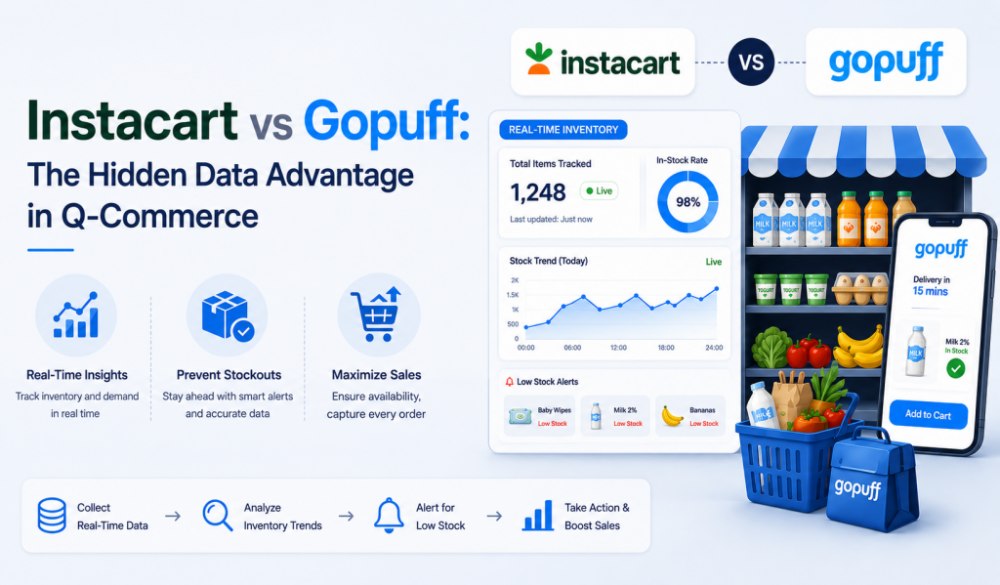
Speed gets all the attention in quick commerce (Q-commerce). But the real competition between Instacart and Gopuff plays out in a less visible arena: data infrastructure. Both companies have built powerful systems for capturing, analyzing and commoditizing consumer behavior. What separates them is not delivery speed or product selection. It is the structural design of how each company captures data and what it does with that data once it has it.
Instacart functions as a marketplace layered on top of existing retail partners. Gopuff owns its fulfillment operations outright. This fundamental difference shapes two distinct data models with very different strengths. Brands, investors, and platform operators who understand these differences will make sharper decisions about where to place their resources in the instant delivery market.
Understanding the Q-Commerce Ecosystem
Q-commerce describes the segment of e-commerce built around delivery in under 30 minutes. The business model prioritizes immediacy over price, and it depends on dense geographic coverage and precise inventory positioning.
This ecosystem has three large groups:
1) Platforms like Instacart and Gopuff that offer fulfillment and consumer interfacing;
2) Brands and retailers that supply the platform with products and pay for digital shelf space; and
3) Consumers who order and continuously generate behavioral and transactional data signals through their purchases.
Instacart’s Data-Driven Marketplace Model
Instacart partners with more than 1,400 retail banners across North America, including Kroger, Costco, and Publix. The platform does not own any inventory. Its role is to connect shoppers with retail partners and, critically, to sit between those two parties as a data intermediary.
How Does Instacart Use Data to Generate Revenue?
The Instacart Ads platform gives CPG brands the ability to purchase sponsored placements, banner advertising, and shoppable coupons across the marketplace. This advertising business runs entirely on first-party purchase data. Instacart tracks the following across its retail network:
- ● Search behavior: what products shoppers look for and how they modify their queries
- ● Substitution patterns: which replacement products shoppers accept when preferred items are unavailable
- ● Basket composition: which product combinations appear most frequently within the same order
- ● Repurchase cycles: how frequently consumers reorder specific items and what drives those habits
Because Instacart scraper aggregates this data across hundreds of retail banners, the cross-retailer dataset it holds is a genuine differentiator. A brand distributing through both Kroger and Wegmans can access unified audience intelligence across both chains through Instacart. Neither retailer can offer that perspective independently.
The Carrot Ads suite extends this capability to retailers directly, enabling targeted promotions based on shared consumer data. This architecture positions Instacart as a retail media network rather than simply a logistics intermediary.
Gopuff’s Vertically Integrated Data Advantage
Gopuff built its operation on a different premise. Rather than working through existing retail infrastructure, Gopuff owns and operates hundreds of micro-fulfillment centers (MFCs) embedded in dense urban markets. Gopuff controls sourcing, storage, order picking, and last-mile delivery as a single integrated system.
What Makes Gopuff’s Data Model Different?
Vertical ownership produces a fundamentally different category of data. Because Gopuff owns its inventory at every location, it captures real-time operational data at the SKU level that no marketplace model can replicate. That data includes:
- ● Constant live inventory counts for all fulfillment centers.
- ● Demand signals, particularly from areas that experience spikes in product purchases over time.
- ● Shrinkage/spoilage metrics that inform product margin.
- ● Processing speed of products to determine how efficiently an MFC operates.
Gopuff Ads extends this advantage to brand advertising. Because Gopuff grocery data API controls both the digital shelf and the physical inventory, brand placements within Gopuff create measurable closed-loop attribution. Advertisers can track whether a sponsored placement directly produced a purchase, rather than relying on probabilistic modeling.
Instacart vs Gopuff: Comparing the Hidden Data Infrastructure
| Feature | Instacart | Gopuff |
| Business Model | Third-party marketplace | Vertically integrated retailer |
| Inventory Ownership | No (retail partners hold inventory) | Yes (owns MFC inventory directly) |
| Core Data Type | Cross-retailer consumer behavior | Real-time operational and SKU-level data |
| Retail Media Platform | Carrot Ads and Instacart Ads | Gopuff Ads |
| Fulfillment Execution | Gig workers shop at partner stores | Employees pick from owned MFCs |
| Primary Data Advantage | Cross-retailer purchase intent signals | Neighborhood-level demand forecasting |
| Main Revenue Drivers | Advertising fees and transaction commissions | Product margin and advertising revenue |
| Data Refresh Rate | Near real-time based on order activity | Continuous real-time inventory and operations |
| Brand Targeting Depth | Audience segments spanning multiple banners | Closed-loop SKU-level attribution |
How Web Scraping Powers Competitive Intelligence in Q-Commerce?
Internal data only shows part of the Q-commerce market. Brands, analysts, and investors tracking platforms like Instacart and Gopuff also rely on web scraping to collect external market data and evaluate real platform performance.
Q-commerce data Scraping to automatically collect the publicly available product data (e.g. prices, stock levels, estimated delivery times, and sale/promotional discounts). The data collected provides businesses with independent data points to compare the performance of the platform without relying solely on company reported data.
Scraped data provides several important use cases, such as:
- ● Monitoring SKU price changes across multiple platforms
- ● Identifying out-of-stock patterns and speed to replenish
- ● Comparing product selection across different regions and competing brands
- ● Measuring delivery times across geographic regions based upon demand
For CPG companies, the Q-commerce competitive intelligence can help build more effective advertising and business partnerships, resulting in better return on investment. For investors, the scraped data from the marketplace provides an early indication of the potential for growth and operational efficiency, driven by customer demand, that may not be apparent from earnings report data alone.
Key Challenges in Q-Commerce Data Operations
The data advantages held by Instacart and Gopuff are real but not frictionless. Both companies contend with structural challenges that affect the reliability and utility of their data assets.
- ● Instacart is a hybrid of retailer systems and items, so it’s a far more complex way of standardizing and managing quality.
- ● Gopuff needs real-time synchronization of inventory from its micro fulfillment centers to reflect appropriate stock levels accurately. Any delays lead to stock inaccuracies and poor customer experiences.
- ● Instacart and Gopuff both work with personal shopping data and have specific requirements regarding compliance with CCPA, as well as other ever-changing privacy regulations.
- ● Many retail advertising platforms, such as Instacart and Gopuff, cannot validate if their advertising actually provides incremental sales for the associated retailer.
Future of Data-Centric Q-Commerce Platforms
The trajectory of both platforms points toward deeper data monetization and greater reliance on AI-driven decision systems over the next several years.
Demand Forecasting Through AI
AI and machine learning technology are used at Instacart and Gopuff to forecast demand, place inventory, provide substitutions, and deliver personalized recommendations to customers.
Continued Growth of Retail Media Networks
Retail media networks continue to grow, and Instacart and Gopuff are both competing for a larger portion of CPG advertising spend as brands move towards commerce-driven ad environments.
First-Party Data as Strategic Asset
The value of purchase and behavioral data in the ownership of Instacart and Gopuff, as third-party cookies become obsolete, makes this data an important resource for both targeting and advertising.
Integrating Loyalty Programs
Instacart grocery data scraping API is integrating loyalty programs and membership data with real-time shopping behavior data to create richer customer profiles and improve the accuracy of its advertising targeting.
Conclusion
Instacart and Gopuff each hold a genuine data advantage within the Q-commerce delivery market, but those advantages are structurally different. Instacart’s value comes from the breadth and cross-retailer scope of its consumer behavior data, which powers a retail media business of meaningful scale. Gopuff’s advantage comes from vertical control of its supply chain, which produces real-time operational intelligence that a marketplace model cannot replicate.
For brands evaluating where to invest in Q-commerce advertising, the decision depends on which data architecture aligns with the measurement outcomes they need. Cross-retailer audience reach favors Instacart. Closed-loop SKU-level attribution favors Gopuff.
As Q-commerce competition continues to intensify, data infrastructure will function increasingly as the primary competition. Platforms that accumulate richer, more actionable data assets and translate those assets into better consumer and brand outcomes will define the long-term shape of the instant delivery industry.