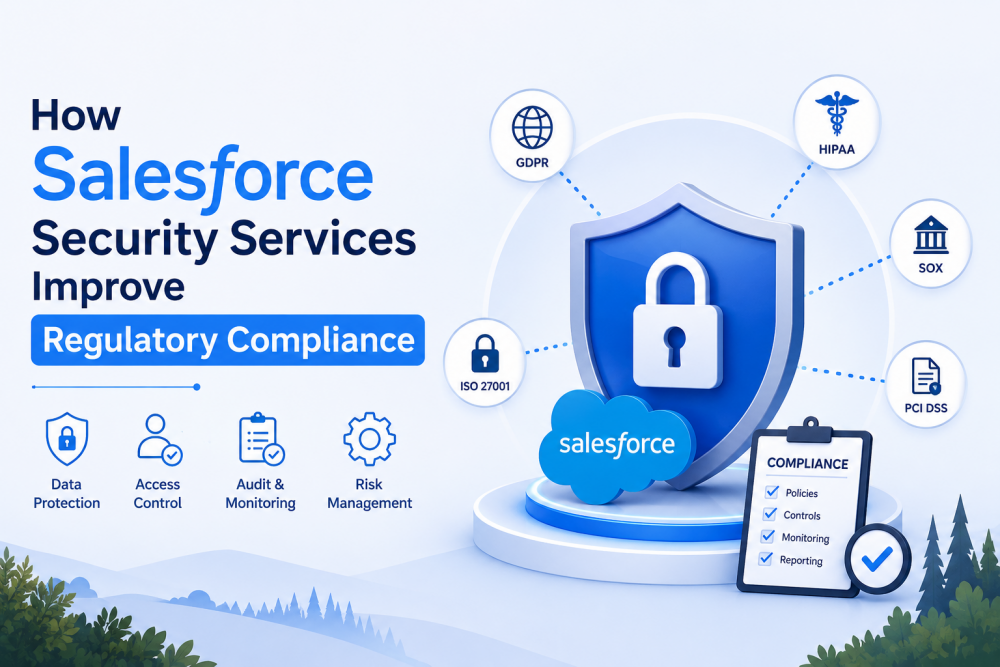
Compliance failures cost companies more than in a financial sense. It also comes through customer trust eroding and legal teams getting involved. The underlying problem isn’t usually negligence because compliance at scale is hard to maintain with fragmented tools and teams working in silos. Organizations can resolve this issue with Salesforce security services. Salesforce security services use tools and different measures to help you identify potential security vulnerabilities in your Salesforce org. It works not as a bolt-on measure, but as a structural part of how data governance gets built and maintained across the platform.
Let’s explore different ways these Agentforce consulting services partners help organizations enforce data policies, monitor access, and meet regulatory obligations. Also, the way does it without treating compliance as a separate workstream. Additionally, we’ll also discuss why organizations need it in the first place.
Why Do Businesses Need Salesforce Security Services?
Data Breach Risks are Rising:
Large Salesforce CRM environments come with high risk of data breaches or exposure due to a single misconfiguration or incorrect data entry. Therefore, layered controls help you timely resolve issues.
Compliance Mandates are Growing More Complex:
Regulations such as GDPR, HIPAA, CCPA are just a few of these that continue to grow. Each framework has its own specifications on what happens to the data. This means that organizations must have security infrastructure that’s able to meet these requirements without creating friction across the process.
Default Settings are Insufficient:
Out-of-the-box Salesforce configuration handles a lot but enterprise-grade compliance isn’t part of that package. Your business needs tailored architecture, often developed alongside Agentforce consulting services to address their specific risk profiles and industry requirements.
Internal Access Controls Require Active Management:
People change roles or teams restructure, and employees leave. Each of these transitions creates permission drift that quietly accumulates over time. So, you need active management to ensure only relevant users have access to sensitive information.
Top 7 Ways Salesforce Security Services Enhances Regulatory Compliance
1. Enables Granular Access Control
HIPAA, GDPR, and SOC 2, among others, all these frameworks come with specific requirements related to who can access regulated data and in particular circumstances. These are dealt with directly at the role, field and profile levels of security. The difference between compliant and vulnerable organizations is that when a business adds new data types to their systems, changes to roles, team memberships are checked for access rights. Salesforce security services maintain that process actively.
2. Offers Continuous Audit Monitoring
Most compliance frameworks don’t just require you to protect data, they require you to prove it. Salesforce security services configure event monitoring and log management tools to capture user actions, login histories, and data exports in real time. When regulators ask questions or an incident needs investigating, that documentation already exists. There’s no scrambling to reconstruct a timeline after the fact.
3. Data Encryption Across Storage and Transmission
Salesforce Shield and platform encryption protect sensitive fields such as personal identifiers, health records, financial data both at rest and in transit. For organizations working toward HIPAA-compliant deployments, this isn’t a feature to evaluate later. It’s a baseline requirement. Security services handle the initial configuration and keep it current as the platform evolves, rather than treating encryption as a one-setup task.
4. Delivers Automated Policy Enforcement
Manual enforcement is unsustainable because processes become more complex, exceptions increase and eventually teams follow different aspects of the same policy. But with Salesforce CRM optimization, you can integrate the rules to manage data retention, share permissions, as well as consent management workflows into the platform. This eliminates the need to rely on people being able to remember “the right way,” and each unit and region share a common governance that manual oversight can hardly offer.
5. Integration Security Across Connected Platforms
Organizations working with Salesforce and other applications built through a Salesforce Marketing Cloud partnership must require security across systems. Data transfers continuously in and out of systems, and at each such data transfer point, there is a possibility of non-compliance issues. Security services establish OAuth controls, IP restrictions, and data masking at integration boundaries to prevent unauthorized flows. This establishes the oversight that frameworks requiring governance of external processors explicitly demand.
6. Ensures Proactive Risk Management
Compliance posture degrades over time if it’s not actively maintained. Every new update in the platform brings new configurations and newer regulatory requirements. So, what passes a health check initially may not pass later. Through regular security health checks and penetration testing, often supported by Agentforce consulting services you find these gaps before they escalate. The value isn’t just in finding problems but it’s in demonstrating to clients and regulators that finding problems is part of your standard operating procedure.
7. Supports Incident Response Readiness
Breaches or compliance issues can occur, what’s important is that if you were prepared in advance for them or not and how quickly you share the issue. Salesforce security services establish pre-configured incident response workflows that detect anomalies, contain potential breaches, and generate the documentation required for regulatory notification before an incident ever occurs. Organizations well prepared in advance can manage a breach without it becoming an enforcement case.
Conclusion
Compliance doesn’t maintain itself as it requires controls that are built into how the platform actually operates, not layered on top when an audit is approaching. Whether you’re refining an existing deployment or expanding through new platform partnerships, security belongs at the centre of that work, not added later. With the nature of compliance frameworks changing constantly, it’s essential that you adopt Salesforce security services. From access governance and encryption to integration security and incident readiness, Salesforce security services provide the foundation that makes sustained compliance possible.