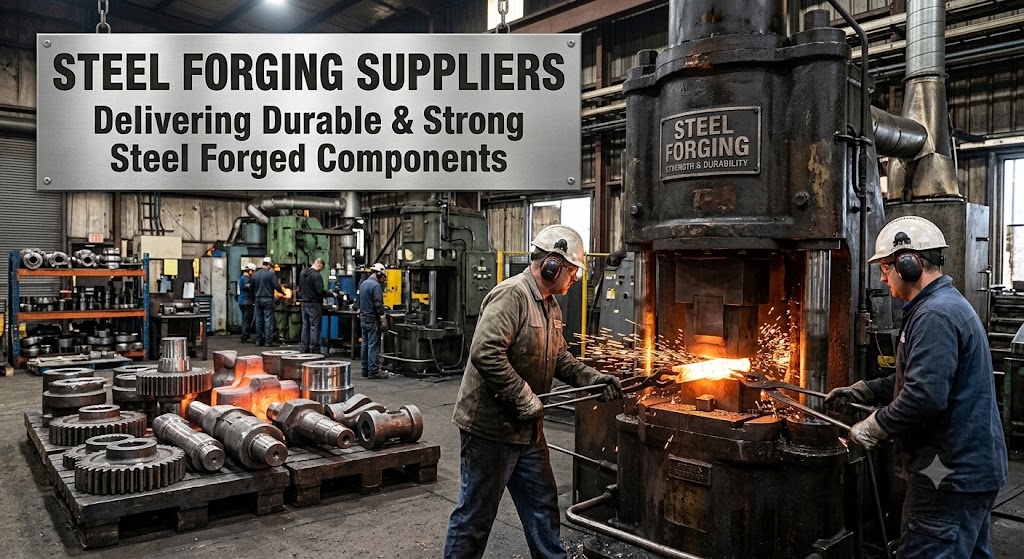
India has a large number of forging suppliers and manufacturers, with the most being small or medium size companies. At least 83% of these forging units are classified as small or very small. India is now also the second largest forging industry in the world based on installed capacity.
According to estimates, the Indian forgings steel business will reach a value of about USD 5.7 Billion in 2025 and grow to USD 12.7 billion by 2034 fuelling its growth through the strong demand for forgings from the automotive and infrastructure, aerospace, defence, railways and engineering sectors. To meet the growing demand, steel forging suppliers are investing in automation, CNC machining, precision forging, robotics, quality certifications and capacity expansion and expanding their exports to global OEMs.
There are many challenges faced by steel forging supplier in India. There are large price fluctuations of steel raw materials, increased energy and fuel costs, competitive pressure from lower-cost overseas products, increased quality requirements from global customers, environmental compliance costs are rising, there is a lack of skilled labour, increased equipment downtime, and increased pressure to accept/help develop advanced manufacturing technologies. Infrastructure constraints, pipeline limitations, and intermittent power supply interruptions also contribute to the efficiency of production processes.
Steel forging suppliers are addressing their difficulties with technology, such as the use of automation, digital manufacturing, lean production systems, energy-efficient equipment, and workforce training programs. They are also utilizing precision forging technologies more often. The Indian government is assisting the sector through a variety of initiatives, including its ‘Make in India’ initiative, the Production Linked Incentive (PLI) programme for new investment, the development of infrastructure, the establishment of policies that promote domestic steel procurement from Indian manufacturers, the establishment of export promotion programmes, and the provision of support to micro, small and medium-sized enterprises (MSME) and skill development initiatives. This has aided domestic forging companies in becoming more competitive on an international basis while increasing their capacity utilization rates and increasing their ability to compete effectively within international supply chains.
Modern technologies used by steel forging suppliers in India
The number of steel forging suppliers in India implementing new age manufacturing technology at their plants to enhance productivity, precision and overall cost efficiencies is growing every day. Modern CNC forging and machining centres are now available and are designed with precision engineering capabilities which enable manufacturers to achieve tighter tolerances, better surface finishes and the highest level of product quality on a consistent basis for critical industrial applications. Additionally, many forging plants have incorporated energy management systems that use AI to monitor their electricity consumption in real time as well as optimise their energy usage, thus achieving substantial power savings and improving operational efficiency.
Robotic material handling systems automate the movement of materials and/or the performance of repetitive tasks related to the production of goods. Robotic material handling systems improve workplace safety and increase the speed of the manufacturing process. Laser cutting machines use high-powered lasers to cut metals with extreme precision and perfection; and they can be used for very delicate operations such as shaping and finishing forged parts. The use of 3D printing technologies will also provide rapid prototyping of parts, development of tooling and validation of product designs. In addition, the use of automated inspection equipment for quality control (using sensors or vision systems or a combination) has accelerated and improved the accuracy of traditional methods of quality control. All of these improvements are contributing to the evolution of legacy forging operations into intelligent manufacturing facilities (smart factories), which have the ability to produce high-precision steel forged components for both domestic and international markets.
Applications of steel forged components in Different sectors
Forged steel components are foundational in multiple industries because of their unique characteristics including exceptional strength and durability, the ability to resist fatigue, the ability to perform under extremely high temperature and high pressure, and maintaining structural integrity and dimension throughout their service life (that is, long-term reliability). Within the automotive industry, forged crankshafts, connecting rods, gears, axle shafts, steering components, wheel hubs, and transmission components provide improved reliability and performance. Within the railway industry, the use of forged couplers, wheels, axles, brake assemblies, and suspension components allows trains to carry heavy loads and provides safety for passengers. In aerospace, forged parts for landing gear, turbine discs, engine shafts and structural fittings are used because of their superior strength-to-weight ratio and structural reliability. Military and defence applications are forged components for armoured vehicles, weapons systems, naval equipment, missile components and heavy-duty machinery operating in extremely difficult conditions. In oil and gas, forged flanges, valves, fittings, drilling tools, pressure vessel parts and pipeline accessories are widely used in extremely hot and/or high-pressure operational conditions.
Forged turbine shafts, generator rotors, boiler parts, nuclear plant equipment, and transmission systems are utilized by the power generation industry to maintain an uninterrupted supply of electricity to consumers and businesses. In the construction and infrastructure sectors, forged components are required for cranes, excavators, earth-moving equipment, bridge construction, and other heavy equipment. Mining companies use a variety of various types of forged components for their operations when drilling, crushing, and moving material. Examples of using forged components within mining operations include: drilling tools (drills), the hammer parts of a crusher, gears, and components of conveyor systems that experience high levels of wear as well as significant impact loads.
Manufacturers of agricultural machinery use forged items in tractors, harvesters, plows and driveline components so that they can have a long lifespan in tough conditions on the farm. To withstand corrosive environments in shipbuilding and marine applications, manufacturers of ships and boats use forged propeller shafts, anchor chains, marine valves, engine parts and equipment used at offshore platforms. Manufacturers of industrial machinery use forged bearings, gears, couplings, shafts, rollers and machining components to improve their performance. Chemical and petrochemical processing plants rely on forged reactors, pumps, valves, pressure vessels and heat exchangers and piping systems to safely transport corrosive and high-temperature fluids. Forged components are also used in renewable energy projects, including forged shafts and gearbox components for wind turbines, equipment for hydroelectric generation, and the structural systems for these projects; as well as in the material handling industry with forklifts, hoists, conveyors, and automated warehouse systems. In addition, the steel and metallurgical industry uses forged rolling mill machinery, furnace components, and large gears which work under very high temperatures and very heavy mechanical loads.