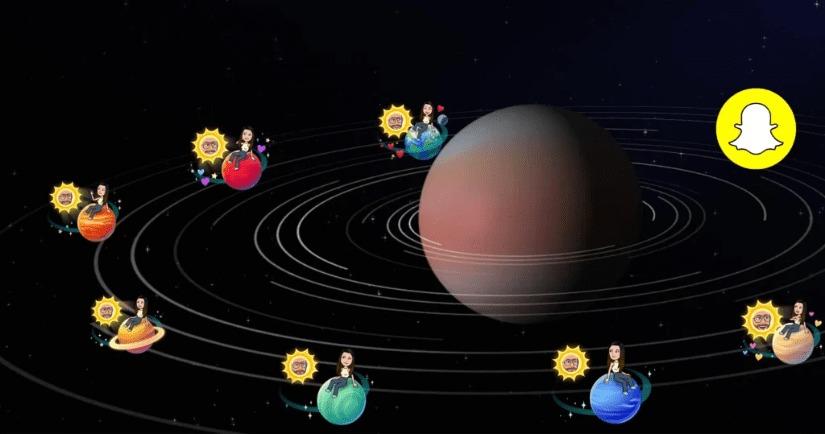
Over the last year, Snapchat Planets have appeared on numerous screens, and it’s typically in the form of screenshots that Snapchat users share among themselves, with their friends appearing as tiny planets orbiting around them. The feature will connect people you talk to most to create a mini solar system, with the closest persons appearing nearest the center. It’s not only a fun idea, but it’s also a different approach from any other app that’s major at the moment. There’s a close friends list on Instagram too. Even before the introduction of Planets, Snapchat had a friend ranking system. Despite all of them posing the same question, who do you actually know in the online world, the answer to that question is quite different.
This article explains the inner workings of Planets, the alternatives to them, and their implications for users of these applications on a daily basis.
Understanding Snapchat Planets
Snapchat Planets is an enterprise feature of Snapchat Plus, so it’s only available for paying subscribers. When it’s on, you’re in the middle of the sun, and your eight closest friends are displayed as planets orbiting around you.
The more a planet is towards the center, the more you interact with that friend. Mercury is the most dynamic friendship planet, spelling out everything about your current friendships. Neptune is the farthest planet, or eighth planet, in the solar system. The entire system is designed as a real solar system, hence the wide spread of the screenshots.
This is a feature that’s disabled by default. It was initially launched with the automatic feature turned on, but was later changed because of its impact on younger users emotionally with the ranking visible.
The Planet Rankings Are Determined by How the Planet Is Ranked
No planets are “manually arranged.” Snapchat ranks you based on your engagement activities, such as the number of snaps you send, how frequently you chat with them, and if you maintain a streak with them.
This translates to making the system update without you having to do so. If you have a friend who you speak to regularly, but not as much as you’d like, and then one month, it’s even less the next; that person may move further away the next month. No one orders things manually. The algorithm simply mimics the actual usage.
This also gives rise to an asymmetry that it is necessary to understand. Your solar system is hidden from other people. A friend can access their position within your system, but won’t be able to view your complete list or how everyone else is doing compared to you. And the ranking they see of themselves in your world has nothing to do with how you rank in theirs. Two persons can have opposite rankings at the same time.
The newer Best Friends emojis on Snapchat are being compared to the older ones. Older and newer emojis for Best Friends are being compared on Snapchat.
Prior to Planets, Snapchat already had a means of indicating close friendships: tiny emojis appearing alongside a friend’s name. If you had a heart of gold heart, you were each other’s best friend. A baby emoji indicated a more recent friendship. A smirking face indicated that you were seen as one of your best friends, but you weren’t yet a best friend.
On the other hand, these emojis were more private than Planets because people didn’t have to see their name in a conversation to know they were emojis. However, they only displayed a few possible indications, and not a visual ranking of your entire friend list.
Planets, in essence, substituted a simple set of symbols for a richer, more visual representation of the same concept, who to speak to and how often.
In Addition to Ranking, Snapchat Charms Reward the Friendship Itself
Aside from that, Snapchat also has a feature called Charms, which succeeded the platform’s Trophies system, which was discontinued. Charms are little badges that are attached to a particular friendship and not to your overall rank. They appear on social media platforms according to the duration of a streak, shared achievements, and other entertaining aspects such as whether two friends are both born under the same zodiac sign.
Charms are not comparing one friend with another, as they are with Planets. In a friendship, both feel the same attractions, and there is no “up” or “down” on a list. It also comes for free, and not just for Snapchat Plus subscribers.
This makes Charms feel more like a scrapbook than a ranking system. It honors a unique relationship in a unique way – in a way that doesn’t compete for attention with everyone else in your friend list.
Instagram Close Friends Takes a Manual Approach Instead
The Close Friends list in Instagram is quite different. You pick the people that you want to put on the list, rather than algorithmically. No automatic sorting, no engagement tracking, and no ranking order within the list at all.
This list determines who can view certain Stories or posts, with a green ring indicating that it is more exclusive. Those on the list will know that they are on it as they will be able to see the green ring on the content, but they won’t be able to see who else has been included.
The difference is all about control. Snapchat Planets will tell you who you are interacting with the most, regardless of whether you like them or not. Instagram Close Friends allows you to choose who you consider close, even if you don’t talk to them as much.
The Core Difference: Algorithm-Ranked vs. Self-Curated
Right now, it’s the divide between the two strategies on social media. Some features are there to record behaviors and present the outcome. Others allow you to make a conscious decision, and do not comment on whether it is congruent with your own habits.
Where algorithmic systems, such as Snapchat Planets, go right, they go right – with a genuine product as opposed to a curated image. But this honesty can also be unpleasantly awkward, particularly when the ranking doesn’t correspond to how that friend feels about the friendship on the emotional level.
Instagram’s Close Friends system is self-curated, which means you don’t have to experience that awkwardness, because you always have the choice over who’s on the list. What it means is that the list is more about who you want to see as your closest friends rather than your closest on a daily basis.
These Features Have Different Settings That Affect Privacy
Both features maintain privacy of your list from other users, but the type of privacy is different. Your Close Friends list is completely hidden on Instagram. It is unknown to anyone not on the list, and those on the list cannot view who else is on the list.
Snapchat Planets are different. If both friends have Snapchat Plus and the feature enabled, you can check your position in each other’s solar system. That gives Instagram a two-way visibility that it doesn’t have. You may not want to tell them where he or she ranks, but he or she can find out on his or her own.
This distinction is important, as it affects the extent of control over the information. Instagram’s system remains concealed until you decide to expose it. The other party can check the system of Snapchat even if you didn’t mean for it to be visible.
Most Other Platforms Won’t Even Bother With This Kind of Feature
It is notable that few major platforms have attempted anything like Planets at all. For years now, Facebook has had a basic list of friends from which to prioritize posts in your feed, but it never developed into anything quite like the Snapchat version, which is visual and public-facing.
There isn’t a direct match for TikTok and X either. Both platforms are more focused on public content and following relationships than on private, ranked friend groups. Discord displays online status and activity, but doesn’t compare friends in any visible manner.
Snapchat is an exception in this regard. It’s the one big platform that has been attempting over and over again to make private social information visual and shareable, whether through emojis, Charms, or Planets.
Why the Emotional Pressure Arises When You Use Ranking Features
The psychological aspect, which an individual list does not, is caught by visual friendship rankings. There is a difference to being listed on a solar system than to being on the solar system, isn’t there?
That’s part of what led Snapchat to reverse its decision to turn on Planets by default. Younger users in particular said they felt pressured to take the shots or reply quicker just to keep their rankings, and in effect making it more of a game for attention.
Instagram’s Close Friends does not have this particular issue, primarily because there is no ranking or movement to respond to that can be seen. There’s either you or there’s not, and it will not change from day to day based on how many messages you send.
This is one of the reasons why both the Charms and Planets functions feel lighter, despite the fact that they’re both from the same app. There are no rankings involved with Charms. They represent a shared moment or milestone, and are not quite as emotional as having your position change from Mercury to Neptune.
Specific Implications for Users of These Applications
All of this is not to say that one method is necessarily better than the other. The algorithm-based ranking provides a “straight, yet hard to swallow” account of the actual behavior. Manual curation carries with it the control and does not imply much about the actual day-to-day interaction.
The one thing that is important to keep in mind about any of these features is that they’re about activity and not the true worth of friendships. Someone who does not have a high rank in the solar system of another friend doesn’t necessarily mean that they are less important to that person. Things get hectic, communication methods vary, and there’s a lot of communication that occurs primarily through other channels outside of one app.
These features can be entertaining and educational to view and compare, but they’re more effective when used as reminders of what’s going on in the app, not as a scorecard of how valuable someone is.
The popularity of features such as Planets is more a testament to what people love to share online than to friendship. It’s easy to post a colored solar system screenshot, and it’s easy to discuss, so it seems to have become popular rapidly. Whether such a feature will remain enjoyable a year later, after the initial hype has died down, is another story, and one that will likely help determine if Snapchat will continue to invest in this area or decide to seek out something entirely new.