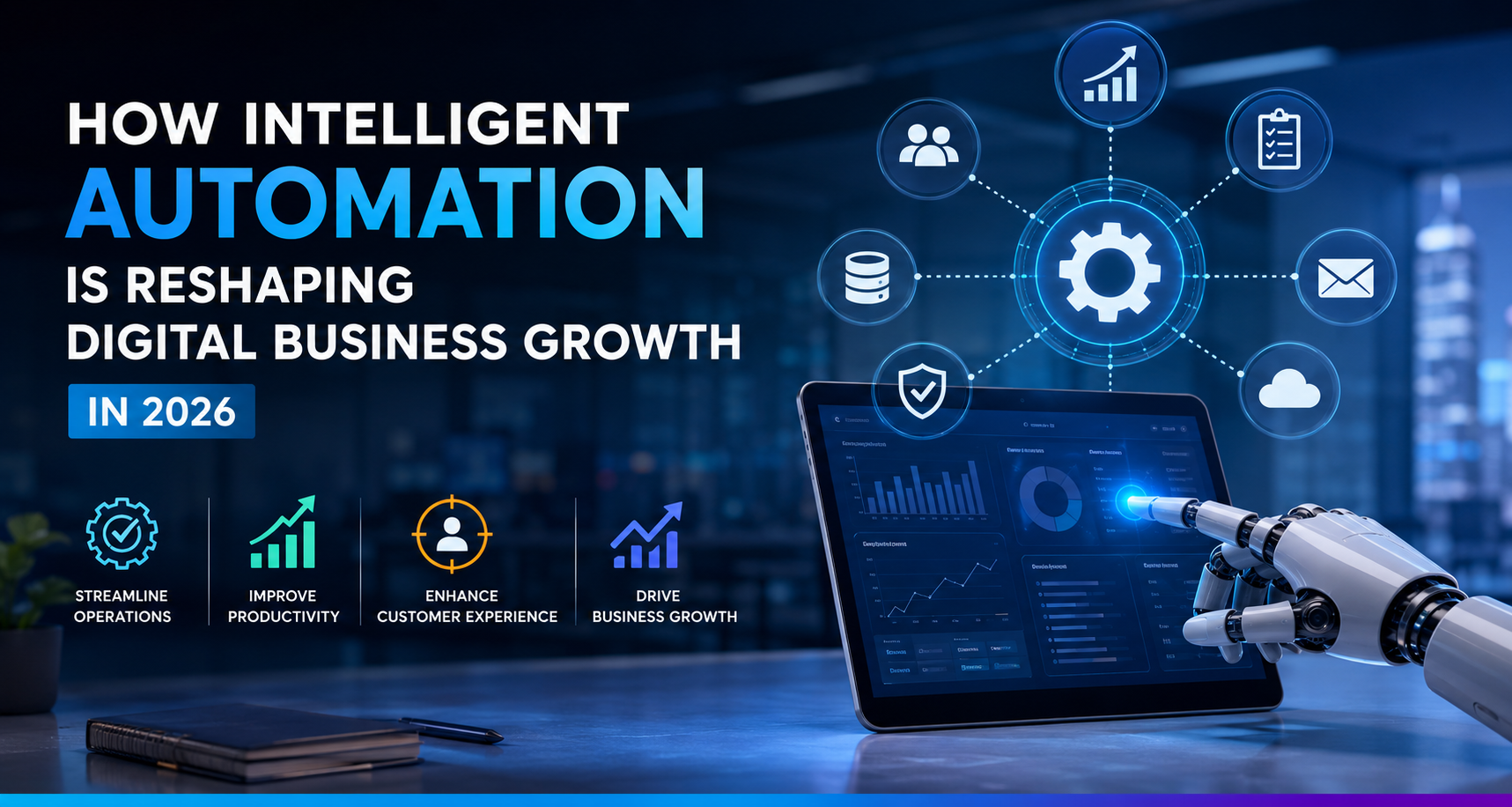
Nowadays, it is the speed, precision, and flexibility of businesses that dictate their success over time. Companies of any size are getting more and more pressured to improve the experience of their customers, cutting down the costs of their personnel, and quickly reacting to market changes. As the competition becomes fiercer, lots of firms are resorting to intelligent automation for making their processes more effective and for discovering new avenues for growth.
Automating processes doesn’t mean just doing repetitive tasks behind the scenes anymore. Technology can facilitate decision-making, dialog with customers, data processing, and business operations as well. Automated systems became indispensable for the continuation of business development both for small companies offering digital products and big ones operating globally. Due to the rapid development of artificial intelligence, cloud computing, and machine learning, the area of automation has Quite a bit expanded.
Organizations that are willing to leverage these technologies are constantly finding new ways to enhance efficiency and ensure their business models remain flexible in a changing world.
The Evolution of Automation in Business
In the past ten years Automation has seen a dramatic change.
Initially, machines only helped with simple chores and few administration works. Nowadays, highly progressing ones are able to analyze even complex data, find correlations, and aid in decision making. Companies are turning more and more to automation for things like customer service, keeping stock, running advertising, and checking results. Such functions make it possible for staff to be engaged in designing creative solutions and raising strategic plans, instead of doing monotonous work.
More and more businesses are going digital first, which means the need for intelligent systems is increasing rapidly. The fact is that firms see automation not only as a way to reduce expenses but also as a major contributor to their growth and market competition.
Creating Stronger Foundations for Scalability
One major problem for business is how to expand their operations without increasing their expenses dramatically. Growth often involves additional tasks that require more staff, resources, and management.
With the help of automation, companies can meet the challenge of working with larger amounts of work at the same time without operational costs going up to the same degree. Whether it is dealing with customer requests, updating databases, or handling internal directing, automated systems can execute tasks dependably and efficiently.
Being able to scale is a crucial element In particular for technology companies, digital marketplaces, and platform-based business. When the number of users grows, automated processes help to ensure that performance remains stable without compromising the provision of high-quality service.
Enhancing Decision-Making Through Data
It’s a common fact that most modern companies produce a huge volume of data on a daily basis. A user’s habits, commercial statistics, operational effectiveness, and factors within the market all create an expanding pool of highly useful data. Automation is a great aid for companies to change their massive data into remarkable and valuable insights.
Powerful tools for the analysis of data help find patterns explain irregularities and create reports at the exact time. This will help executives to come up with wise decisions through the use of correct and timely information.
A company that was able to use the automated analytics almost perfectly got ahead of its rivals because it could react faster to the ever-changing desires of customers and new market situations.
The Growing Importance of Investing in Digital Efficiency
More and more, companies aiming for sustained growth are understanding that investing in technologies which enhance operational performance is key to their success. Instead of treating automation as merely a cost that will be incurred only once, visionary leaders consider it a strategic move that will give them very tangible results that accumulate over time.
Spending digital efficiency pays off work by eliminating production slow-downs, optimizing employee time, and even enabling all to get to know each other and share ideas in departments for innovation. Enterprises that use their money mainly for acquiring the latest technology usually become more flexible and stronger when facing the changes in the market. Because of this, business leaders who want to have a lasting growth are still very much interested in making investments that are related to automation.
Improving Customer Experiences
Customers nowadays expect more and more from every industry. They want quick replies, tailored offers, and smooth conversations no matter the channel.
With automation, companies can be able to satisfy these demands more so that is less time-consuming. For example, chatbots are available 24/7, recommendation engines personalize content, and the automated support system has the function of directing inquiries to the right department.
Such changes make customer journeys not only more entertaining but also lessen the pressure on support teams. Automation, when planned well, leads to more satisfied customers and results in a stronger loyalty towards the brand.
Those businesses who give priority to customer experience tend to find that it is actually through automation that their relationships are enhanced rather than that their interactions become increasingly impersonal. Besides, when employees are freed from routine activities via automation, they can invest more time in creating meaningful customer engagement
Supporting Innovation Across Teams
Customers nowadays expect more and more from every industry. They want quick replies, tailored offers, and smooth conversations no matter the channel.
With automation, companies can be able to satisfy these demands more so that is less time-consuming. For example, chatbots are available 24/7, recommendation engines personalize content, and the automated support system has the function of directing inquiries to the right department.
Such changes make customer journeys not only more entertaining but also lessen the pressure on support teams. Automation, when planned well, leads to more satisfied customers and results in a stronger loyalty towards the brand.
Those businesses who give priority to customer experience tend to find that it is actually through automation that their relationships are enhanced rather than that their interactions become increasingly impersonal. Besides, when employees are freed from routine activities via automation, they can invest more time in creating meaningful customer engagement
Why Modern Businesses Depend on Automation Software
The advent of cloud platforms has democratized the use of Automation Software for organizations regardless of their size. Those small business that didn’t have the opportunity to leverage high-tech tools are now able to do so without big infrastructure investments.
These products facilitate various business processes such as customer relationship management, project tracking, document generation, communication, and performance measurement. Besides, they give companies the possibility to tailor their workflows in line with their unique business needs.
Given the constant change in software offerings, companies have the possibility of merging several systems into one operational platform. This interconnected way of working not only offers better departmental visibility but also helps to get rid of the information silos that often block the expansion of a business
Reducing Human Error and Increasing Consistency
Human error is inevitable in manual operations. Mis-typing data, not meeting deadlines, and getting messages wrong are the ways in which, direct human contact, and communication breakdowns can cause significant problems.
When automation is introduced, it can help increase the level of consistency by assuring that the tasks will be done as per the laid down instructions and methods. Since automated systems continue to work without being tired, they have a propensity to get repetitive activities done with minimal mistakes That means reducing the chances of costly errors.
Such a level of consistency is critical in sectors where follow-up operations, security, and a high standard of correctness have to be there all the time. Besides raising the level of trustworthiness, organizations will be able to adhere to and maintain a firm set of operational standards, that is a win-win situation.
Building More Agile Organizations
Fluctuations in the economic, technological and consumer domains can cause business environments to change at a fast pace. Companies which react immediately to changes usually manage to gain advantages over their slow-moving counterparts.
Automation plays the role of a catalyst for agility it makes available to the business operations real-time visibility and offers the possibility of a quick reaction to any changes in the circumstances. First, automated reporting systems can track the starting trends; But, intelligent tools enable organizations to change their business processes without a lot of manual effort.
Nowadays, efficient response to change is one of the main features of successful businesses
Streamlining Operations with Workflow Automation
Many establishments are faced with the challenge of disjointed departments, where the transfer of information from one to another is done manually. Such delays and mishandling of tasks result in extra costs and Because of this reduced productivity.
Workflow Automation is a solution that helps in overcoming such problems by integrating different processes and ensuring that work is seamlessly carried out at each stage. Activities like approval, issuing of notices, management of documents as well as project tracking can be easily synchronized by the automatically integrated systems.
Efficient workflow operation will result in faster performance, increased teamwork, and enhanced transparency within the organization. Employees will be better informed about the progress of their projects, while the management team will get their performance measured more accurately.
Such a quest leads to a well-organized operational structure which has the capacity to not
only support the coming expansion but also ensure a long-term successful venture
The Role of Automation in Digital Platforms
Digital platforms are taking over many sectors like e-commerce transportation education, healthcare, and financial services. These platforms usually host a huge number of users and handle enormous data daily.
Automation is a big part that helps in enhancing the performance of platforms. Tasks like user registration, content checking, transaction handling, and customer service can be easily controlled by automated systems.
When it comes to making digital products and software, automation is a source of enhancing customers’ experience and decreasing operational work at the same time. This double effect is very important in fierce competition where consumers’ demand is changing all the time
Preparing for the Future of Business
Automation In the near future, the role of automation will change A lot compared to what it does today. New methods like predictive analytics, generative AI, and smart process orchestration are making more outcomes possible for enterprises.
Companies that create their automation plans now will have greater chances to benefit from future technological breakthroughs. Having a reliable digital base enables businesses not only to embrace new tools quickly but also to integrate them seamlessly into their operations. Ultimately, the winning formula will probably revolve around a company’s capacity to layer expert human skills with artificial systems that raise productivity, flexibility, and come up with new ideas simultaneously
Conclusion
Automation has emerged as one of the primary factors in a company’s ability to succeed Today. Through making processes faster, making clients’ experiences better, lowering errors, and allowing an increase in size without problems, automated systems give a great advantage to businesses that are ready to fight on the digital battlefield of tomorrow. Entities that opt for smart machines will be able to lay down robust operational bases, inspire their teams for creative work, as well as set up themselves for a long-term growth. When the world around businesses keeps changing, those enterprises who knowingly use automation tools will find themselves in a better position both to handle difficulties and to grab the chances arising from the new world.