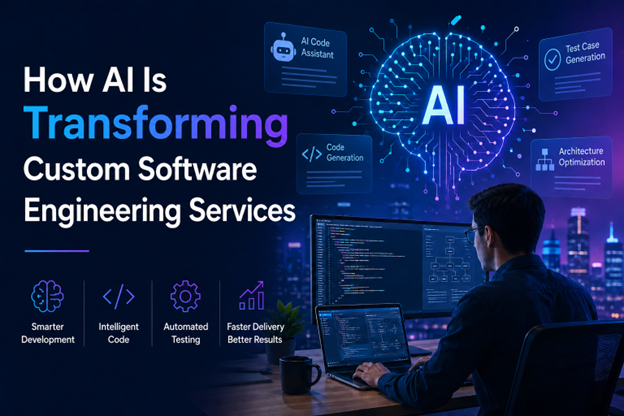
For some time now, things have changed almost secretly. AI went from being an add-on to whatever was created by the team to becoming an internal part of the process of developing software. Teams that previously had to waste many days just in the preliminary stages of development can release prototypes in no time at all.
But more importantly, this change opens up new possibilities for businesses that could not afford customized software development before.
Why 2026 Marks a Turning Point
This is the year when AI-integrated software development solutions moved from experimental to expected. Clients are walking into discovery calls already knowing what GitHub Copilot is. Engineering leads are being asked about agentic workflow on day one. The conversation has fundamentally changed.
According to McKinsey’s 2024 State of AI report, over 65% of firms are now using AI in at least 1 business function, up from 50% just a year earlier.
The Current Landscape of Custom Software Engineering
Traditional Challenges in Bespoke Development
Anyone who’s worked on custom software knows the friction points. Long scoping cycles. Cost overruns. Miscommunication between business stakeholders and dev teams. Testing that gets rushed because the deadline crept up. These aren’t new problems — they’ve been part of the territory for decades.
You might notice that many of these challenges trace back to one root cause: too many manual handoffs between people, phases, and tools.
How AI Addresses Legacy Pain Points
AI doesn’t eliminate the need for skilled engineers. What it does is absorb a lot of the repetitive, low-creativity work that slows teams down. That means developers spend less time writing the same CRUD logic for the fifth time and more time solving the genuinely interesting architectural problems.
If you’re exploring custom software development services for your business, you’ll notice that the better firms have already woven AI into their delivery workflows – not as a gimmick, but as standard practice.
Key Ways AI Is Reshaping Custom Software Engineering Services
AI-Powered Code Generation and Automation
AI-driven software engineering tools like Amazon CodeWhisperer, GitHub Copilot, and Cursor have become everyday utilities for dev teams. They autocomplete functions, flag potential bugs mid-write, suggest entire modules, and in some cases generate working endpoints from plain-language descriptions.
The productivity gains are real. Some teams report cutting development time by 30–40% on repetitive tasks. That’s not a rounding error – its budget freed up for harder problems.
Intelligent Testing and Quality Assurance
Testing, being a super important thing, comes last and is the first thing that gets cut when timelines slip. AI changes that dynamic. Tools can now auto-generate test cases, detect edge cases based on code patterns, and run regression tests continuously without someone scheduling them.
Smart software engineering practices treat testing as something that happens along with development, not after it. That shift alone catches more bugs earlier and reduces the cost of fixing them.
Personalized Architecture Design
This one’s a bit less obvious but arguably more impactful. AI tools can now analyze project requirements and recommend system architectures, database types, flagging concerns related to scalability before a single line gets written.
In custom software engineering, where every project has different constraints, this kind of early intelligence saves significant time in architecture review cycles.
Low-Code/No-Code Integration for Rapid Prototyping
There are times when businesses need to confirm their ideas before making any serious development commitment. Thanks to low-code solutions that have been transformed with the help of artificial intelligence, development teams can quickly create working prototypes within days. This does not mean that developers are not needed, but it allows stakeholders to have something tangible to respond to.
Real-World Applications on AI in Custom Software Engineering Services
AI in Enterprise Custom Solutions — the UK Market
The UK tech scene has been quick to adopt. Financial services firms in London are using AI-driven custom platforms for compliance automation. Healthcare providers are commissioning bespoke systems where AI flags anomalies in patient data. Logistics companies are rebuilding routing software with machine learning baked into the core, not layered on top.
End-to-end software development in these sectors used to mean 18-month projects. AI-assisted delivery is compressing that to 9-12 months for a comparable scope.
Transforming Web, Mobile, and Cloud-Native Projects
It does not matter whether we are talking about an enterprise cloud solution or about a consumer mobile app; artificial intelligence can be found everywhere. Mobile development uses artificial intelligence for automated accessibility validation. Cloud native builds use it for optimization and cost savings.
Generative AI for UI/UX Customization
Design is no longer bottlenecked on a single designer’s availability. Generative AI tools can produce UI variations at scale, A/B test them in staging environments, and surface user behavior insights that inform the next iteration. Custom software engineering teams that combine generative AI with experienced UX thinking are producing interfaces that
feel surprisingly human for the speed at which they’re made.
Benefits for Businesses and Developers of AI in Custom Software Development
This is where things get concrete. Businesses commissioning custom software today are seeing advantages that weren’t realistic even two years ago. Here’s what that actually looks like in practice:
- AI tooling cuts repetitive development work by 30–40% on average, which directly reduces billable hours
- Faster prototyping means stakeholder feedback happens earlier – when changes are cheap, not late in the build when they’re expensive
- Automation of code reviews and testing will detect errors prior to QA, eliminating the need for iterations that silently drain budgets.
- AI-enabled infrastructure monitoring ensures self-scaling of resource allocation based on actual traffic levels, saving you from over-provisioning and unexpected costs during peak times.
- Continuous vulnerability scanning runs in the background rather than waiting for a scheduled audit — problems surface faster
- For custom software built to specific compliance standards, AI can flag deviations from security rules as code gets written, not after deployment
Challenges and Ethical Considerations
Skill Gaps and the Need for AI Literacy
Not every team is ready for this shift. There’s a real gap between firms that have invested in AI literacy and those still treating it as optional. Custom software engineering teams that don’t adapt risk falling behind on delivery speed, which clients will notice rapidly.
Data Privacy, Bias, and Regulatory Hurdles
If the AI algorithms are fed with data that is discriminatory or biased, then the output generated from them will be similarly biased or discriminatory, which is potentially harmful in custom software development. Furthermore, there are regulatory guidelines, such as GDPR in European Union countries, that create further complications. It becomes imperative for all companies developing software infused with AI technology for UK companies to incorporate legal and ethical considerations into their process.
Integration Barriers in Legacy Systems
Here is where the complexities lie. Established businesses typically have legacy systems that are decades old, not built with integration with advanced AI software technology in mind. These kinds of integrations in legacy systems will be slower and costlier than in other scenarios.
Conclusion
Custom software engineering isn’t what it was three years ago. The teams winning today are the ones that have stopped debating whether to adopt AI and started figuring out how to use it well. Speed matters. So does quality. So does the judgment to know when to trust the tool and when to override it. If you’re building software in 2026 and AI isn’t part of the conversation yet, it probably should be.