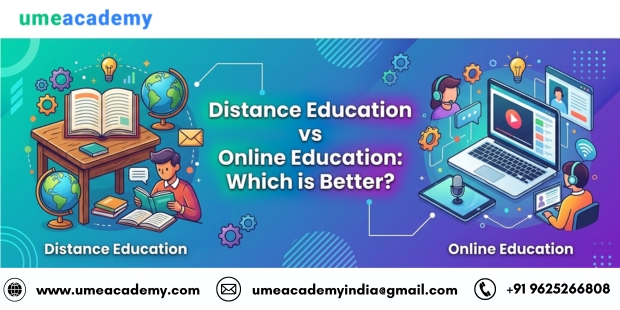
Recently, the structure of education has changed a lot. It is obvious that with the development of technology and as we get used to new life-style, students are not dependent on the former learning only in the classroom only. Among easy alternatives, the initial ideas are more focused on the flexibility of distance education and online education. At the beginning, both institutions are similar but they are both different in several ways. For the students, which one should they follow?
What is Distance Education?
Distance education (sometimes called correspondence education), is a form of education where the student is not in a location where the learning is taking place. Back in the old days this involved mailing textbooks, assignments and homework and exam papers; nowadays it is purely electronic, but the concept is still the same…the distance between student and teacher!
Distance courses tend to be more organised. Usually it is a university or a recognised body that offers an accreditation; a diploma, undergraduate or postgraduate.. Deadlines for assignments and exams are given. Students communicate with lecturers by using the computer via email or chat room, or being called at home at certain times for a moderated discussion in a video call.
What is Online Education?
Online education, by contrast, uses the internet as an entire platform for education. Online education is interactive, self-guided, and flexible. Webinars, live online courses, online video tutorials, and online virtual experiences are all online learning opportunities. The accessibility and efficiency of online learning sites such as Coursera, edX, and Udemy reflect online education‘s diversity.
Online education also has an advantage of technology in making the distance-learning as close as possible to the traditional education. Compared to traditional distance education, it can provide less lagging communication between student and instructor. Communication will be in real time, as students are able to discuss with instructors or other students via video chatting, conference, discussion forum, etc. virtual face-to-face.
Key Differences Between Distance and Online Education
- Mode of Delivery: Distance learning may be done offline or online, in the sense that the course material is either sent by post or uploaded on the portals. Online learning is internet-based only, hence necessitates a stable connection to the web.
- Flexibility:Distance education tends to be rigid and continues with a fixed timetable as most of the services are time specific in nature. Online education is flexible and can be accessed by the learners anywhere at any time.
- Interaction: With distance education it is mostly impossible to interact and discuss with instructors instantly. Online education is mainly based on direct communication and collaborative work; it‘s far more compelling to their students.
- Technology dependence: Distance education can be implemented with little use of technology; on other hand online education depends on technologies: hardware, software and Internet.
- Learning Experience:Distance education favors students who are well disciplined and comfortable with a fixed study schedule. Online education is suitable for motivated students who prefer engaging computer-based learning.
Which is Better?
What is better really comes down to your learning style, future plans, and resources.
On the other hand if you want a more conventional structure with officially recognized certification, then distance learning could be for you. It is perfect for those who wish to attain a degree from a reputable and recognized establishment without having to give up work or home commitments.
E-learning is the most suitable for learners who prefer flexibility, instantaneous feedback and collaborative learning environment. It would be 100% suitable for learning new skills or professional certification or for up-skilling.
In the end, one is not better than the other; a sound degree will surely require a mixture of these two methodologies. Certainly a third possibility exists, since most universities now have hybrid degrees.
Conclusion
The “online vs. distance learning” debate is one that doesn‘t have a one-answer-fits-all solution. Each has their various perks, suited to different types of students. Traditional distance education typifies formal learning, whereas online education can be distinguished from the former by its interactivity and flexibility. Knowing your aims, study tendencies and means can assist you in reaching a conclusion. Your best choice is whichever suits your individual aspirations best.