I used to think you needed a co-founder. Everyone told me that. Investors said it. Blog posts said it. Startup accelerators practically required it. The idea was simple: one person cannot do everything. You need a technical person if you are not technical. You need a business person if you are a developer. You need someone to keep you sane when things go sideways.
And honestly, for a long time, they were right.
But something shifted in the last two years that none of those people saw coming. The co-founder problem did not get solved by finding better people. It got solved by AI for startups.
I know that sounds like hype. Give me a few minutes to show you it is not.
What a Co-Founder Actually Does
Before we talk about AI for startups replacing the co-founder role, it helps to be honest about what that role actually involves. Because most people romanticize it.
A co-founder fills gaps. If you cannot code, they code. If you hate sales, they sell. If you are the big-picture thinker, they handle the details. A good co-founder doubles your output by covering the areas where you are weakest or where you simply do not have enough hours.
That is it. That is the core of it. They cover the gaps so the company can move forward without stopping every time one person is out of their depth.
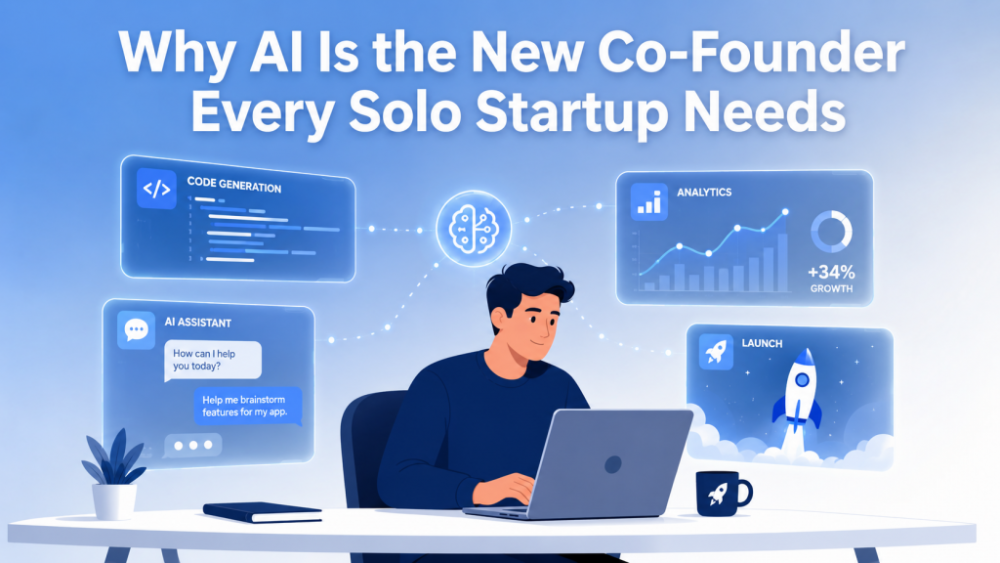
Now ask yourself: what has changed about that in 2026? AI for startups covers gaps. That is literally what it does.
The Gaps AI for Startups Is Filling Right Now
Let me be specific because vague claims about AI are useless.
Building the product:
This used to be the biggest gap for non-technical founders. If you could not code, you needed someone who could. Now tools like Cursor, Bolt, and Windsurf let you describe what you want and generate working code. Not perfect code, but functional, shippable code that you can test with real users. Many founders are now building their startup MVP with AI (https://www.appclonescript.com/ai-app-clone-scripts-transform-startup-mvps-2026/) in a matter of weeks, something that genuinely was not possible three years ago.
Writing and content:
Most founders are terrible at writing consistently. Blog posts, email sequences, social content, product copy: it all piles up. AI writing tools handle the volume work so you are not staring at a blank page at 11pm trying to write a welcome email.
Customer support:
You cannot personally respond to every support ticket when you are also building the product, talking to investors, and trying to sleep occasionally. AI agents trained on your product documentation can handle a significant chunk of incoming queries without you. Not all of them and not the hard ones, but enough that you are not drowning.
Research and analysis:
Competitor research, market sizing, user interview synthesis. The prep work that used to eat days now takes hours with AI for startups. You can ask a well-structured AI prompt what your competitors are charging and get a structured breakdown in minutes. Is it perfect? No. Is it good enough to make a fast decision? Usually yes.
Getting your app live:
This one catches people off guard. You can build an app with AI for startups tools and then hit a wall the moment you try to deploy it. Server setup, environment configs, DNS, SSL, scaling when traffic spikes: it is a whole different skill set from building the app itself. The emergence of tools that let you deploy your app with an AI agent, where the agent handles your cloud infrastructure and gets your app to production without manual configuration, is closing this gap fast. Solo founders who used to lose days to deployment problems are now handling it in under an hour.
What AI for Startups Cannot Do Yet
I want to be straight here because there is a version of this conversation that becomes dangerously optimistic.
AI for startups cannot tell you if you are building something people actually want. It can help you research the market but it cannot replace getting on a call with a real person and listening to what frustrates them. That judgment, the human reading of whether someone actually cares about your product or is just being polite, is still yours.
AI makes mistakes. Coding agents introduce bugs. Content agents go off-brand. Support agents sometimes give wrong answers. At the solo founder stage, you are the quality control layer. You still have to review outputs and catch errors before they reach your customers.
AI has no skin in the game. A real co-founder loses sleep over the same things you do. They care because their name and their equity are on the line. An AI agent does not care. The emotional resilience of having another human who is equally invested in the outcome is something AI for startups genuinely does not replace.
So let me be precise: AI for startups replaces the execution gaps that a co-founder would fill. It does not replace the judgment, the emotional partnership, or the shared accountability.
The Practical AI for Startups Stack in 2026
If you are starting something solo right now, here is a realistic picture of what your AI stack looks like.
For building: use a coding assistant with an agent mode that can hold context across files, understand your codebase, and implement features you describe in plain language. Cursor and Windsurf are the ones I have seen work best for AI for startups in practice. If you want to go further, you can even build an AI-powered app as a startup that uses intelligence as a core feature, not just a development shortcut.
For content: use a writing assistant that you have trained on your brand voice. Feed it your best-performing content as examples. Let it handle first drafts. You edit and make it real.
For customer support: set up an AI agent with your documentation, your FAQs, and examples of how you personally respond to common questions. Let it handle tier-one tickets. Review the ones it escalates.
For deployment: find a platform that handles the infrastructure layer for you. The best ones in 2026 use AI agents to manage your cloud environment so you are not becoming a DevOps engineer by accident. One-click AI agent deployment, where the agent handles getting your app to production without you writing config files or managing servers, is no longer experimental. It works and every solo founder using AI for startups should have this sorted early.
For research: build a habit of structured prompting before any major decision. Before you build a feature, ask what alternatives exist. Before you launch, ask what the obvious objections will be. Use AI for startups to pressure-test your thinking before you commit.
The Bigger Shift This Represents
Here is what I think is actually happening and why it matters beyond the productivity angle.
For most of the last decade, building a software startup without a technical co-founder meant either raising money to hire developers or convincing a developer to take equity. Both of those paths had real gatekeeping. Investors skeptical of single founders. Developers choosing between multiple opportunities. Ideas stuck in limbo.
AI for startups is dissolving that gatekeeping. A solo founder with domain expertise and a clear idea of what they are building can now move from concept to live product without needing to convince anyone to join them first. The question is no longer who is going to help me build this. It is whether what I am building is worth building.
That shift is bigger than it sounds. It means the ceiling on what one person can create is moving up fast.
The startups that win in this environment will not win because they have better AI for startups tools. Everyone has access to the same tools. They will win because the founder understands the problem deeply, stays close to the customer, and makes better decisions about what to build and what to ignore.
AI for startups is the new co-founder. But you still have to be a good founder.