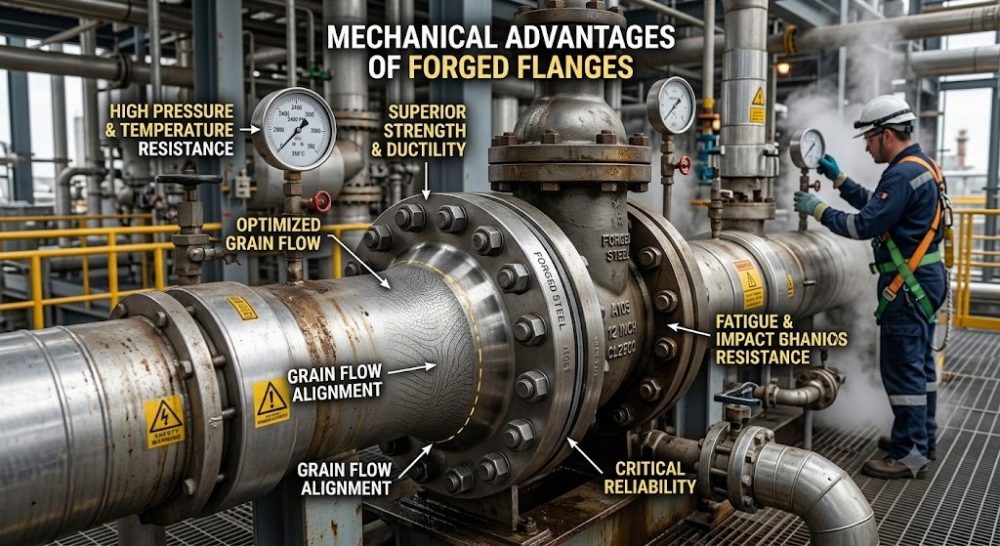
A power station in Odisha brought a steam header offline for an unscheduled inspection after maintenance found one of the Class 1500 weld-neck flange joints on the HP turbine extraction line weeping steam at a rate that tripped the acoustic emission monitoring. The header operates at 156 bar and 540°C, and the flanges in that circuit had been in service for seven years. What the inspection found was not a failed gasket, not a corroded sealing face, and not bolt fracture. The bolt load on four of the eight bolts on that particular joint had relaxed to 65% of the original assembly stress — from 200 MPa to 130 MPa — while the adjacent joints retained 88–91% of original stress. The differential relaxation pattern pointed at one cause: the low-stress joints had correctly processed ASTM A182 F22 forged flanges with the creep properties the specification demands. The weeping joint had a flange that, when sectioned for metallographic examination, showed a coarse grain structure with ASTM grain size number 4–5 and undissolved carbide networks at prior austenite grain boundaries — characteristics of material that was either over-austenitised before quenching or post-weld heat treated at an incorrect cycle. The chemical composition was correct. The mechanical property certificate was correct. The creep behaviour at 540°C was not.
The flange was replaced. The investigation took three weeks. The report recommended enhanced incoming inspection protocols that the procurement team had deemed unnecessary when the flanges were ordered.
Why Demanding Systems Expose What Ambient Pressure Testing Hides
Hydrostatic testing at 1.5 times working pressure — the standard commissioning test under ASME B31.1 and B31.3 — is a static pressure test at ambient temperature. It confirms pressure boundary integrity at the test moment. It confirms nothing about creep behaviour at 540°C over seven years, about fatigue life under 15,000 startup-shutdown cycles across a 30-year plant life, or about resistance to hydrogen stress cracking in a wet H₂S environment at 60 bar partial pressure. A flange that passes hydrostatic test with margin to spare can fail in service through mechanisms the test doesn’t probe, and forged flanges in demanding industrial systems are specified on the basis of service performance, not test performance.
The mechanical demands on a flanged joint in high-temperature process service involve four conditions operating simultaneously: internal pressure creating a separating force that bolt load must overcome; pipe bending moments from deadweight, thermal expansion, and seismic loading; thermal cycling that alternately relaxes and re-loads the bolt-gasket-flange system; and time-dependent creep deformation that gradually reduces net bolt load on the gasket. The design of forged flanges managing this combined loading is governed by the mechanical property profile of the flange material — yield strength, creep rupture strength, fatigue limit, and notch toughness — all sensitive to the microstructural quality that forging and heat treatment either produce or fail to produce.
Creep Relaxation and What Grain Structure Controls at Temperature
Creep relaxation in a bolted flange joint is the mechanism by which the elastic strain energy stored in the bolt during assembly gradually converts to plastic deformation in the most compliant element of the joint — in high-temperature service, that is typically the flange itself at the hub-to-body transition, where sustained stress at temperature drives time-dependent strain that reduces the net clamping force on the gasket. The creep rate at a given temperature and stress level depends on three microstructural variables: grain boundary area per unit volume (finer grain means more boundary area and faster creep at moderate stresses), grain boundary chemistry (chromium and molybdenum carbides stabilising the boundary resist boundary sliding), and dislocation density (higher initial dislocation density from forging thermomechanical working provides more obstacles to creep-driving dislocation motion).
Forged flanges in F22 and F91 achieve their creep resistance through all three microstructural factors. Closed-die forging at 1,050–1,200°C introduces the dislocation density that heat treatment tempers to optimal level — high enough for creep resistance, controlled enough to maintain toughness. Post-forge heat treatment at 730–760°C for F22 precipitates fine M₂₃C₆ chromium-molybdenum carbides at grain boundaries and within the ferrite matrix, creating the pinning structures that resist grain boundary sliding under sustained stress. The correct forging and heat treatment sequence produces ASTM grain size 6–8, translating to 22–45 µm average diameter — sufficient boundary area for carbide precipitation sites without the total boundary area per unit volume that makes boundary sliding dominate the creep strain rate.
The coarse grain structure at ASTM 4–5 (45–90 µm range) had substantially less grain boundary area for carbide precipitation, and the undissolved carbides — indicative of incomplete authentication or PWHT temperature overshoot — left the boundary chemistry carbide-depleted rather than carbide-stabilised. At 540°C and 156 bar, that combination produced a creep rate roughly 2.5–3 times higher than correctly processed F22 at the same stress, translating to the 35% bolt load loss over seven years that triggered the acoustic emission alarm.
Pressure Cycling Fatigue and the Hub Geometry Requirement
Process plants don’t operate at constant pressure. Every startup, shutdown, process upset, and control valve response introduces a pressure transient that cycles the flange joint through a stress range. A Class 1500 steam extraction header cycling between 0 bar at cold shutdown and 156 bar at operating conditions experiences a pressure range that generates a stress amplitude at the hub-to-pipe weld toe — the fatigue-critical location in a weld-neck flange — that is calculable from the B31.1 stress intensification factor for the specific hub geometry.
For a 4″ Class 1500 weld-neck forged flange in ASTM A182 F22, the hub taper geometry per ASME B16.5 maintains the stress intensification factor at the weld toe below 1.3. At 156 bar operating pressure and a 25mm wall thickness at the matching pipe end, the nominal hoop stress at the pipe section is approximately 155 MPa, and the weld toe stress with the B16.5 geometry factor is 155 × 1.3 = 201 MPa. If the plant sees 2 pressure cycles per day across a 30-year operating life, the joint accumulates approximately 21,900 cycles — well within the ASME fatigue design curves for F22 at 200 MPa stress amplitude, which show a design fatigue life of approximately 100,000 cycles at that stress level. The safety factor on fatigue is approximately 4.6 on cycles — substantial margin. But it assumes the weld-neck hub geometry is correct, the weld quality is code-compliant, and the flange material meets the F22 creep properties that keep the mean stress from drifting upward as creep relaxation shifts the bolt load distribution.
A cast equivalent flange in ASTM A217 Grade WC9 at the same Class 1500 pressure rating carries the same nominal pressure design capability on paper. What it doesn’t carry is the same fatigue resistance at the hub-to-weld-neck transition, because the dendritic, randomly-oriented grain structure at that location in a casting presents grain boundaries perpendicular to the maximum principal stress at the weld toe — the grain boundary orientation that maximises crack initiation rate under cyclic loading. The fatigue design curves that ASME publishes for wrought materials are not directly applicable to cast flanges at the same stress amplitudes because the microstructural crack initiation mechanism is different. Most engineering assessments apply a de-rating factor of 1.5–2.0 on the fatigue design life for cast material in equivalent cyclic service.
The Specifications That Govern Each Service Environment
The following table maps the principal demanding service environments against the forged flanges specifications and test requirements that govern each, along with the failure mode that results from using inadequately specified material in each application. The table represents the specification-conscious minimum for each service category — not the conservative design choice, but the baseline that prevents the failure modes listed.
The pre-table observation that matters: every row in this table has an “inadequate specification” failure mode that occurred in service somewhere, in a case study published in NACE or ASME proceedings or in a plant investigation report. None of these failure modes are hypothetical.
| Service Environment | Material Spec | Critical Property | Test Requirement | Inadequate Spec Failure Mode |
| High-temp steam (>450°C) | ASTM A182 F22, F91 | Creep rupture strength, ASTM grain size 6–8 | PWHT records, hardness 156–207 HB | Bolt load relaxation, gasket leak at 5–10 year mark |
| Wet H₂S sour service | ASTM A105 / A350 | Hardness ≤22 HRC per NACE MR0175 | Brinell survey per flange, EN 10204 3.2 | Sulphide stress cracking at HAZ, brittle fracture |
| Low-temperature / cryogenic | ASTM A350 LF2 / LF3 | Charpy 27 J avg at -46°C or -101°C | Impact test per heat, test temp per spec | Brittle fracture on cold startup or thermal shock |
| Hydrogen partial pressure | ASTM A182 F22 | Resistance to HTHA per Nelson curves | Nelson curve compliance verification | High-temp H₂ attack, decarburization, fissuring |
| Cyclic pressure / fatigue | ASTM A182 F11, F22 | Wrought grain structure, weld toe geometry | B16.5 hub geometry compliance, radiography | Fatigue crack at weld toe within design life |
| Chloride / stress corrosion | ASTM A182 F316 / F316L | Low carbon content (<0.03%), austenite stability | IGC test per ASTM A262, sensitisation check | Intergranular stress corrosion cracking |
Sendura Forge Pvt. Ltd., IATF 16949:2016 and ISO 9001:2015 certified, operates from Rajkot as a manufacturer of forged flanges and precision drivetrain components — with belt-drop hammer capacity from 1 to 3 tons, 800 metric tonnes monthly capacity, and a product range exceeding 700 part numbers spanning coupling flanges, gear blanks, cross shafts, ring gear carriers, balancing shafts, and helical gear and shaft assemblies for customers including DANA, Mahindra, Eaton, WABCO, Escorts, New Holland, TAFE, and Bonfiglioli — with in-house QA/QC infrastructure covering Brinell and Rockwell hardness, CMM dimensional reporting, MPI, and full EN 10204 documentation capability aligned to the test requirements the table above demands.
Conclusion
The power station investigation that opened this article took three weeks and produced a recommendation for enhanced incoming inspection that cost a fraction of the unscheduled outage. The metallographic section that explained the premature bolt load relaxation showed a coarse grain structure and undissolved carbide networks — both characteristic of a heat treatment cycle that deviated from the F22 specification in ways that the material’s tensile test and hardness certificate couldn’t detect, because neither tensile strength nor ambient temperature hardness predicts creep behaviour at 540°C. The forged flanges that retained 88–91% of their assembly bolt stress after seven years at those conditions had grain structure, carbide distribution, and dislocation density that the correct forging and heat treatment sequence produced and the incoming inspection documented.
The mechanical advantages of forged flanges in demanding industrial systems — creep resistance, fatigue life at the hub-to-weld transition, resistance to hydrogen attack, toughness in sub-zero service — are not guaranteed by the alloy grade on the certificate or the pressure class on the flange face. They are produced by the specific microstructural outcomes of correctly executed forging and heat treatment, verified by the specific tests that each service environment demands, and documented in records that are retrievable when the investigation starts — not assembled when the procurement team is asked to explain what they bought.