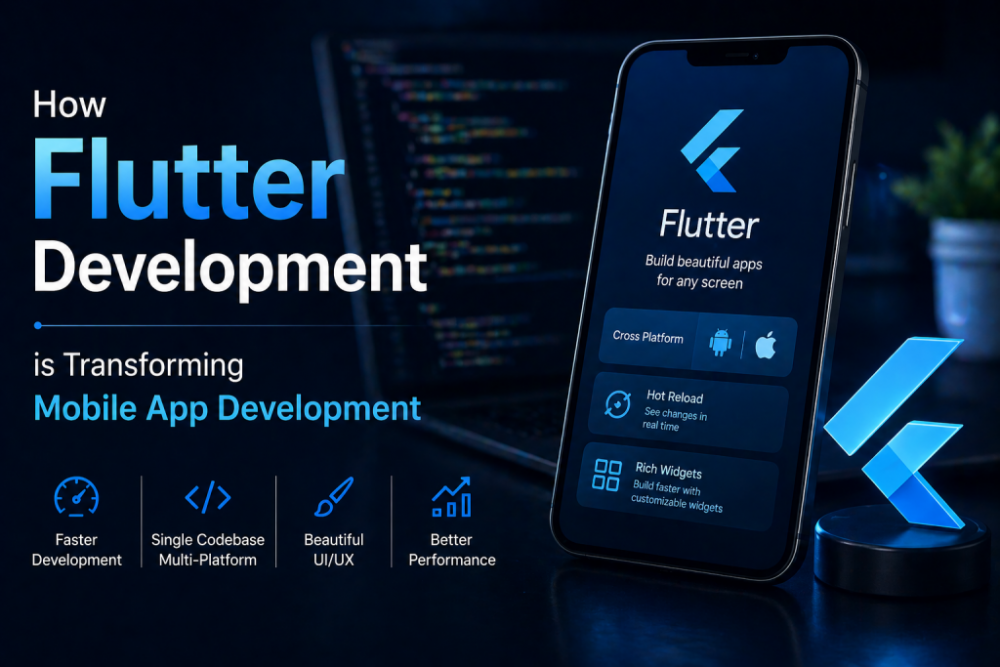
The mobile industry is a dynamic sector with new structures every time to meet the demands of businesses and users. The most popular of these is the UI toolkit of Google, which has gained considerable momentum regarding its capability to create high-performance applications using only one source of code.
Flutter Development Services is a priority of many companies today, as they are striving to compete in a saturated market. This model enables teams to develop both iOS and Android software that is both functional and visually appealing without necessarily having separate codebases on each platform.
The Shift in Mobile Construction
Earlier mobile developmentneeded to have two separate teams, one Android and one iOS. It implied that the code would have to be written twice, increasing time and budget. The developers had to apply updates to both versions independently to make updates when necessary, but this often resulted in differences between the sites.
The Flutter framework reverses this situation by producing software in several environments using one codebase. The framework uses a rendering engine known as Skia, to render its own interface components, that is, the application will look and behave identically on all devices. This is beneficial to businesses in that it would save the technical overhead in having to maintain two different projects.
Speed Through Instant Updates
One of the most notable features of this framework is the hot reload capability. In conventional arrangements, developers are required to compile code, and wait until the whole application restarts to see a small design change or fix. This process is repeated dozens of times in one day.
Using hot reload, developers can observe changes in real-time. Once a line of code has been changed, the change can be reflected on the screen within milliseconds, with the application remaining in its current state. Such an immediate feedback loop enables teams to experiment with new ideas fast and to refine the user interface without losing momentum.
Cost and Efficiency Benefits
Budget allocation is a priority to companies, particularly startups. The creation of a Minimum Viable Product (MVP) through the conventional means might turn out to be costly due to the necessity to have a large number of specialists on the staff. With this framework, a small team can reach more people by deploying to both major platforms at the same time.
Costs of maintenance are also reduced to a large extent. With a single codebase to maintain, security patches, and feature additions are made to the entire project simultaneously. This avoids the platform gap that an iOS application may have a new feature months before an equivalent update is made to an Android version.
Consistent Visual Performance
The user experience is related to the speed and responsiveness of the interface. Certain structures depend on the bridges to communicate with the device that may slow down the performance. This architecture does not rely on these bridges by compiling directly to machine code, enabling easy animations and short load times.
Since it is not based on the native widgets offered by the operating system, the interface is the same on other phone models. This provides the designers with complete control over the appearance of the application. Whether it is a particular brand aesthetic or a full-on custom animation, the framework makes these elements accurate.
A Growing Community and Ecosystem
The sustainability of a framework in the long term is determined by the support of the community and constant enhancements. The ecosystem of plugins and packages continues to expand on a daily basis with the support of Google, and a considerable population of independent contributors. When a team requires adding features such as camera access, geolocation or payment gateways they can often find existing, tested packages to do the same.
Such maturity implies that developers do not need to spend a lot of time creating basic features and instead focus on the logic that makes a product unique. This is beneficial to businesses in that it increases their delivery times and the final product is more stable.
Scalability for Future Growth
When a business is initially launched with a small project, they must have the chance to grow in the future. The framework supports this direction by enabling the codebases to evolve beyond a simple MVP to a full-scale application. Many companies claim that they are able to add complex features, including database integration or complex state management without needing to rewrite their original underpinning.
Such stability gives peace of mind to the project managers. With the ever-changing market demands, the codebase will be flexible enough to adapt to the changing requirements without necessarily having to rewrite the whole base.
Hiring for Success
Since the need to produce high quality mobile products is on the increase, one of the decisions to make is to seek a partner to undertake the technical implementation side. A partner with the insight into the peculiarities of this framework will know how to structure the code in a way that can be maintained over time. They will also focus on the user interface, testing and performance measurements to ensure that the end product is professionally acceptable.
The possibility of collaborating with an established team helps the business to avoid many traps of the development lifecycle and concentrate on their core objectives. The indicators of a good development company are clear communication and emphasis on the standard code practices.
In case you want to develop a modern and high-performance application, we welcome you to explore the special Flutter Development Services provided by Webclues Infotech and contact us to start the development of your project.