The world now moves toward sustainable transportation which leads to increased electric vehicle (EV) usage. EVs provide multiple environmental benefits and operational efficiencies yet their safety issues need to be addressed as a major priority. Battery fires represent one of the most critical dangers in the current situation. Researchers study advanced fire protection materials for electric vehicle (EV) batteries because these materials protect passengers, infrastructure and environmental resources.
Understanding the Risk: Why EV Battery Fires Occur
Lithium-ion batteries, which represent the most widespread energy storage technology used in electric vehicles, achieve substantial energy storage capacity within their physical dimensions. The batteries operate at high efficiency levels, however, they face a possibility of thermal runaway which occurs when excessive heat results in an uncontrollable cycle that leads to either fire or explosion. The occurrence of fires involving electric vehicle batteries results from multiple risk factors which contribute to the problem. The process of mechanical damage which includes impacts from accidents creates a risk that battery cells will break and start thermal events. The electrical faults which include overcharging, short circuits, and manufacturing defects produce excessive heat that increases the risk of ignition.
The existence of thermal conditions, which include high ambient temperature exposure and internal overheating, serves as a trigger for thermal runaway. Chemical instability exists because electrolytes and separator materials undergo degradation, which leads to increased fire hazards through enhanced flammability. The consequences of such incidents extend beyond the vehicle itself. The process of extinguishing electric vehicle battery fires proves challenging because issues arise during the fire emergency situation which needs firefighters to control the active emergency. Organizations need protective materials which will safeguard them against multiple types of dangers.
EV Battery Fire Protection Materials: An Overview
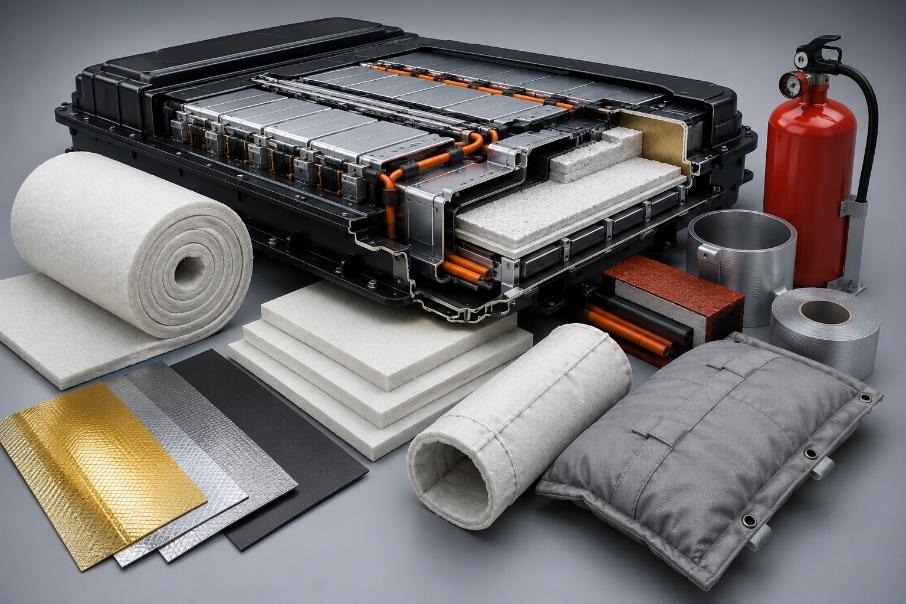
The materials used for EV battery fire protection are developed to stop fires from spreading through battery systems and reducing their spread rate. Multiple levels of a battery pack system use these materials which can be found in cell casings and module components and the entire battery enclosure system. The main purposes of EV battery fire protection materials show essential functions which include thermal insulation, flame retardancy and structural reinforcement. The process of thermal insulation helps to block heat transfer between cells which protects the system from experiencing thermal runaway through chain reactions. The process of flame retardancy makes battery components less flammable which decreases the likelihood of fires starting and spreading throughout the system. Structural reinforcement works to protect the battery from losing its mechanical strength when facing stress or impact thus creating extra protection for both routine operations and emergency situations.
Types of Fire Protection Materials for EV Batteries
1. Ceramic-Based Materials
The properties of ceramic materials enable them to withstand extreme temperatures which makes them effective thermal protection materials for electric vehicle batteries because they can be used in separators, coatings and insulative layers. The material withstands temperatures above 1000°C while it reduces heat transfer between cells and maintains its structural integrity during mechanical stress.
2. Flame-Retardant Polymers
Battery housings, wiring insulation and separators use specialized polymers to improve safety. Chemical changes through halogen-free additive incorporation together with physical protection from aluminum hydroxide and phosphorus compounds create flame retardant materials.
3. Phase Change Materials (PCMs)
Phase change materials function as thermal barriers which absorb extra heat during thermal events to delay temperature increases while they protect against thermal runaway. They are applied by layering between battery modules or integrating within battery casings for active thermal management.
4. Intumescent Coatings
Intumescent coatings create a protective insulation layer through their expansion process which occurs when they are exposed to intense heat. The system detects temperature increases and builds a barrier that protects sensitive battery components from flames, which improves the fire protection performance of electric vehicle batteries.
5. Aerogels and Nanocomposites
Emerging technologies in EV battery safety design thermal insulation systems which require both lightweight materials and high-performance thermal insulation. Aerogels create an insulation solution through their extremely low thermal conductivity which enables them to deliver effective thermal protection without adding substantial weight. Nanocomposites materialize through the combination of polymers with nanoparticles which results in enhanced flame resistance and improved mechanical strength.
Integration of Fire Protection Materials in EV Battery Design
Fire protection materials need to be distributed throughout EV batteries because their safety requirements, weight restrictions and cost factors need to be maintained in equal measure. Engineers use a multi-layered protection system which provides security for all operational areas. The cell protection system uses coatings and separators which prevent ignition from spreading between individual cells. Insulative barriers together with phase change materials create a module-level containment system which stops thermal propagation between battery modules. The pack design uses housing materials together with structural reinforcements to protect against impacts and high temperatures.
Key Factors Driving the Adoption of Fire Protection Materials
The EV Battery Fire Protection Materials Market experiences growth because of multiple key technological and industrial developments which drive market expansion. Global safety regulations that require strict compliance force manufacturers to use innovative materials which fulfill fire safety requirements. The increasing use of electric vehicles raises the risk of battery accidents which drives greater need for protective equipment. Material science advancements especially in ceramics, polymers and nanomaterials research lead to greater performance capabilities and lower production costs. The increasing knowledge of electric vehicle safety among consumers drives automotive manufacturers to make vehicle fire protection systems their top priority.
Future Trends in EV Battery Fire Protection Materials
The upcoming development of electric vehicle battery fire protection systems will require material solutions that increase intelligent capabilities. The innovations range from self-healing polymers to thermal management systems which use phase change materials and active cooling systems for their temperature control needs and bio-based flame retardants which provide sustainable solutions compared to traditional chemical methods. The system uses embedded sensors to monitor real-time conditions while detecting early overheating signs which trigger alerts to drivers and safety systems. The new technologies will drive market growth for EV battery fire protection materials while improving vehicle safety and reliability.
According to Pristine Market Insights, safety is paramount in the widespread adoption of electric vehicles and fire protection materials play a critical role in mitigating the risks associated with lithium-ion batteries. The solutions use ceramics, flame-retardant polymers, phase change materials and nanocomposites to prevent thermal runaway while protecting both passengers and infrastructure. The EV battery fire protection materials market will become a major area of interest for automakers and regulators as the EV industry expands. The ongoing development of new technologies, establishment of industry standards and the combination of cutting-edge materials will help electric mobility achieve its environmental objectives while establishing new standards for automotive safety.