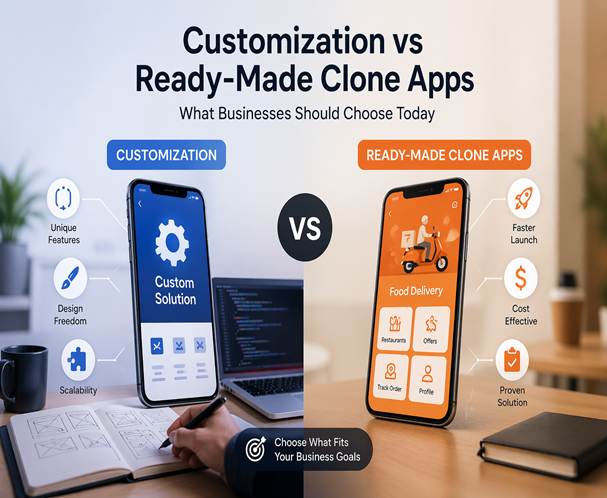
In today’s fast paced digital economy, business looking to enter the app development marketspace face a critical decision, build a fully customised application or opt for a ready-made clone app. This is an important choice as it directly impacts cost, market entry and future success of any application and hence should be made after considering all the pros and cons of both the models.
Customization offers a developer full control over the application and they can design every feature according to their choice and interest. Developers can design a platform specifically tailored according to the business needs, user expectations and brand identity. It allows companies to innovate with and integrate unique features which often helps an app stand out in the market.
Ready-made clone apps, on the other hand, are often inspired by successful apps such as Uber and Zomato and prove to be a faster and more economical alternative. These apps come with pre built basic and core functionalities of these apps and allows the businesses to launch within a shorter time frame as compared to customised applications.
While both the models have numerous advantages, they also have their fair share of disadvantages or limitations. While customization requires significant time and financial resources, at the same time, clone apps lack flexibility and originality.
As market become more and more competitive, simply choosing a model and praying for it to work won’t cut it out anymore, businesses need to make a balanced decision after carefully evaluating their long-term goals and budget and then decide which method works with their vision the best.
Understanding Custom Built Applications
Custom built application means creating an application from the total scratch to meet the specific need of the business. Unlike ready made apps, these apps are built with complete flexibility and control, allowing the companies and developers to decide everything- from design to backend features. This means that businesses can align their app perfectly with their brand identity and user expectations.
One of the biggest advantages that custom built apps provide is their uniqueness. Brands are not limited to pre-built templates and hence can integrate new and innovative features and techniques in their application which provides them a competitive edge in the market.
However, in order to achieve this uniqueness and create a name in the market, significant investment in the form of cost, time and technical expertise is required.
Overall, custom built applications are best suited for those businesses that aim for long term growth, scalability and strong market differentiation over quick market entry.
What Are Ready Made Clone Apps?
Ready-made clone apps are pre developed software solutions designed by replicating the core features and functionalities of already successful platforms. These models follow proven business models such as that of e-commerce, food delivery or ride sharing that makes it easier for businesses to enter in the market without worrying too much of app failure and financial loss.
The biggest advantage of clone app is speed. Since the basic structure, design and features are already developed, businesses can launch their app in a much shorter time- usually days- as compared to the weeks and months taken to launch an app after developing it from scratch.
Another advantage of such apps is their cost effectiveness. Compared to custom development, clone apps are significantly cheaper because they use existing framework and require less effort in development.
However, they also have significant limitations. Since they are built on already existing apps they do not provide any space for flexibility and innovation. Many businesses using similar scripts may end up providing the same type of services leading to less chances of creating a unique brand name and identity.
In short, ready-made clone app are for businesses looking for quick, effortless and low risk entry into the market and have no decided goals regarding future growth and expansion.
Suitability for Startups vs Established Businesses
The choice between custom built apps and ready-made app clone scripts largely depend on the stage and resources of the businesses.
For startups, ready made clone apps often offer a more practical solution. Startups usually operate with smaller teams, limited budget and a quicker need to enter into the market. Clone apps allows them to launch fast, test their business model and start generating revenue without heavy initial investments. This approach reduces risks and help in understanding customer preference early.
Contrary to this, existing enterprises have an advantage in investing in the development of apps that will serve the specific needs of their users. Supported by the means to pay, a larger pool of customers and having a long-term plan in mind, it becomes easier for them to invest both time and money in order to develop a customised app. It helps them in making use of the best possible technological advances.
To sum up, new enterprises gain from clone apps, whereas existing businesses find more benefit in custom apps.
Which Option Fits Your Business Goals?
The choice between both the models is based on various factors such as business priorities, resources and long-term vision, there is a no ‘one size fits all’ answer.
If the goal is quick launch and early market entry, clone apps are ideal, specially, when you are low on funds and entering a market already dominated by giants. However, if aiming for long-term growth, uniqueness and stability, a custom-built app is the more suitable option despite the high investment cost.
Many businesses today follow a hybrid approach, starting with a clone app and then customising it as they continue to grow. Ultimately, the decision should be taken considering the balance between budget, timeline and creating a name in the market. Along with this, businesses must also consider application lifecycle management, a continuous process that involves developing, maintaining, updating and improving an application throughout its life, to ensure the chosen approach remains scalable, efficient and relevant in the long run.