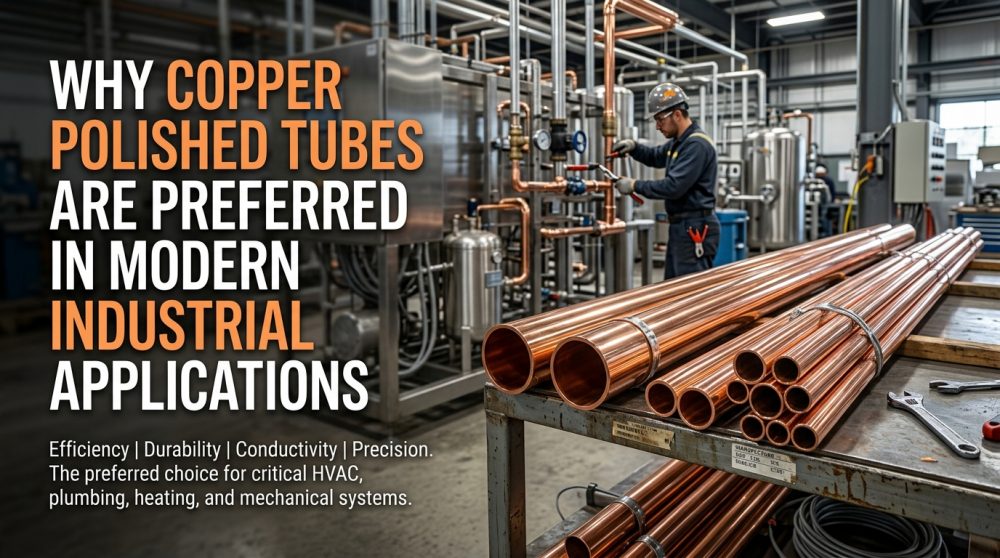
Copper has held its place in industrial engineering for centuries, but the shift toward polished tube formats in precision manufacturing reflects something more specific than tradition. Copper polished tubes combine tight dimensional tolerances with surface finishes that directly affect flow efficiency, hygiene compliance, and assembly reliability. In industries where contamination control, heat transfer rates, or fluid dynamics determine system performance, the Copper polished tube finish is a functional specification. Manufacturers across HVAC, medical equipment, refrigeration, and architectural sectors increasingly source seamless copper polish tubing because the surface and structural integrity work together from the outset, reducing rework and failure rates.
Understanding Copper Polished Tubes and Their Manufacturing Characteristics
Polished copper tubes carry a surface finish achieved through mechanical buffing, electrolytic treatment, or both, depending on end-use requirements. The result is a surface roughness value typically below 0.4 Ra micrometers for precision grades, compared to 1.6 Ra or higher in standard drawn tubes. Seamless copper polish tubing adds a structural advantage: without a weld seam, the tube wall maintains uniform grain structure throughout its length, which matters in pressure applications and wherever fatigue resistance determines service life. Standard welded alternatives develop micro-stress concentrations at the seam under cyclic loading. For industries specifying both dimensional consistency and surface finish, this combination is the most reliable starting point for component fabrication.
Material Properties That Make Copper Tubes Suitable for Industrial Use
Corrosion Resistance and Surface Stability
Copper forms a stable oxide layer that resists further corrosion in most atmospheric and liquid environments. In water systems operating up to 120°C, copper tubing shows corrosion rates below 0.001 mm per year in neutral pH conditions. The polished finish accelerates passivation by removing surface irregularities where corrosive agents concentrate. In marine or chemical processing environments, service lives exceed 25 years with minimal maintenance, compared to carbon steel alternatives that need periodic coating renewal.
Thermal and Electrical Conductivity Advantages
Copper delivers thermal conductivity of approximately 385 W/m·K, roughly eight times higher than stainless steel at 16 W/m·K. For heat exchanger and condenser tube applications, this gap determines how much surface area a design needs to reach a target heat transfer rate: smaller tube bundles, tighter coil configurations, more compact assemblies. On the electrical side, copper tubing achieves conductivity at 58 MS/m, making it the practical default for conductive tube formats in power distribution hardware.
Smooth Surface Finish and Precision Requirements
A smooth internal bore reduces losses from fluid friction significantly. If pressure drop influences the compressor load in refrigerant circuits, the difference between a 0.4 Ra finish and a rough-drawn bore can be significant over a long piping run. A uniform polished surface facilitates non-destructive inspection: ultrasonic and eddy current tests give more accurate readings because the probe couples more uniformly to the tube wall. Precision grades with out-of-roundness tolerances of less than 0.05 mm enable direct assembly with press-fit or solder joints without pre-machining of the tube ends.
Modern Industrial Applications of Seamless Copper Polish Tubing
HVAC and Heat Transfer Equipment
In refrigeration and air conditioning, copper is used for evaporator and condenser coils which require a uniform wall thickness for optimum heat transfer. Seamless copper tubes in the standard range from 6.35 mm to 28.58 mm OD cover split-system and chilled-water plant assemblies. The polished finish provides a uniform base for the fabrication of grooved tubes, facilitating the application of internal fin enhancements.
Medical and Precision Equipment Systems
Tube materials used in oxygen delivery pipelines, autoclave fittings and surgical air systems must resist microbial adhesion and tolerate sterilisation cycles above 134ºC. HTM 02-01 and similar standards specify polished copper tubing with an internal finish of less than 0.8 Ra for medical gas pipeline systems. The smooth bore also minimizes particulate entrapment in pharmaceutical processing lines where contamination control is required by regulation.
Industrial Fluid Transfer Systems
Seamless copper polish tubing is used in hydraulic lines, fuel transfer circuits, and compressed gas distribution networks where leak integrity over years of vibration and pressure cycling takes precedence. Copper tube joints using compression fittings or brazed connections are not dependent on thread engagement for seal integrity, thus reducing potential leak points in complex multi-connection assemblies.
Decorative and Architectural Applications
Exposed copper tubing in furniture, architectural facades, and handrail systems depends on finish consistency across batches. The polished copper tubes will have a uniform reflective surface when the base material grain structure and the final abrasive sequence are controlled by the manufacturing process. Architects specifying copper as a visible design element require batch-to-batch colour and finish repeatability that standard industrial tubing cannot reliably provide.
Why Seamless Copper Polish Tubing Supports Reliable Industrial Performance
Most industrial purchases are based on performance over the life of the product rather than the initial purchase price. A seamless tube with a controlled polished finish goes into service free of internal scale, surface pits or seam discontinuities which cause early failure modes. This results in fewer inspection frequencies and less costs related to unplanned maintenance, especially for embedded or hard-to-reach installations. A.B.C. Tube Company has been supplying copper and brass tube products for over half a century. The company manufactures ASTM, BS, DIN, JISH, EN, and I.S. standards to consistently meet dimensional and surface specifications. For industries where tube replacement requires a shutdown of the system, that consistency directly reduces operational risk.
Key Considerations When Selecting Copper Tubing for Industrial Projects
Before procurement the finished grade, dimensional tolerance class and alloy composition must be suitable for the application. For potable water and refrigerant service a tube specified at C12200 phosphorus-deoxidized copper is suitable, but for high-strength mechanical applications, C17200 or a brass alloy will give better fatigue resistance. The DIN EN 12449 tolerance classes A, B and C define progressively tighter dimensional bands and the additional joint preparation cost, if a too loose tolerance is selected for press-fit assemblies. A trusted supplier of polished copper tube holds surface and dimensional targets across repeat orders, mitigating engineering risk at the project level.
Conclusion
Copper polished tubes hold their position in modern industrial applications because the material properties and manufacturing characteristics address real engineering problems together. Corrosion resistance, thermal conductivity, dimensional consistency, and surface finish combine in a product covering precision requirements across a broad set of industries. Seamless construction removes the structural variable that welded alternatives introduce. For engineers specifying tube materials for long-service installations, polished copper tubing remains a defensible choice not for historical reasons but because performance data in active installations continues to support that selection.