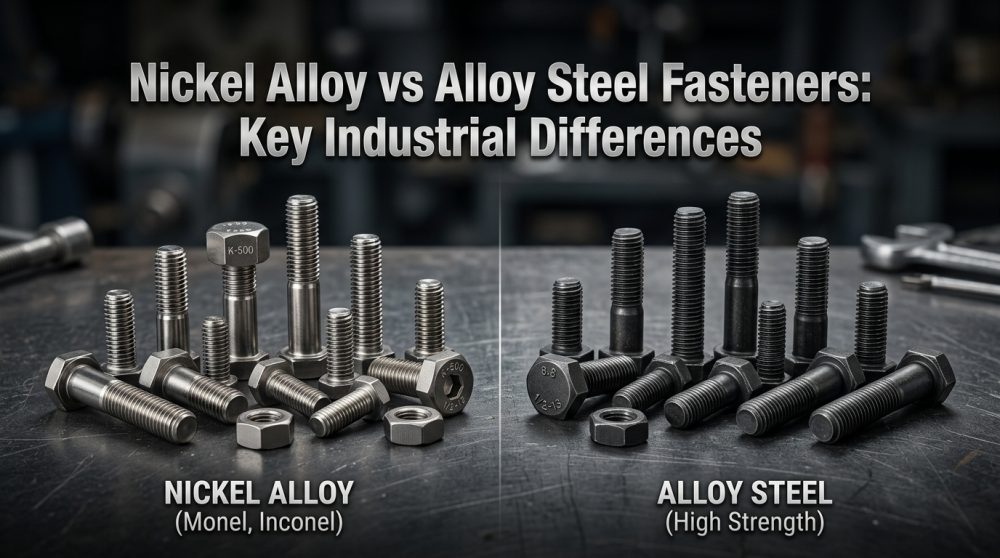
Most procurement decisions on fasteners come down to what the plant used last time or what fits the budget. That works fine until something fails. Nickel alloy and alloy steel fasteners are not interchangeable, and the wrong material in the wrong environment creates problems that cost far more to fix than the original saving was worth
In offshore oil and gas, chemical plants, and power generation, fasteners face saltwater, acid vapours, temperatures above 600°C, and constant pressure cycling. Standard materials wear out quickly, and a corroded stud in a critical flange costs far more than the bolt. Choosing the right fastener material from the start affects maintenance intervals, joint reliability, and whether parts last two years or fifteen.
Understanding Nickel Alloy and Alloy Steel Fasteners
What Are Nickel Alloy Fasteners?
Nickel alloy fasteners are mainly nickel with elements like chromium, molybdenum, iron, and copper added for specific conditions. Different grades suit different environments. Chromium improves oxidation resistance, molybdenum helps in chlorides and acids, and nickel keeps strength at high temperatures. They’re chosen when regular materials can’t survive the service conditions.
What Are Alloy Steel Fasteners?
Alloy steel fasteners are carbon steel with added chromium, molybdenum, vanadium, or manganese to improve heat treatment response and load performance. ASTM A193 B7 is widely used in plant flanges. These steels achieve over 860 MPa tensile strength while remaining inexpensive than nickel alloys, so they stay the standard choice.
Material Composition Differences Between Nickel Alloys and Alloy Steel
Alloy Steel Composition Fasteners and Their Properties
Alloy steels usually contain 0.25–0.50% carbon and less than 5% alloying elements. Chromium helps hardening, molybdenum adds strength at moderate temperatures, and vanadium refines the grain. Heat treatment results in a tensile strength of 860–1000+ MPa. For most structural and process applications, alloy steel is the material of choice because it is inexpensive.
Nickel-Based Alloy Composition and Performance Benefits
Nickel alloys contain about 40–72% nickel. Monel 400 (nickel–copper) suits seawater and hydrofluoric acid. Inconel 625, rich in molybdenum and niobium, resists pitting and crevice corrosion. Hastelloy C-276 survives wet chlorine and harsh mixed acids. Unlike steels, nickel alloys keep their strength as temperatures rise above 500°C.
Corrosion Resistance Comparison: Nickel vs Steel
Performance in Marine and Chemical Environments
Uncoated alloy steel rusts quickly in seawater, and even zinc plating wears out in harsh marine conditions. Offshore splash zones and subsea areas need better materials. Monel 400 and Inconel 625 work well in chloride-rich environments, while Hastelloy C-276 survives sulfuric and hydrochloric acid where alloy steel quickly fails.
Oxidation and Environmental Resistance
Above 500°C, alloy steel oxidizes fast. Scale builds up on threads, reduces preload, and previously tight joints start leaking. Nickel alloys form a stable chromium–nickel oxide film that protects up to about 980–1000°C, so they’re used in fired heaters, cracking furnaces, and steam reformers where alloy steel fails.
Mechanical Strength and Load-Bearing Capabilities
Tensile Strength and Yield Strength Comparison
B7 alloy steel studs provide at least 860 MPa tensile and 724 MPa yield strength, enough for most flange joints. Inconel 718 is much stronger at over 1240 MPa. Alloy 625 is around 930 MPa, but it’s chosen mainly for corrosion and heat resistance. In mild environments, alloy steel is sufficient.
Fatigue Resistance and Long-Term Durability
Compressors, pumps, and pressure-cycling piping put fasteners through repeated stress. At elevated temperatures, nickel alloys hold fatigue resistance better than steels. In sour gas service with hydrogen sulfide present, alloy steel can suffer stress corrosion cracking that leads to sudden failure. Nickel alloys are far less susceptible. That distinction has serious safety implications for upstream oil and gas.
High Temperature Performance and Thermal Stability
Heat Resistance in Industrial Operations
Above 500°C, alloy steel loses strength and slowly deforms (creep), so bolts relax and need ongoing maintenance, even with higher-grade steels. Nickel alloys resist creep at 700–900°C, which is why Inconel and Hastelloy are used in turbine casings, cracking furnaces, and high-temperature steam headers, where alloy steel has no real substitute.
Thermal Expansion and Dimensional Stability
Bolted flange assemblies with mismatched thermal expansion between fastener and flange develop problems over time like leaks, loose bolts and repeated re-torqueing. Checking expansion compatibility at the design stage is worth the time. It does not show up as a problem immediately, but it creates recurring maintenance over a plant’s operating life.
Cost Comparison and Lifecycle Value
Initial Investment Costs
Nickel alloy fasteners are expensive. Depending on grade and size, the difference against B7 alloy steel can be 10x to 30x on a unit basis. For large bolted assemblies across an entire plant, that adds up to a significant procurement number. Alloy steel fasteners are cheap, readily available, and come with short lead times in most markets.
Maintenance and Replacement Costs
In corrosive or high-heat service, alloy steel fasteners may need replacement every 2–4 years, adding labour, flange repair, and costly unplanned shutdowns. Nickel alloy fasteners chosen for the service often last through multiple turnaround cycles, changing the total cost picture over 10–15 years in favour of nickel alloys.
Industrial Applications of Nickel Alloy and Alloy Steel Fasteners
Industries Using Nickel Alloy Fasteners
They are used in subsea connections, topside piping and heat exchanger flanges on offshore platforms. In petrochemical facilities, Hastelloy and Inconel are used in reactors, columns and fired heaters. Power generation plants use nickel alloy studs in high-pressure steam systems and turbine casings. Jet engine hot section components rely on Inconel 718 in aerospace.
Industries Using Alloy Steel Fasteners
Structural construction and bridge building use alloy steel bolts at scale. Automotive and heavy vehicle manufacturing depends on them for engine and drivetrain assemblies. Mining equipment, cranes, and general heavy machinery run on alloy steel fasteners. Most fabrication sectors use them as the standard, because conditions do not require anything more.
How to Choose Between Nickel Alloy and Alloy Steel Fasteners
Environmental Factors to Consider
Consider the temperature. If the operating temperature is consistently above 500-550°C, alloy steel is likely out. Then look at the corrosion environment. Chloride exposure, acid contact, saltwater immersion, sour gas. Any of those shifts the decision toward nickel alloys.
Dry service, moderate temperature, no aggressive chemicals. Alloy steel is fine and costs a fraction of the alternative.
Performance Requirements and Budget Constraints
Both performance and budget matter. In simple, low-risk conditions, cost can lead the decision and alloy steel is the best choice. In harsh or high-risk services, the cost case for alloy steel quickly collapses. Using alloy steel where nickel alloy is needed isn’t a saving; it’s delayed cost with interest.
Common Mistakes When Selecting Industrial Fasteners
Poor choices in industrial fasteners often come from not performing a corrosion analysis, assuming mechanical grade is all that matters and reusing old specs without verifying the service conditions really align. Another risk is ignoring galvanic compatibility. Pairing nickel alloy studs with carbon steel flanges can speed up corrosion of the less noble metal. Engineers also sometimes treat high tensile strength as proof of high temperature capability. A bolt strong at room temperature can still creep and deform badly at 550°C. Mechanical strength and high-temperature performance are separate properties and must both be verified for the actual service environment.
Conclusion
Alloy steel fasteners suit most industrial uses with good strength, low cost, and easy availability. Nickel alloys are not upgrades for everything; they are for high temperatures, corrosive chemicals, chlorides, and sour gas where alloy steel fails. Material selection should be based on actual service conditions and not only on price. Getting it right the first time avoids leaks, shutdowns and early replacements that end up costing much more.