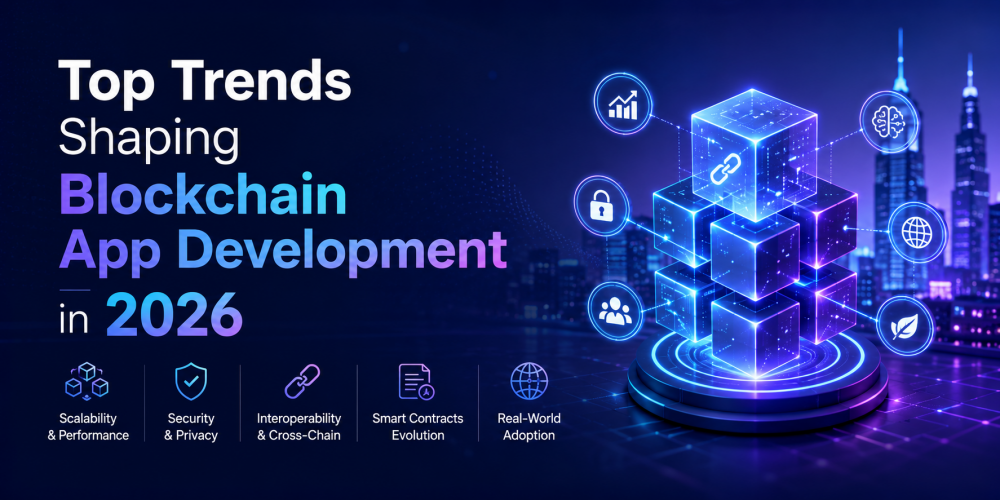
The blockchain industry is moving much quicker than ever before. Once an “experimental” technology for crypto fans, it has now become the foundation of sectors as wide-ranging as healthcare, supply chain, finance, and gaming. As we venture further into 2026, businesses are not debating if blockchain is something they should do anymore, they are debating how quickly they can do it.
Whether you’re a startup entrepreneur, product manager, or enterprise decision-maker seeking to stay ahead, here’s a candid glance at the trends shaping blockchain application development today, and how they impact your next build.
Top 7 Trends in Blockchain App Development in 2026
1. AI Meets Blockchain and It’s Changing Everything
One of the most anticipated transitions in 2026 is the joining forces of Artificial Intelligence and blockchain. Both technologies have a lot of power on their own. Together, they’re transformative.
Blockchain offers the tamper-proof, transparent data layer AI models require to make smarter decisions in the face of clean data. In the meantime, AI makes smart contract auditing automatic, identifies fraud patterns on-chain in real time, and customizes the decentralized app (dApp) experience at scale.
This is already happening in DeFi apps equipped with AI-based risk engines, or supply chain apps that leverage on-chain data to forecast disruptions with ML. In 2026, providing AI integration has become a requirement for any blockchain app development services and isn’t just an option anymore.
2. Layer 2 Solutions Are Now the Default Architecture
The “Layer 2” networks Optimism, Arbitrum, zkSync, and Polygon have come quite a way. Formerly taking minutes, transactions can now be completed in seconds, while former exorbitant gas fees have become virtually free for everyday consumers. The general developer sentiment is that everyone is building on top of Layer 2, and not using it as an upgrade path.
This is a very significant change for app builders. Consumer-facing blockchain applications, such as micro-payment platforms, gaming economies, ticketing systems, and others, are now commercially viable, where they were not two years ago. Blockchain roadmap that is still completely tied to Ethereum mainnet, it’s time to rethink the architecture.
3. Real-World Asset Tokenization Is Going Mainstream
Tokenization of real-world assets (RWA) stands out as one of the pivotal advancements transforming the landscape of blockchain applications in 2026. Think real estate, commodities, government bonds, private equity and even IP all as digital tokens on a blockchain.
Asset managers like BlackRock, JPMorgan and Goldman Sachs have already tokenized billions of dollars worth of assets. This institutional recognition has now paved the way for startups to emerge and create RWA infrastructure, encompassing marketplaces, compliance layers, liquidity protocols, and custody solutions.
The possibilities here are huge. As of now, the most sought after developer profiles are those who not only possess technical expertise of smart contract architecture but also have an understanding of the regulatory aspects. If you are looking to hire blockchain app developers for an RWA project, you can avoid many headaches later by hiring those with legal-tech hybrid skills in addition to proficiency in Solidity.
4. Zero-Knowledge Proofs Are Entering the Mainstream
In blockchain, privacy has been a paradox all along. The transparency that makes it trusted, also makes it vulnerable to exposure of sensitive data if observed by someone.
Zero-knowledge proofs (ZKPs) elegantly solve this problem and enable one party to prove something is true without revealing what it is. By 2026, ZKP technology has transitioned from research papers to production-grade apps.
New use cases are growing rapidly such as private voting systems, data sharing in healthcare, KYC without data exposure, and confidential DeFi transactions. With the introduction of zkEVM solutions, developers can now deploy Ethereum-compatible smart contracts that have privacy embedded.
ZKP is no longer a special skill in the developers’ hand. It’s becoming a fundamental element, and now some regulated industries are beginning to require it as a strict criterion for blockchain.
5. Cross-Chain Interoperability Is Finally Reliable
The blockchain landscape was a real headache for builders for years with dozens of incompatible chains and different standards. Users were restricted to single-chain silos, with restricted liquidity and functionality.
In 2026, the mature cross-chain infrastructure will be brought. This is possible with protocols such as LayerZero, Wormhole, and Chainlink CCIP, which enable the seamless transfer of assets and data between Ethereum, Solana, Avalanche, BNB Chain, and other networks, and users are unaware of the underlying complexity.
It has major implications for the development of applications. Builders can no longer make just one ecosystem choice at the beginning of a project. A DeFi application can access liquidity in 5 chains. Any network’s native assets can be listed on an NFT marketplace. The flexibility is changing the way blockchain product teams design from scratch.
6. Decentralized Identity Is Gaining Enterprise Traction
Self-Sovereign Identity (SSI), in which users manage their own identity credentials on-chain, not with a centralized platform, is a concept that’s been around for years. It’s moving up from pilots to production in 2026.
In the world of enterprises, especially within the financial and health sectors, there is one simple reason why decentralized identity is attractive. New regulations like GDPR, HIPAA, and some new EU and Asian digital identity regulations are forcing organizations to reimagine how they handle and validate user data. In a single architecture, blockchain-based identity systems provide auditability, user consent and data minimization.
Standard-based employee onboarding, patient record management and cross-border KYC flows are gaining traction with apps built on standards such as W3C’s Decentralized Identifiers (DIDs) and verifiable credentials.
7. Sustainability Is Now a Product Decision
Social and environmental issues regarding blockchain, including proof-of-work, have not been solved, but the response of the blockchain industry has been critical. With the transition to proof-of-stake, Ethereum’s energy usage was cut by more than 99%. Sustainability is being integrated into new chains from the ground up.
Enterprise clients and investors are actively analyzing the environmental impact of blockchain infrastructure prior to contracts in 2026. For development teams it is no longer an after thought, it is part of the pitch to select an energy efficient chain.
Final Thoughts
In 2026, blockchain is not the same speculative and volatile market that it was five years ago. Its infrastructure ranges from serious to scalable and entrenched in systems that power business and finance the world over.
The above trends already exist in the current market, influencing what is being created, who is creating it, and what users are looking for in decentralized applications. Looking at a new product line or building a new extension to an existing product line, this is the easiest way to ensure that you are creating something that will stand the test of time.
The window for building with an edge is open, but not forever.