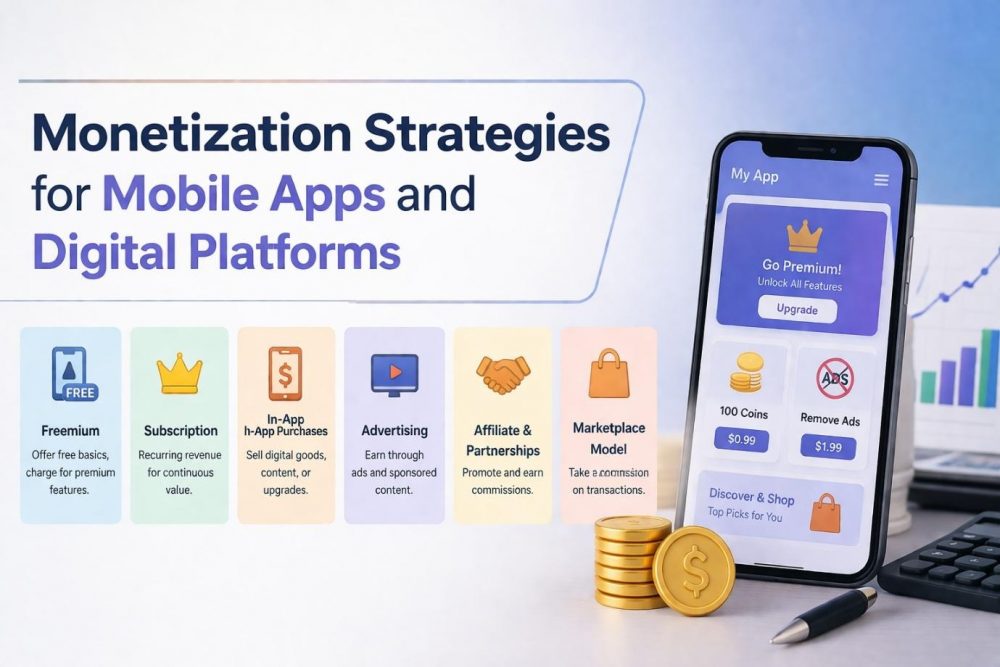
The digital economy has experienced rapid expansion where mobile apps and other digital platforms have become a part of daily life. They range from entertaining, communicating, transacting, conducting business and other productivity-related activities. In the highly competitive landscape, monetization should not just be an avenue for generating money but a crucial step in the development of product strategy that should be set early for its successful implementation.
Selection of the appropriate monetization strategy will enable developers to build a seamless journey for their customers towards revenue generation. Moreover, it is influenced by various factors including user behaviour characteristics. Other aspects include the nature of the product whether it is a content-based or involves any transactions. Another important aspect of determining which monetization technique to adopt is the niche being served.
For success, there needs to be balance in profit maximization and satisfaction among users of the platform. Furthermore, proper monetization strategy will enhance the perception of value while others may have adverse impacts on the relationship between the customer and the firm.
Freemium, Subscription, and In-App Purchases: Core Revenue Models
Modern business monetization on mobile apps includes freemium (combination of free and premium), subscription, and in-app purchases models that are unique and effective for achieving various goals. A freemium approach gives its users access to basic features at no extra cost, and providing them with more advanced tools when they pay for their usage, facilitating fast scaling of an app but faces problems while converting users into actual paying clients. Subscriptions provide users with stable monthly or annual fee payments making revenue predictable, but they require excellent retention and pricing strategies.
IAPs (in-app purchase) include consumable IAPs (virtual currency, coins, gems, energy resources) and non-consumable ones (removal of ads, unlocking premium content). It is mostly applied in gaming applications, productivity, health and fitness apps. Hybrid monetization is popular among companies as it combines three monetization types in one application.
It is important to analyse ARPU (Average Revenue Per User), LTV (Lifetime Value), and churn rate metrics for measuring the effectiveness of chosen strategy.
Advertising-Based Monetization: Maximizing Revenue Without Hurting UX
Monetization through ads continues to be one of the most potent methods of generating income from mobile applications and online platforms as long as it is executed properly. There are several types of ads that include banner ads, interstitial ads, native ads, and rewarded ads. Here, banner ads represent a more discreet form of advertisement; where others are capable of generating greater revenue. Native advertisements are designed to become an integral part of the content, thus increasing their effectiveness.
Another factor that plays a vital role in monetizing through ads is choosing the appropriate advertising networks and mediating platforms for them. Equally important is making use of data-driven personalization to increase the effectiveness of advertisements. Therefore, it is crucial to implement measures that ensure optimal ad placement.
Alternative Monetization Strategies: Beyond Traditional Models
Apart from the conventional methods of monetization, there is also the adoption of modern ways by digital platforms that aim at providing diverse sources of income generation. For instance, affiliates and referral program strategies involve generating income through the promotion of third-party services/products or through incentivized actions performed by users that encourage the attraction of new clients. Sponsorship and brand partnership programs, on the other hand, create win-win situations for the generation of revenue and promotion of brands.
Moreover, a valuable option is data monetization as one can extract useful insights from user data; nevertheless, ethics and legal requirements should be strictly followed. One can also monetize a platform by integrating e-commerce and using the platform as a marketplace to perform transactions. Furthermore, the use of Fintech as a Service (FaaS) is becoming common among platforms for integrating financial capabilities such as payment, loans, and wallets that can create additional revenue channels via transaction charges and commissions. Transaction fees and commissions on sales also work well for marketplaces and SaaS (Software as a Service) platforms.
Some of the latest trends involve micropayments, creator economy, and incorporation of Web3 technologies as they change digital monetization fundamentally. All of these monetization strategies open up unique opportunities for businesses to develop successfully in an ever-changing environment.
Conclusion
In summary, monetization has become much more complex than merely making money out of mobile apps and other digital platforms. In an era when competition keeps growing fiercer, businesses need to use a more informed approach, which takes into account what the users want and what is achievable with the digital platform being used. This involves choosing the right monetization methods, including core methods like freemium, subscription, and in-app purchase, along with other options like advertising. Moreover, monitoring the performance of the organization using critical indicators is equally important for ensuring success.