Introduction
Abrasion-resistant plates are engineered specifically to survive wear. They’re used wherever rock, ore, sand, or other abrasive materials grind against steel surfaces during normal operation. Standard structural steel won’t last long in those environments. That’s why wear-resistant grades exist.
BHN (Brinell Hardness Number) is the key measure. The higher the BHN, the harder the surface and the greater the resistance to abrasion. It sounds simple. In practice, hardness comes with trade-offs in weldability, fabrication, and cost.
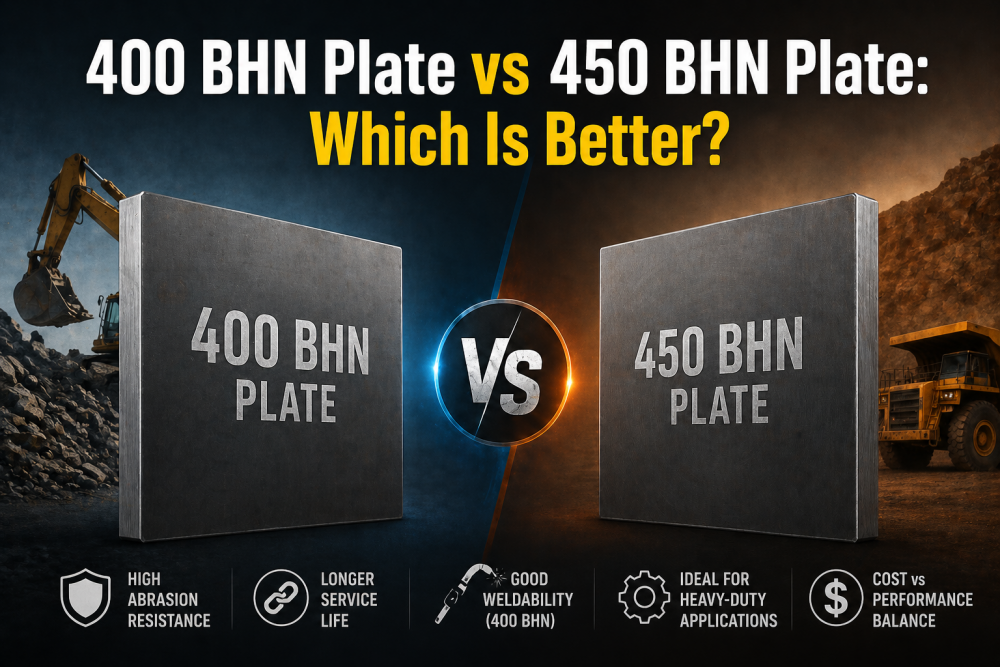
Two grades dominate industrial procurement: 400 BHN and 450 BHN plates. Each serves a purpose. Choosing between them depends on the wear severity, fabrication requirements, and project budget. We are a reliable 400 BHN plate supplier with ready stock, and this blog walks through an honest comparison to help you make the right call.
What Is 400 BHN Plate?
A 400 BHN plate is a quenched and tempered steel offering a Brinell hardness of 360–440 HBW. By providing significant abrasion resistance and staying tough enough to handle heavy impacts without cracking, it serves as a perfect middle ground. This reliable, high-performance material is ideal for today’s most demanding industrial sectors.
This material’s main advantage is that you can easily weld, cut, or cold-form it without the risks of harder grades. Consequently, it offers an affordable way to reinforce dump truck beds, excavator buckets, and dozers. This ensures that heavy machinery handles constant contact with rough surfaces and debris on busy construction sites without failing or wearing down.
For more information, read about the advantages of 400 BHN plates in industrial use.
What Is 450 BHN Plate?
A 450 BHN plate is a high-hardness steel quenched and tempered to 420–480 HBW, specifically engineered for extreme wear conditions. This significant hardness uplift provides superior abrasion resistance and a longer service life, making it the more economical choice when standard 400 BHN plates would fail too quickly.
Although the primary advantage involves reduced replacement cycles in demanding applications, the material presents specific practical limitations. Building with it is complex; you must use regulated preheating for welds and handle cuts with extreme care. Higher material costs also arise due to the metal’s very tight manufacturing requirements today. These operational constraints necessitate a thorough technical understanding of the material’s complex industrial characteristics.
Key Differences: 400 BHN Plate vs 450 BHN Plate
Choosing the right grade depends on balancing your project’s operational demands against fabrication complexity; here is a detailed breakdown:
Material Workability
While 400 BHN provides a workable balance for standard fabrication, 450 BHN offers superior wear resistance at the cost of being less tolerant during the manufacturing process.
Weldability and Processing
Standard procedures work for 400 BHN, but 450 BHN requires strict preheat management and heat control to prevent cracking, increasing the time and cost for site repairs.
Service Life Equation
In extreme environments like rock crushing, 450 BHN significantly outlasts 400 BHN; however, in moderate-wear applications, the added material complexity and cost are rarely justified.
Cost and Availability
While 400 BHN is generally more affordable and readily available, 450 BHN commands a higher premium due to its specialized manufacturing and enhanced alloying elements.
Application Suitability
Select 400 BHN for general earthmoving and moderate impact tasks; reserve 450 BHN for severe abrasive conditions like mining chutes where material longevity is the top priority.
When to Choose 400 BHN Plate
For funnels, hoppers, and tipper bodies with mild wear, specify 400 BHN plate. It strikes the right balance between cost and durability for budget-conscious buyers. Good weldability and machining make site repairs and field cutting easy, extending service life and maintaining structural integrity.
When to Choose 450 BHN Plate
- Quarrying, mining, and processing rocks are all examples of high-abrasion conditions.
- Equipment that continuously handles abrasive, sharp, or heavy materials
- Heavy-duty machinery in which component replacement is costly or disruptive
- Applications in which a longer lifespan outweighs the greater initial cost
Cost vs Performance
Higher hardness costs more. That’s straightforward. But procurement decisions that focus only on material price often miss the larger picture.
A 400 BHN plate fitted in a high-wear application will wear out faster and need replacing sooner. Multiply that over a few replacement cycles, and the cumulative cost of material, labour, and downtime typically exceeds the premium of a correctly specified 450 BHN plate. Choosing the right grade upfront reduces maintenance expenses over the life of the equipment. It’s not always the harder plate that’s the better value or the cheaper one. It’s the correctly specified one.
Conclusion
There’s no single correct answer here. A 400 BHN plate is the right choice for the majority of wear applications; it balances performance, fabricability, and cost in a way that’s hard to beat. 450 BHN earns its place in genuinely demanding service conditions where the extra hardness pays back over the equipment’s service life.
The decision should be driven by the application, not by a preference for the harder or cheaper option. Define the wear conditions, consider the fabrication requirements, and match the grade to both.
Final CTA Section
Getting the grade right matters, but so does getting it from the right source. Work with a 400 BHN plate supplier who understands the material, not just the price list. We supply both 400 BHN and 450 BHN wear plates with full mill certification, consistent quality, and competitive pricing.
Before you place an order, our technical team will assist you in selecting the appropriate grade for your application and advising on fabrication needs. Please contact us to discuss your needs, obtain a price, or confirm stock availability for your project timetable.