AI citation optimization is a visibility challenge most marketers are experiencing. Ignoring it means missing out on a growing slice of how people discover information today.
But First, What Is AI Citation Optimization And Why Should You Care?
AI citation optimization is the practice of structuring your content so AI systems like ChatGPT, Perplexity, Google’s AI Overviews, and other LLM-based tools actually reference your brand or content when answering user queries.
Think of it this way: traditional SEO gets you on page one of Google. AI citation optimization gets you inside the AI’s answer. That’s a meaningful difference when more users are skipping search results entirely and trusting what the AI tells them. Start paying attention to this shift now, before your competitors figure it out.
How Traditional SEO Works And Where It Falls Short Today
Traditional SEO is built around one core idea: rank higher in search engines. You optimize your metadata, build backlinks, improve page speed, and target keywords. It works well, and it still does.
But here’s the catch. AI search tools don’t always rank results the same way Google does. They pull from trusted sources, structured data, and content that’s written clearly enough for a machine to summarize confidently. If your content isn’t optimized for that kind of retrieval, you won’t get cited, even if you rank on page one.
What Does AI Citation Building Look Like?
AI citation building is about creating content that AI tools trust enough to reference. It’s less about gaming an algorithm and more about being genuinely useful, well-cited, and clearly written.
If you’re asking, “Where do I even start?” Here’s the honest answer. Focus on producing content that directly answers specific questions. Use clear headings. Back your claims with data. Write like a subject matter expert, not a keyword-stuffing machine. AI citation building services focus on this exact process: structuring content, earning mentions on authoritative platforms, and ensuring your brand appears in the right knowledge ecosystems. Treat every piece of content as a potential AI source because increasingly, that’s what it is.
How Google AI Citation Works And Why It’s Different
Google AI citation is what happens inside Google’s AI Overviews. those summarized answer boxes that now sit above traditional search results. Google’s AI pulls from indexed pages it considers credible, concise, and directly relevant to the search query.
Getting cited in Google AI Overviews isn’t purely about domain authority anymore. It’s about how well your content answers the specific question being asked. Short, factual paragraphs win. Vague, fluffy content doesn’t get cited; it gets skipped. This is why some high-DA sites are being overlooked in AI answers while smaller, tightly-focused content creators are getting featured.
LLM Citation Optimization: The New Frontier
LLM citation optimization is about making your content readable and referenceable by large language models- ChatGPT, Claude, Gemini, Perplexity, and others. These models were trained on vast datasets, and they continue to pull from indexed web content for real-time queries.
The goal of LLM citation optimization isn’t just traffic. It’s brand authority. When an AI tool recommends your company, cites your research, or summarizes your content. That’s a signal of trust that no ad can buy. Investing in this early, especially if you’re in a competitive B2B or SaaS space where buyers are increasingly using AI tools to do their research before ever talking to a salesperson.
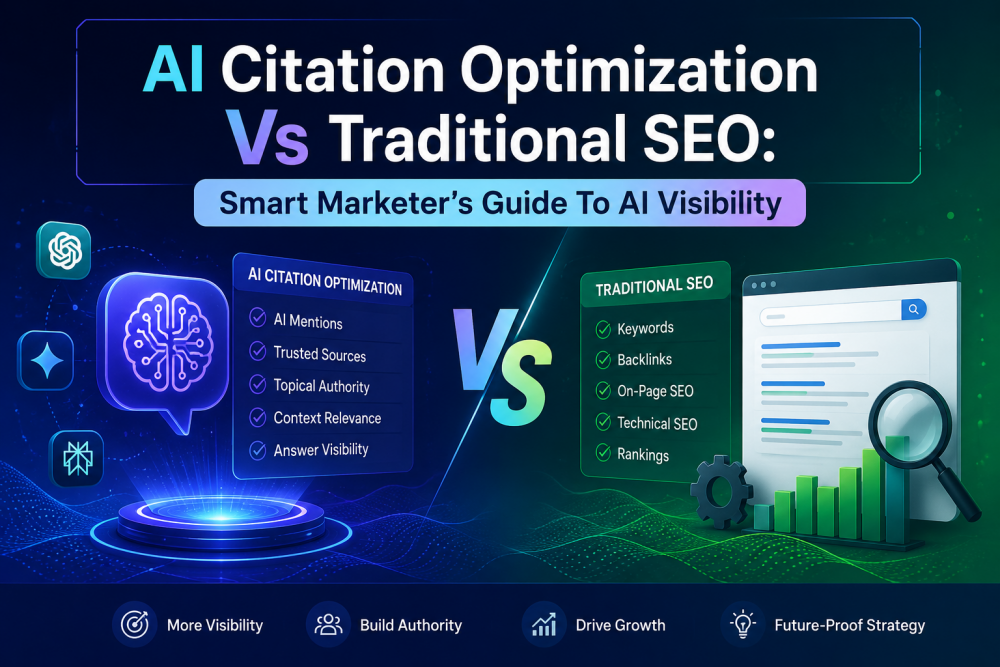
AI Citation Optimization Vs Traditional SEO: Key Differences
Both strategies want the same end goal. Get your content in front of the right audience. But the mechanics are quite different.
Here’s a quick breakdown of how they compare:
- Ranking signal: Traditional SEO relies on backlinks, keywords, and technical signals. AI citation optimization relies on content clarity, trustworthiness, and factual accuracy.
- Output: SEO gets you a blue link in search results. AI citation gets your content quoted or summarized by an AI tool.
- Content style: SEO content can be keyword-heavy. AI-ready content needs to be concise, well-structured, and authoritative.
- Discovery path: SEO users click through to your site. AI users may get the answer without ever visiting your page.
Understanding this gap is what separates marketers who stay ahead from those playing catch-up.
Should You Choose One Over The Other?
Short answer: no. You need both. But you need to understand where each one wins.
Traditional SEO still drives enormous traffic. Billions of searches happen on Google every day, and ranking well still matters. But as AI tools become the first stop for information queries, AI citation optimization fills a gap that SEO alone can’t.
Think of traditional SEO as getting your store on the main street. Think of AI citation optimization as getting your store recommended by the most trusted person in town. Both matter. One without the other leaves visibility on the table.
Practical Tips To Start Optimizing For Both
You don’t need to hire an AI citation SEO agency on day one. Start with what you control. Here are practical steps that serve both traditional SEO and AI visibility:
- Answer questions directly: Start paragraphs with the answer, then explain. AI tools love direct responses.
- Use structured headings: H2s and H3s help both Google and AI models understand your content’s structure.
- Cite credible sources: Linking to authoritative data builds trust with both algorithms and AI systems.
- Keep sentences short: Complex, meandering sentences get ignored by AI summarizers.
Once you’ve built a solid content foundation, you can explore AI citation building services or work with an AI citation SEO agency to scale your presence across more AI platforms. The infrastructure you build now will compound over time.
Upgrade Your SEO Strategy Now!
The way people search is shifting. Quietly, steadily, and faster than most marketing teams are prepared for. AI citation optimization isn’t a trend to bookmark and revisit later. It’s a real and growing part of how your brand gets discovered.
Traditional SEO built the foundation. AI citation optimization is what comes next. Start with clear content, genuine authority, and a strategy that works for both humans and machines. The marketers who understand both worlds today will be the ones leading the conversation tomorrow.