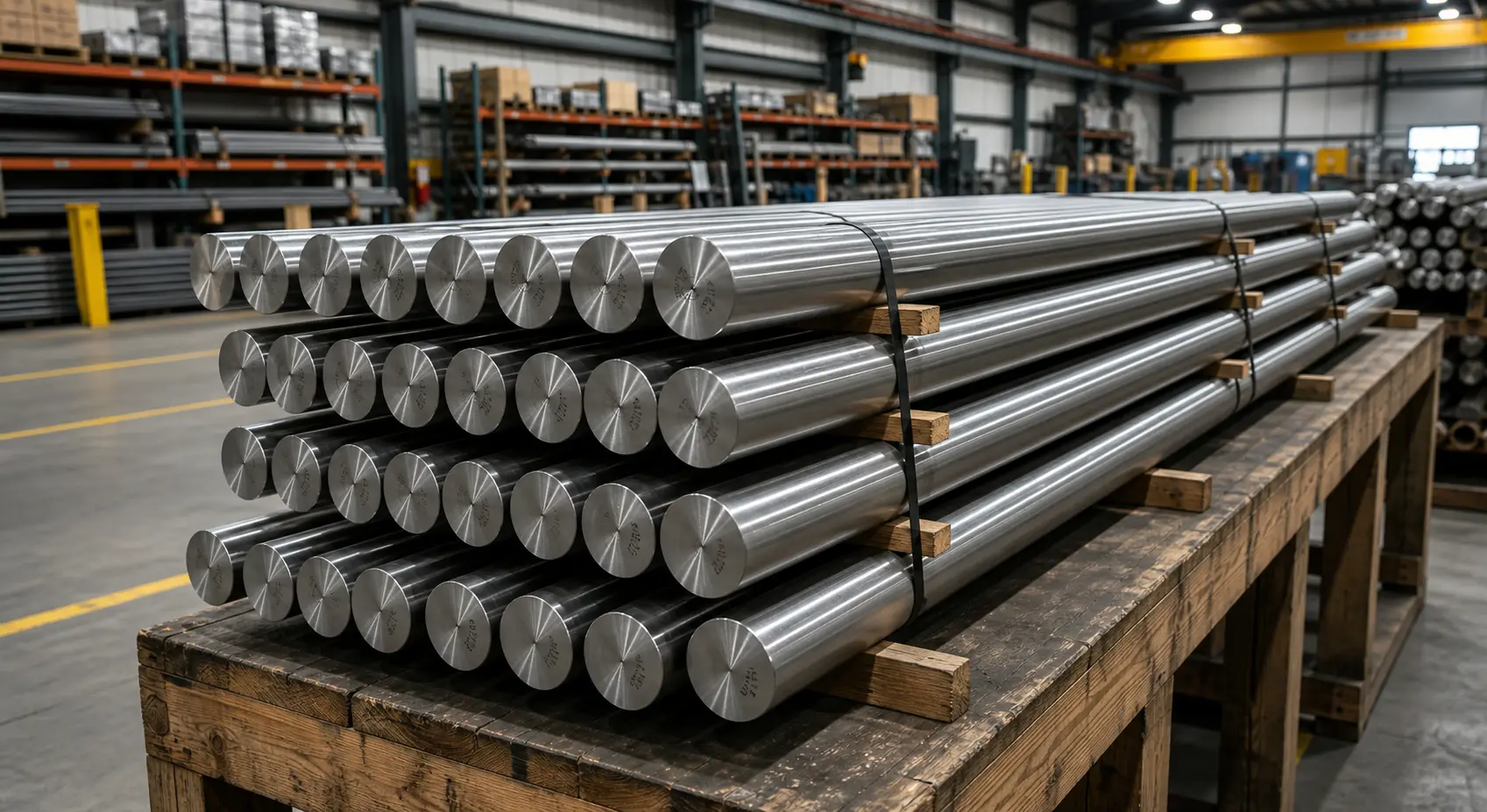
Stainless steel 304 round bars serve as the primary workhorse across the global manufacturing, fabrication, and industrial engineering sectors. While it is the most frequently specified austenitic grade, sourcing from an established supplier like Steel House India ensures you select the correct dimensional tolerances, surface finishes, and verified structural compliance critical to avoiding component failure and ensuring long-term operational efficiency.
This comprehensive technical guide provides procurement officers, industrial engineers, and supply chain managers with the foundational material data required for precise sourcing, tax compliance, and engineering design.
What is an SS 304 Round Bar?
An ss 304 round bar is a solid cylindrical metal rod manufactured from an austenitic alloy predominantly composed of 18 percent chromium and 8 percent nickel. This specific chemical composition creates a natural, self-healing chromium oxide film on the surface, which provides exceptional resistance to atmospheric oxidation and mild corrosive environments.
If you are sourcing materials for critical manufacturing projects, reviewing a verified stock catalog from Steel House India for an ASTM A276 AISI 304 Stainless Steel Round Bar ensures your inventory meets strict global engineering tolerances. In industrial settings, these bars are highly favored because they offer an optimal balance of high ductility, excellent fabricability, and superior weldability. Whether machined into intricate internal valve components or utilized as heavy structural supports, this material delivers predictable performance under diverse environmental stresses.
ASTM A276 Grade 304 Data Sheet: Composition, Strength, and Global Standards
To ensure structural integrity and machining efficiency during manufacturing, it is essential to understand the precise metallurgical boundaries of an ASTM A276 AISI 304 stainless steel round bar. Below are the definitive material data sheets compiled from global manufacturing standards.
Chemical Composition of ASTM A479 GR 304 Bright Bar
The chemical profile of standard 304 material compared to its low-carbon variant contains specific elemental limits to ensure corrosion resistance and weldability:
| Grade | Carbon | Manganese | Silicon | Phosphorous | Sulfur | Chromium | Molybdenum | Nickel |
| SS 304 | 0.08 max | 2 max | 0.75 max | 0.040 max | 0.030 max | 18 – 20 | – | 8 – 11 |
| SS 304L | 0.03 max | 2 max | 0.75 max | 0.045 max | 0.030 max | 18 – 20 | – | 8 – 12 |
Mechanical Properties of 304 Stainless Steel Bars
The mechanical properties dictate how a 304 stainless steel round bar performs under high-stress loads, extreme temperatures, and cold working setups. According to standard engineering benchmarks, the material adheres to the following parameters:
- Density: 8.0 g/cm3
- Yield Strength: Psi – 30000, MPa – 205
- Melting Point: 1400 °C or (2550 °F)
- Tensile Strength: MPa – 515, Psi – 75000
- Elongation: 35 %
International Equivalent Designations for AISI 304 Round Bars
Because industrial projects rely on supply chains crossing different continental borders, specifying cross-reference standards helps procurement teams match structural designs with regional mill availabilities. When sourcing an Astm A276 Type 304 stainless steel round bar, refer to the following official cross-reference table for matching equivalent international designations:
| Standard | Werkstoff Nr. | UNS | JIS | BS | GOST | AFNOR | EN |
| SS 304 | 1.4301 | S30400 | SUS 304 | 304S31 | 08X18H10 | Z7CN18-09 | X5CrNi18-10 |
Commercial Logistics & SS 304 Round Bar HSN Code
What is an HSN Code and Why Does It Matter?
The HSN code (Harmonized System of Nomenclature) is an internationally standardized, 6-to-8-digit numerical classification system developed by the World Customs Organization (WCO). It serves as a universal language for global trade, allowing customs authorities, tax departments, and freight forwarders across more than 200 countries to instantly identify the exact type, material, and manufacturing process of a product without any linguistic confusion.
For B2B buyers, entering the correct ss 304 round bar hsn code on shipping manifests and tax invoices is non-negotiable. It dictates your customs duty rates, determines local taxation (like GST), and ensures your industrial shipment moves through ports without being flagged for misclassification.
The 8-Digit HSN Code Classification for Grade 304
Under global trade tariffs, all stainless steel round bars fall under Chapter 72 (Iron and Steel) and Heading 7222. Because Grade 304 is an Austenitic alloy (typically containing 18% Chromium and 8% Nickel), it is specifically classified under the Nickel-Chromium Austenitic Type sub-headers.
To ensure your documentation passes automated audits, you must match the code to the precise manufacturing finish of your ss 304 round bars:
| HSN Code | Manufacturing Condition / Processing Type | Applicable Tax Rate (GST) |
| 7222 11 12 | Hot-Rolled, Hot-Drawn, or Extruded (Circular Cross Section) — Bright Bars | 18% |
| 7222 11 92 | Hot-Rolled, Hot-Drawn, or Extruded (Circular Cross Section) — Other Finishes | 18% |
| 7222 20 12 | Cold-Formed or Cold-Finished (e.g., Cold-Drawn) — Bright Bars | 18% |
| 7222 20 92 | Cold-Formed or Cold-Finished — Other Finishes | 18% |
| 7222 30 99 | Other Bars & Rods (Further worked / Forged / Formed by other means) | 18% |
Shipping and Audit Compliance
While the unified GST rate for products under HSN Code 7222 is fixed at 18%, misdeclaring a cold-drawn bright bar under a hot-rolled tariff line can flag your shipment during automated customs audits. Always ensure your Material Test Certificate (MTC) matching the fabrication type aligns perfectly with the 8-digit code on your commercial invoice.
The Surface Finish Selector for SS 304 Round Bars
Selecting the appropriate surface finish for an ASTM A276 AISI 304 stainless steel round bar is critical because it dictates dimensional tolerances, machining ease, and final aesthetic appearance. Different industrial manufacturing processes require specific processing conditions.
Mill Finish Options and Machining Application Selector
| Finish Code | Process Description | Primary Usage / Application Benefit |
| CD | Cold drawn | Increases tensile strength and provides excellent dimensional accuracy for linear machining. |
| CG | Centreless ground | Delivers precise diameter tolerances and high straightness, ideal for high-speed CNC Swiss machines. |
| BD | Bright drawn | Provides a smooth, scale-free shiny surface that minimizes initial polishing steps for visible parts. |
| P and T | Peeled and turned | Removes surface defects and decarb layers from hot rolled stock, preparing it for forging. |
| HRAP | Hot rolled annealed and pickled | Offers excellent ductility and corrosion resistance for heavy welding and structural fabrications. |
| PR | Peeled and reeled | Combines superficial defect removal with mechanical straightening for rotary shaft applications. |
Common Industrial Applications of 304 Stainless Steel Round Bars
Due to its optimal balance of structural strength, weldability, and resistance to atmospheric oxidation, the ss 304 round bar serves as a fundamental raw material across diverse global sectors.
Critical Components Fabricated from SS 304 Bars
- Chemical Processing: Used extensively for manufacturing mixing tanks, valve components, and specialized piping manifolds where resistance to corrosive organic acids is mandatory.
- Food and Beverage Production: Selected for food handling machinery, conveyor systems, and bottling units because the clean chromium oxide film prevents bacterial contamination and withstands aggressive sanitation chemicals.
- Industrial Valve and Pump Manufacturing: Utilized for precision machined pump shafts, fasteners, and internal valve trims due to predictable mechanical properties and excellent tensile strength.
- Architectural and Structural Engineering: Integrated into structural bracing, outdoor frameworks, and ornamental metal installations exposed to ambient atmospheric conditions.
- Automotive and Aerospace Fabrication: Formed into structural supports, custom exhaust couplings, and heavy-duty brackets requiring reliable performance across wider temperature bands.
- Pharmaceutical Equipment Manufacturing: Utilized in the production of cleanroom furniture, processing vessels, and storage tanks due to its non-reactive properties and ability to endure rigorous chemical sterilization cycles.
- Marine Infrastructure and Fasteners: Extensively applied in freshwater environments and sheltered marine installations for crafting propeller shafts, marine hardware, and high-strength corrosion-resistant bolts.
- Heat Exchangers and Pressure Vessels: Formed into critical structural components, tie rods, and flanges within industrial heat transfer systems handling non-highly-corrosive media.
ASTM A276 AISI 304 vs SS 316 Stainless Steel Round Bars: Key Differences
Now that we know the core specifications of the standard material, let us get into the stainless steel 304 and 316 difference. Though they look virtually identical, their chemical composition and performance in different environments set them apart.
Evaluating these deviations is essential before finalizing your bulk procurement order. Reviewing the premium stock collection at Steel House India for a 304 Stainless Steel Round Bar can help you determine the most cost-effective path for your project.
Comparative Metallurgy Data: AISI 304 vs AISI 316 Matrix
| Performance Metric | Grade 304 Stainless Steel | Grade 316 Stainless Steel |
| Core Chemical Definer | 18% Chromium, 8% Nickel baseline allocation. | 16% Chromium, 10% Nickel, plus 2-3% Molybdenum. |
| Marine and Chloride Setting | Vulnerable to localized surface pitting and crevice corrosion over time. | Highly resistant to pitting and general rusting in heavy saltwater environments. |
| High Temperature Strain | Offers reliable tensile strength across standard industrial temperature windows. | Delivers superior creep resistance under high stress at elevated temperatures. |
| Raw Material Valuation | Most economical and readily available baseline grade for commercial fabrication. | Carries a pricing premium due to the addition of valuable molybdenum alloying elements. |
Detailed Property Analysis
Corrosion Resistance
When comparing SS 304 vs SS 316, corrosion resistance is a key factor. 304 stainless steel holds up well against most oxidizing acids and can withstand everyday exposure to moisture and air. However, in environments with chlorides or salt exposure, like coastal areas, 304 steel can start to pit and corrode over time.
Conversely, upgrading to a certified 316 stainless steel round bar shines in these situations. Thanks to the integrated molybdenum content, 316 stainless steel is highly resistant to pitting, crevice corrosion, and general rusting in saltwater or chemical environments. This is why ASTM A276 AISI 316 stainless steel products like SS bright bars are the standard choice for marine equipment and chemical processing.
Strength, Durability, and Cost
Both 304 and 316 stainless steel are strong and durable, but there are slight differences in their mechanical properties. 304 stainless steel properties include excellent tensile strength and resistance to wear. For demanding high-stress setups, 316 stainless steel offers slightly better creep resistance, which is the specific ability to withstand high mechanical stress over extended periods of time.
When considering cost, SS 304 is cheaper due to its simpler composition and widespread global use. If your application environment does not require the added corrosion resistance of molybdenum, a certified ASTM A276 AISI 304 stainless steel round bar from Steel House India provides excellent value for money. While 316 stainless steel comes at a premium, the extra upfront cost pays off in structural longevity and reduced maintenance downtime in harsh environments.
Frequently Asked Questions
What is the difference between an SS 304 round bar and an SS 304L round bar?
The main differentiator lies in the maximum carbon limit. Standard 304 allows up to 0.08 percent carbon, whereas 304L limits carbon to a maximum of 0.03 percent. The lower carbon profile in 304L prevents carbide precipitation during heavy welding operations, which protects the welded joints from intergranular corrosion.
How does cold drawing alter the mechanical properties of a 304 stainless steel round bar?
Cold drawing pulls the metal bar through a hardening die at room temperature. This cold working process significantly raises the yield strength and tensile strength of the material while reducing its elongation percentage, resulting in a much harder bar with a polished surface finish and superior straightness.
Why is a 316 grade chosen over 304 for submerged marine components?
While standard 304 provides adequate protection against atmospheric salt spray above the waterline, it faces severe localized crevice corrosion and pitting when continuously submerged in seawater. The 316 alternative contains an essential addition of 2% to 3% molybdenum, which radically upgrades the pitting resistance of the metal, making it mandatory for underwater infrastructure.
What is the maximum safe operating temperature window for a 304 stainless steel round bar?
The alloy demonstrates excellent oxidation resistance during intermittent thermal exposure up to 870 °C and continuous service up to 760 °C. Continuous exposure within the 425 °C to 860 °C range is not recommended for wet corrosive environments, as it causes carbide precipitation which increases vulnerability to intergranular cracking.