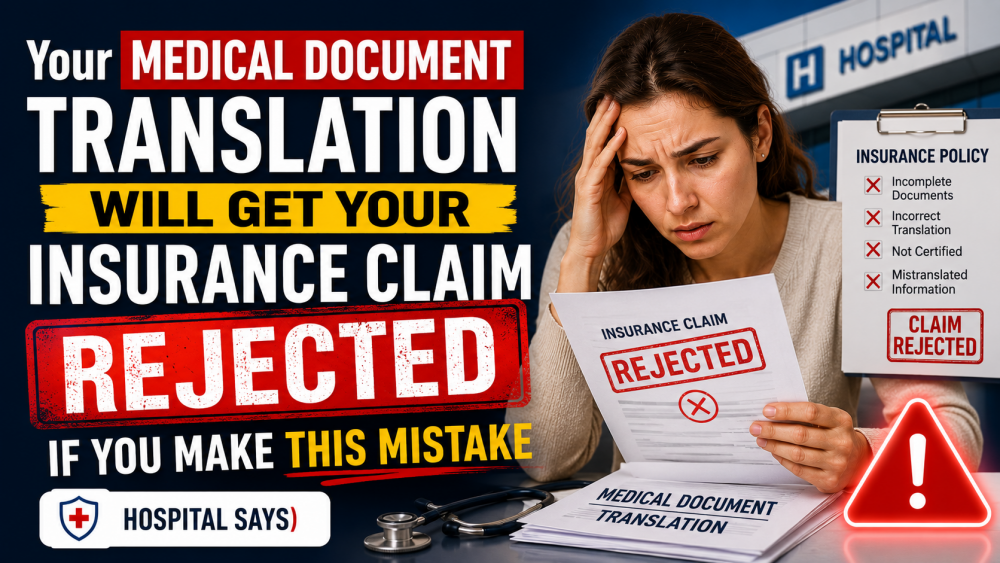
Most people assume an insurance claim is approved or rejected based on medical facts.
The diagnosis. The treatment. The hospital bills.
But after years of seeing international patients move between countries, hospitals, and insurance providers, one frustrating reality keeps showing up: claims are sometimes delayed, challenged, or rejected because of translation mistakes that had nothing to do with the patient’s actual medical condition.
It sounds unfair. In many cases, it is.
Yet hospitals and insurance providers rely heavily on paperwork. If a translated medical document creates confusion, leaves out information, or changes the meaning of a diagnosis even slightly, it can raise questions that insurers are unwilling to overlook.
And one particular mistake causes more problems than most people realise.
The Mistake? Treating Medical Translation Like Ordinary Translation
I’ve seen people spend thousands on treatment abroad and then try to save money by using a general translator, a friend who speaks both languages, or an online translation tool.
On the surface, the translation looks fine.
Names are translated. Dates appear correct. Medical terms seem close enough.
The problem is that insurance assessors don’t review documents casually. They compare translated records against policy requirements, treatment timelines, discharge summaries, prescriptions, specialist reports, and billing information.
A small wording difference can completely change how a claim is interpreted.
What was originally described as an emergency treatment may suddenly appear to be an elective procedure.
- A chronic condition may appear as a newly diagnosed illness.
- A follow-up consultation may look like a separate treatment episode.
That is where problems begin.
Why Hospitals Frequently Warn Patients About Translation Accuracy
Hospitals that regularly deal with international patients understand how sensitive medical records are.
Doctors use precise language for a reason.
Medical reports are not written like everyday conversations. They contain terminology, abbreviations, treatment codes, observations, and clinical conclusions that often carry legal and financial importance.
When those details are translated incorrectly, the issue extends beyond language.
Now it becomes a documentation problem.
And insurance companies are known for examining documentation carefully when significant claim amounts are involved.
If there is uncertainty, they may request additional evidence. Sometimes they ask for fresh translations. Occasionally they reject supporting documents altogether until corrected versions are provided.
That can mean weeks or even months of delay.
The Hidden Risk Most Claimants Never Notice
Interestingly, the biggest problem is not usually a dramatic translation error.
- It’s omission.
- A missing sentence.
- An incomplete discharge note.
- A forgotten laboratory result.
- A skipped physician comment.
Many people never compare the translated version against the original document line by line. They assume everything has been transferred accurately.
Then an insurer notices that information referenced in one report is missing from another translated record.
Immediately, questions arise.
Was the treatment necessary?
Was the diagnosis confirmed?
Did the patient have a pre-existing condition?
Was the procedure recommended by a specialist?
Those questions can trigger additional reviews that slow everything down.
Medical Terminology Is Not the Place for Guesswork
Medical language can be surprisingly unforgiving.
Two words that seem similar to a non-specialist may have very different clinical meanings.
Even experienced bilingual speakers can struggle with specialised healthcare terminology if they do not regularly work with medical documents.
I remember speaking with a translator years ago who admitted that legal and medical translations were the two areas he would never attempt without specialist knowledge. His reasoning was simple: the consequences of getting it wrong were too serious.
That stuck with me.
- A minor mistake in a travel blog might go unnoticed.
- A minor mistake in a medical insurance claim can become expensive.
Why Certified and Professional Translation Matters
Insurance providers are not simply looking for readable documents.
They want confidence that the translation accurately reflects the original records.
That is why professional Medical document translation services exist.
Specialist translators understand medical terminology, formatting requirements, consistency checks, and document verification processes that ordinary translators may not be familiar with.
- The goal is not just translation.
- The goal is preserving meaning.
Every diagnosis, treatment note, physician observation, prescription detail, and hospital recommendation must remain consistent with the original record.
When accuracy is protected, insurers have fewer reasons to question the supporting documentation.
Choosing the Right Translation Provider
Not all translation providers offer the same level of expertise.
Medical records require careful handling, confidentiality, and subject-specific knowledge.
A provider experienced in healthcare documentation understands that a translated medical report may eventually be reviewed by insurance companies, hospitals, legal professionals, immigration authorities, or government departments.
This is why many individuals turn to established providers such as Notarised Translations UK when accuracy and document acceptance are important.
The focus should never be on obtaining the cheapest translation available.
It should be on obtaining a translation that stands up to scrutiny when someone reviews every detail.
Because that is exactly what insurance assessors often do.
Final Thoughts
Most insurance claim problems begin long before the insurer makes a decision.
They begin when supporting documents are prepared incorrectly.
Medical records are often the foundation of an insurance claim. If the translation introduces confusion, omits critical information, or changes medical meaning, even unintentionally, the consequences can be significant.
Before submitting any translated hospital report, discharge summary, prescription, diagnostic record, or treatment document, take the time to ensure the translation is complete, accurate, and professionally prepared.
It may seem like a small step.
But compared with the frustration of a delayed or rejected claim, it’s one of the most important steps you’ll take.