Selecting a web platform can be one of the most impactful technical decisions that an organization faces. If it is done right, the platform can be used for years and grows with the business.
Do it wrong and it comes at a cost over time: performance restrictions that gradually come to light as the site expands; customization restrictions that lead to code hacks; security holes that necessitate constant patches; and eventually, a painful migration that might otherwise have been avoided due to a single wrong choice.
The consistent platform opportunists all have this habit of looking at a platform based on where a business is going, not where they are now. Under those criteria, Drupal’s given a good look.
It does not come in easy to use, and it doesn’t try to. For organisations with the need to run a website that can support true complexity, from a startup with a hugely ambitious digital product to an enterprise with the need to operate a content-driven website on a global scale, Drupal’s architecture can offer a level of capabilities that are unmatched by simpler platforms.
The Architecture Designed for Complexity
Most content management systems are created around a particular concept of what a website should be. They work towards that vision and they deal with deviations from that vision in an extension and workarounds manner. In contrast, Drupal has another strategy.
It exists as a structure for content driven web applications and is designed from the ground up to deal with complexity not to be an after thought.
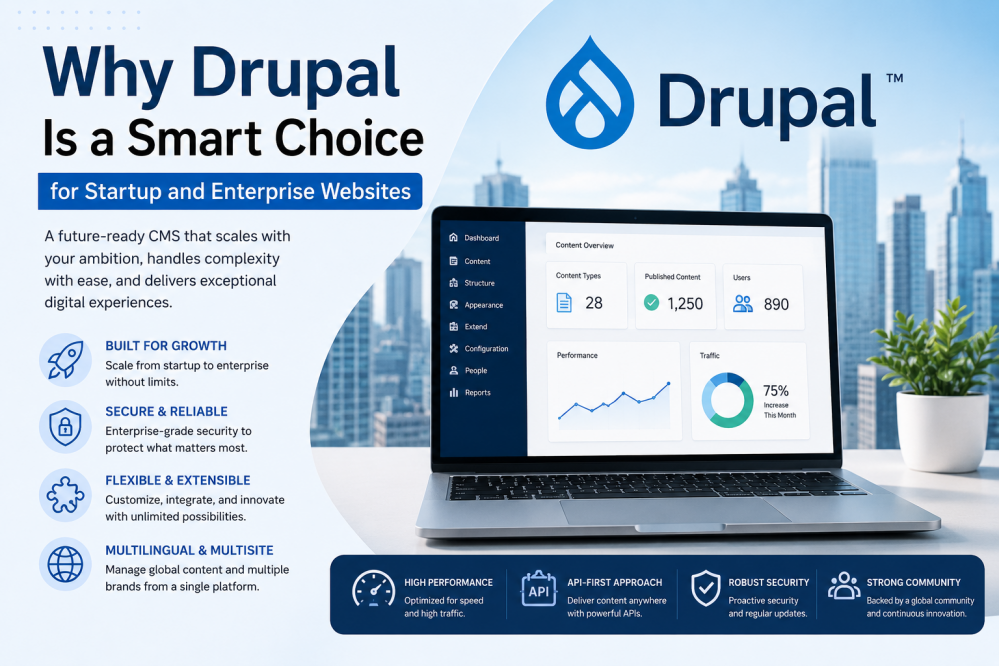
In practice, this difference does not count. A Drupal site can handle thousands of distinct content types, with a different structure, workflow, and publishing rules for each content type. Its API-first approach allows it to serve content to Web, mobile and third-party apps, all at once.
It can be used to manage complex permission sets and have a granular permission to create, edit, publish or archive content at every level of the organization. And all that at scale, with lots of traffic, without the performance degradation that accompanies simpler platforms when they are stressed.
This kind of architectural base is extremely valuable in a start-up developing a platform that must be able to adapt and grow quickly. For a company with multiple brands, regions and channels, it might be the only choice that works with the enterprise’s needs.
Why Startups Should Take Drupal Seriously
In the startup world, the old school attitude towards Drupal is geared downward. The general impression is that Drupal is complicated, resource intensive and more appropriate for large organisations with full time development teams.
It’s true that once you set up a Drupal site, you do have to invest more money in getting it right than does a hosted website builder. However, this false impression is not entirely accurate about the type of web platform that startups require.
New companies will often find themselves limited by a platform prematurely because they select based on speed of initial launch. A structure of content that was thought to be sufficient at the time of launch, becomes a bottle neck when the business model changes.
The solution that worked for a basic marketing site isn’t going to suffice for the product features the company wants to add to the site 18 months later. A site with 10,000 users a month begins to strain at 100,000.
Drupal doesn’t have these limitations! A Drupal based start up with a proper architecture right from the beginning will have a platform for the business that will grow with the business and does not need to be rebuilt every time the business needs something. The content model may be extended. As new frontends and integrations are required, the API layer can be used. The permission system can be expanded to accommodate an increasing number of team members and roles.
The initial investment necessary to get Drupal right is real. However, it is usually not as expensive as rebuilding on a more powerful platform two or three years later, a route that most startups taken on less powerful platforms follow.
Why Enterprises Choose Drupal Over and Over Again
In larger organizations, the Drupal option ultimately can be narrowed down to a number of consistent considerations that simpler platforms are not able to compete with at enterprise level.
Multisite and Multilingual at Scale
For companies with multiple brands, regions, or product lines, a platform that can natively manage this complexity is essential. Drupal’s multisite architecture enables a single Drupal installation to host multiple sites, each with its own design, content and configuration, all controlled from a single administration site.
The ease of running many CMS applications from a single place under the umbrella of Drupal has been a huge benefit to organizations that have historically run dozens of separate installations.
Drupal’s multilingual features are also extensive. Drupal’s core provides built-in support for content translation, language-specific URL structures, locale-aware media handling, and right-to-left language support without relying on third-party modules. This native depth is a huge operational advantage for companies that have to create content in several languages and regions.
Workflow and Governance for Large Teams
A lot of platforms weren’t built for enterprise content operations, which consist of several teams, approval processes, and governance needs. Organizations can control the flow of content from creation to review, approval to publication, with role-based access and audit trails for every step of the way in Drupal’s workflow and moderation systems.
This is not just because its a convenience feature. In regulated industries where content governance is a necessity for compliance, and in large organizations where publishing errors can mean reputational damage, having the authority to set up structured editorial processes in the CMS itself is a true risk management tool.
Security That Matches Enterprise Requirements
Drupal’s security module is one of its most touted corporate benefits and one that is built into the system and not just into the marketing. The Drupal Security Team has a rigorous and systematic process for discovering and fixing security issues, and its history and transparency is hard to beat in the CMS industry.
In industries such as government, healthcare, financial services, and education, where security concerns are critical and the impacts of a security incident are significant, the security of Drupal can make all the difference. It isn’t surprising that a large number of government sites around the world, including many international and national sites, are built on Drupal.
The Decoupled Drupal Advantage
The most important change in the evolution of Drupal is the evolution of a headless and decoupled architecture. Drupal has made a significant development in JSON:API and GraphQL support, which makes it one of the most powerful content backends to choose from for organizations that want to uncouple content management from content delivery.
The decision between a decoupled approach and an integrated one depends on the specific needs of your website.The choice between decoupled and integrated solutions depends on your website’s requirements. This enables organizations to have the power of Drupal for editing while combining the front-end flexibility and performance of popular JavaScript frameworks.
This architecture is the best of both worlds for startups creating complex user interfaces with content-based applications. Decoupled Drupal is the most technically appropriate solution when companies would like to share content via the web, mobile apps, digital signs and third-party platforms from one content hub.
The Module Ecosystem and Community Behind It
Drupal has one of the busiest open source communities in the field of web development. Thousands of contributed modules are available, and are maintained by a global community of developers and organizations, to extend the core functionality of Drupal. Search API, Commerce, Paragraphs, Webform, Pathauto, and hundreds of other modules cover various functional needs and have a depth of functionality and a level of maintenance that stems from years of real-world use.
This is an ecosystem where many functional requirements that a startup or enterprise website may need can be met without having to begin from scratch in Drupal. The development investment is spent on customizing, integrating and configuring proven functionality instead of re-developing everything.
The community also ensures that Drupal is constantly improving. Security patches are issued in a timely manner. New capabilities are added according to the actual needs of practitioners. Finally, the knowledge base surrounding Drupal – the documentation, the communities, and published case studies, is so rich that any complex issues can be addressed without a long research cycle by any Drupal expert.
Where Professional Drupal Development Services Matter
Drupal’s capabilities and flexibility also requires a level of expertise when it comes to implementation. A Drupal site that has not been designed with content architecture, an appropriate module selection, and performance optimization from the start will result in a Drupal site that will lose its performance over time and become a maintenance nightmare.
That’s where professional Drupal development services come in handy. A successful Drupal developer has a standard way of thinking when he starts a project: he takes the time to understand the content model before he starts coding, and buys only the modules he knows he needs for the actual functional requirements of the project, rather than for the features he wants to find in them, he creates a deployment and maintenance process that will keep the site secure and current throughout its lifetime, and he produces code that is readable and maintainable to anyone who inherits the project.
When it comes to Drupal development services, startups can expect to receive a platform that facilitates growth rather than one that must be rebuilt to accommodate growth. For the enterprise, it is a way to maximize the value of Drupal’s features in an implementation that is not just a “one size fits all” solution, but one that’s more closely aligned to the enterprise’s operational needs.
It’s not always obvious at a glance, but the difference between a Drupal site constructed by a team of experienced experts and one not constructed by them is an obvious one. It is evident over the course of the site, in the responsibilities to maintain it, in how the site functions in real traffic, in how new features can be added to the site and in how the site can meet security requirements over time.
Final Thoughts
Not all organizations will be suited to Drupal. Some small personal blog or brochure sites don’t require the architectural depth of Drupal.
Drupal is a truly hard-to-beat mix of flexibility, security, scalability and community support to complement that for startups developing digital products that desire more than just a web presence, and for enterprises running content operations on any practical level.
The ones that opt for Drupal and do it right, discover that it will please them for many different cycles of business change. The platform expands as the organization expands and doesn’t limit what it can do.
Which platform has the right foundation, not the fastest launch time, that’s the key to a platform decision, and three, five, and ten years down the road it will still be the correct foundation.
For many startups and businesses who really do consider that question, it is Drupal