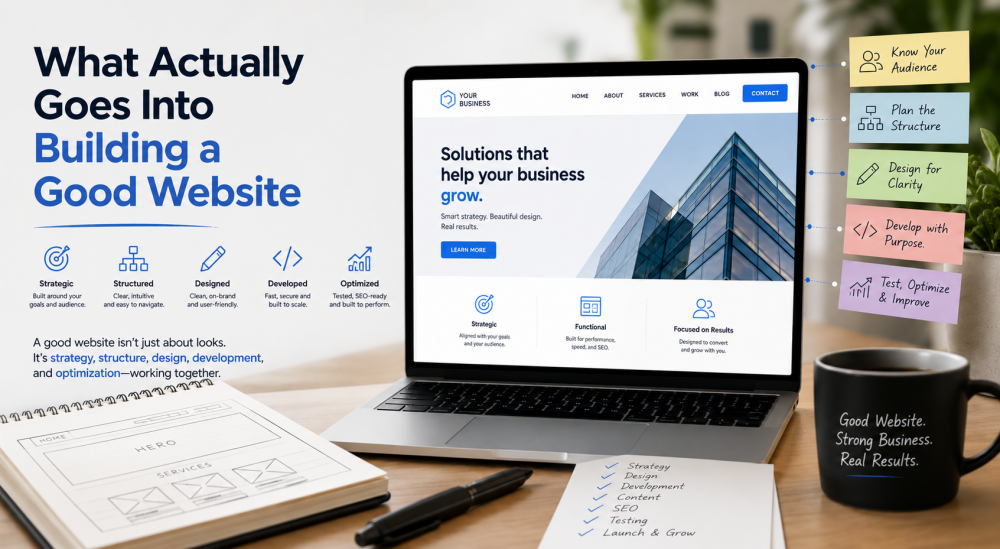
Honestly, most business owners figure this out the hard way. You spend money on a website, it looks fine when it goes live, and then a year later, it’s sitting there doing nothing. Not ranking. Not converting. Just existing. And the frustrating part is that it rarely comes down to how it looks. The real problem usually traces back to decisions that got made, or skipped, before anyone opened a design tool.
So this is a breakdown of what web development actually involves, how to think about what your business needs, and what separates a build that holds up from one that needs replacing in 18 months.
Start With the Business Problem, Not the Website
Here is something most people skip. Before you talk to anyone about a website, write down what the site actually needs to do. Not “look professional.” Specifically, what should happen when someone lands on it.
A consultancy wants people to book discovery calls. A wholesale supplier might need its site to connect with inventory systems and let trade clients log in. A growing SaaS product needs onboarding flows, gated content, and billing integration. These are not the same problem, and they should not get the same solution.
When you approach a website development service already knowing what outcomes matter, the whole conversation changes. You stop comparing quotes based on page count and start evaluating whether a team can actually solve the right problem.
What a Professional Web Development Company Brings to the Table
There is a version of “hiring someone to build your website” that means a freelancer on a fixed price who disappears after delivery. Then there is working with an actual website development company, which is a different thing entirely.
A proper team has structure. Developers who write code. Someone managing the project so nothing falls through. A process for testing before anything goes live. When something breaks after launch, there is a person to call. That sounds basic, but a lot of businesses learn its value only after working with someone who did not offer it.
A website development firm with defined roles also just produces more consistent work. Nobody is stretched across every job at once. The person building your checkout flow is not also designing your homepage and answering your emails.
When a Template Is Enough and When It Is Not
Templates work fine for a lot of situations. If you need a clean site with service pages, a contact form, maybe a blog, a well-configured CMS does that job without drama. The best website development company for that scope is one that executes it efficiently, not one that convinces you to spend more than you need to.
Where things shift is when your business has requirements a template was never designed to handle. Multiple user roles. A pricing engine with conditional logic. Connections to internal tools your team already relies on. Workflows that are specific to how your business actually runs.
At that point, custom website development is not about preference. It is about whether the site can do what you need it to do. Forcing a complex business process into a plugin that was built for something else tends to create technical debt that compounds over time.
What Custom Web Development Services Actually Cover
Custom web development services mean writing code that is specific to your project. Not selecting from existing options. Not configuring something pre-built. Actually building the functionality.
A good custom web development company will spend real time in discovery before writing anything. They want to understand your data structure, how your users move through the product, and what the site needs to connect to. The builds that go wrong almost always skip this part. Developers start coding before anyone fully understands the requirements, and then the project doubles in length, trying to fix decisions that should have been made in week one.
Custom work costs more upfront. That is just true. But the alternative, rebuilding a template-based site two years later because it cannot scale, usually costs more in the end and causes more disruption getting there.
Evaluating a Custom Website Development Agency
The word “custom” gets used loosely. Some agencies mean it. Others mean they picked a specific set of plugins for your project. Both might be fine depending on what you need, but if your project requires actual custom functionality, you need to find out early which kind of team you are talking to.
Bring a real technical requirement into the first conversation. Something you know cannot be solved off the shelf. A custom website development agency that actually builds things will ask follow-up questions. They will want to understand edge cases, data handling, how it connects to other parts of the system. A team without that depth will either avoid the question or point you toward something that does “roughly” the same thing.
Also look at who is actually on the team. A custom website development company doing real backend work has developers who own and write code. If everyone’s title is “digital specialist” or “website builder,” that tells you something.
A Straightforward Comparison
| Standard Build | Custom Build | |
| Best suited for | Business pages, informational sites | Platforms, portals, complex integrations |
| Build time | Weeks | Months |
| Flexibility | Platform constraints apply | Built to your exact requirements |
| Upfront cost | Lower | Higher |
| Long-term fit | Can become limiting | Scales with the business |
Neither is the right answer for everyone. It comes down to what the site actually needs to do.
Before You Sign Anything
A few things worth getting clarity on before committing to any provider:
Who is doing the work, not just who is selling it to you. What the revision process looks like and how changes are handled. What you actually receive at the end, code access, documentation, admin credentials. What support looks like after launch and what it costs. Whether they can put you in touch with a past client on a similar scope.
These apply whether you are hiring for a straightforward website development service or a more involved custom website development service. Any team that is worth working with will answer these without hesitation.
The Decision Comes Down to Fit
There is no version of this where one type of provider is right for every business. A company that needs a fast, clean marketing site and a company building a client-facing platform need different things from a development partner.
The most useful thing you can do before starting the search is get specific about what you actually need. Not in design terms. In functional terms. What should the site do, who should it serve, and what does success look like six months after launch. Start there, and finding the right partner becomes a lot more straightforward.