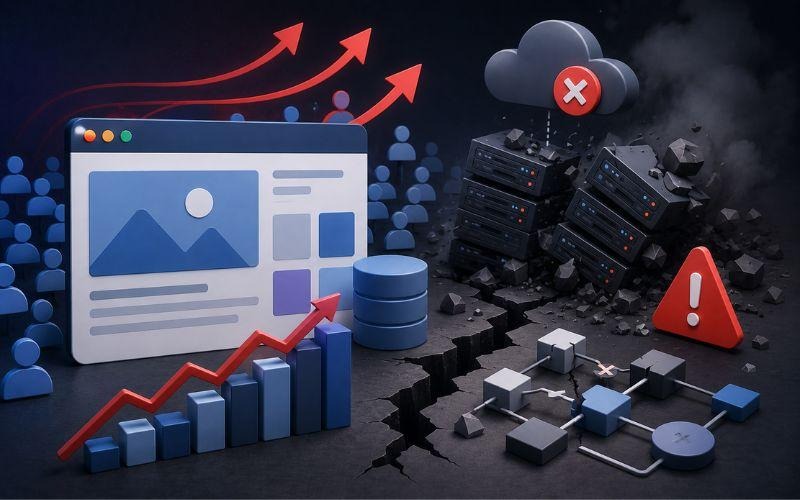
In today’s competitive digital ecosystem, launching a web application is often seen as a major achievement. Most business people soon, however, discover that success does not come with launching it comes with the capacity to manage growth effectively. Applications that were initially running well start to crack when the user traffic increases. User experience begins to be impacted with slow loading speeds, downtimes and lack of responsiveness. These are usually known as web application scalability issues and these can severely curtail the growth of the business unless dealt with at an early stage.
Scalability is not merely related to the ability to serve more users but being able to sustain the performance despite the demand. Most organizations are not effective in planning ahead and only concentrate on short term functionality. This lack of foresight leads to serious app scaling challenges, especially when systems are not designed to expand seamlessly. To develop strong, high performing applications capable of adapting to business requirements, it is important to know why these applications fail.
Lack of Scalable Architecture
One of the key reasons that have caused web application scalability issues is the lack of a scalable architecture. Most applications are initially developed on monolithic frameworks, with all elements closely-knit together. Although this method can be effective in the initial phases, it would be more challenging to expand with the rise of the user base.
The current applications have the advantage of microservices or modular architecture where every component can work on its own. This enables developers to scale only those parts of the system which require more resources. In the absence of this flexibility, business has serious difficulties in scaling of apps, which may lead to increased costs and less efficiency.
Inefficient Database Management
Databases are a core aspect of application performance, and ineffective database management is the primary cause of performance issues in web apps. The whole system can be slowed down by inefficient queries, a lack of indexing, and poor data structuring.
These inefficiencies get more pronounced with the increase in data volume. It can also be time-dependent as applications can take a long time to access information and it is also frustrating to the user. Query optimization, database sharding and caching are some of the techniques that may be employed to decrease the load and enhance speed. Early consideration of these factors will aid in avoiding repeat web application scalability issues.
Ignoring Performance Optimization
During development, performance optimization is not given enough attention, with teams dedicating more attention to features, rather than efficiency. Such a strategy may cause severe performance problems of web applications, such as delayed page loads and high latency.
Optimizing code, compressing assets, reducing unnecessary scripts, and improving server response times are essential steps in building scalable applications. Businesses that invest in optimization from the beginning are better equipped to handle growth. Leveraging professional solutions like Performance Optimization Service ensures that applications are designed for scalability and long-term performance.
Inadequate Load Testing
Most web applications do not work due to lack of testing on real life conditions. Load tests are used to replicate the situation of high traffic and demonstrate the behavior of the system under the pressure. In the absence of it, businesses are oblivious of the possible bottlenecks until users begin to complain.
The results of this unplanned crash and poor performances are some of the causes of significant scaling problems with apps. Frequent load testing enables developers to determine weaknesses and address them prior to affecting users and minimizes the chances of web application scalability problems once it is launched.
Absence of Effective Caching Strategies
Scalable systems have a vital element in caching. Applications can process the same request multiple times, causing server overload and response time, without adequate caching mechanisms. This directly contributes to performance problems in web applications.
Caching strategies that can be employed to improve performance greatly include browser caching, server-side caching and content delivery networks (CDNs). The methods lessen the burden on the servers and also enhance user experience to alleviate the scalability problem of web applications.
Technical Debt and Code Inefficiencies
Developers usually add quick fixes or shortcuts as applications continue to develop, in order to meet deadlines. In the long term, this leads to technical debt – code that was poorly designed, making it hard to maintain, and scale.
Technical debt poses long term scaling difficulties to the system as it makes the system more complex and less efficient. To have clean and scalable codebases, it is important to conduct regular code reviews, refactoring, and follow best practices. Removal of inefficiencies will aid in mitigating the problem of web application scalability and bring about a smoother growth.
Weak Infrastructure and Hosting Limitations
One of the major determinants of the scalability of an application is infrastructure. Most companies are using simple hosting packages which do not have the scalability that they would need to manage the rising traffic. Applications are unable to efficiently allocate resources without scalable infrastructure.
Modern applications require the use of cloud computing, auto-scaling, and load balancing. These technologies make systems dynamic to the demand of the users and minimize downtime and enhance reliability. In their absence, the businesses will be more prone to performance problems within web apps and persistent web application scalability issues.
Poor API and Third-Party Integration Management
Web apps have the tendency to require third party APIs. On the one hand, these integrations add functionality, on the other hand, it may cause latency and reliability problems when not addressed appropriately.
Slow response time, excessive API calls, dependency failures are some of the factors that can lead to app scaling. There are optimized API utilization, caching, asynchronous processing that can assist in improving the performance and alleviating the problem of web application scalability.
Lack of Monitoring and Real-Time Analytics
Scaling is a continuous process, which should be constantly monitored. The use of applications that do not have appropriate analytics tools does not provide a visibility of performance metrics, thus, it is hard to detect and fix the problems.
Monitoring tools will give information on the performance of the servers, user actions and health of the system. This information will be critical in avoiding performance problems in web applications and solving web application scalability issues before they get out of control. Active control guarantees the maintenance of uniform performance and improved decision making.
Security Constraints Impacting Performance
When talking about scalability, security is easily neglected, yet it is an important factor. Security measures which are not implemented properly may slow down applications and produce heavier workload on servers.
Indicatively, busy authentication procedures or high-encryption costs may affect response times. It is important to strike the balance between security and performance to prevent avoidable performance problems in web apps without compromising the level of data protection.
Conclusion:
Scaling a web application is a complex process that requires careful planning, continuous optimization, and the right technological approach. A lot of companies face scalability problems in their web applications due to the fact that they are in a hurry to start their business and not develop it to be scalable in the long run. These challenges can greatly affect the performance of the application and user satisfaction, based on architectural constraints, to a lack of good database management.
Fine Digital Marketing Agency supports the proactive scalability planning. Businesses can avoid app scaling challenges by tackling them early in the process and focusing on best practices to make sure their applications are efficient and reliable. The emphasis on optimization, infrastructure, and monitoring helps to remove performance issues in web apps and ensures sustainable growth.
Finally, scalability must be an integral aspect of all development strategies. When companies focus on it early, they are in a better standing to manage the pressure of growing demands, provide smooth user experiences, and have a competitive advantage in the digital marketplace.