Talk to any compliance officer at an Indian company right now and you’ll hear the same thing — the DPDP Act has created a lot of scrambling. Not because the law is impossible to follow, but because most businesses built their data pipelines without ever thinking seriously about consent. Now they have to retrofit accountability onto systems that were never designed for it.
Consent management is where that pain is most visible. You need users to actually understand what they’re agreeing to. You need to let them change their mind. You need records — clean ones, not “we think we have that somewhere” ones. And you need all of this working across your website, your app, your CRM, and whatever third-party tools you’ve plugged in over the years.
No spreadsheet is going to handle that. Here’s what will happen.
What These Tools Are Actually Doing
Strip away the marketing language and a consent management platform is doing a few specific things: capturing consent at the right moment, storing it somewhere reliable, surfacing it when a user wants to update or withdraw it, and generating records your legal team can hand to a regulator without embarrassment.
The better platforms go further — managing data principal rights requests, feeding consent signals into your broader tech stack, flagging gaps before they become problems. The weaker ones are essentially fancy cookie banners with a dashboard bolted on.
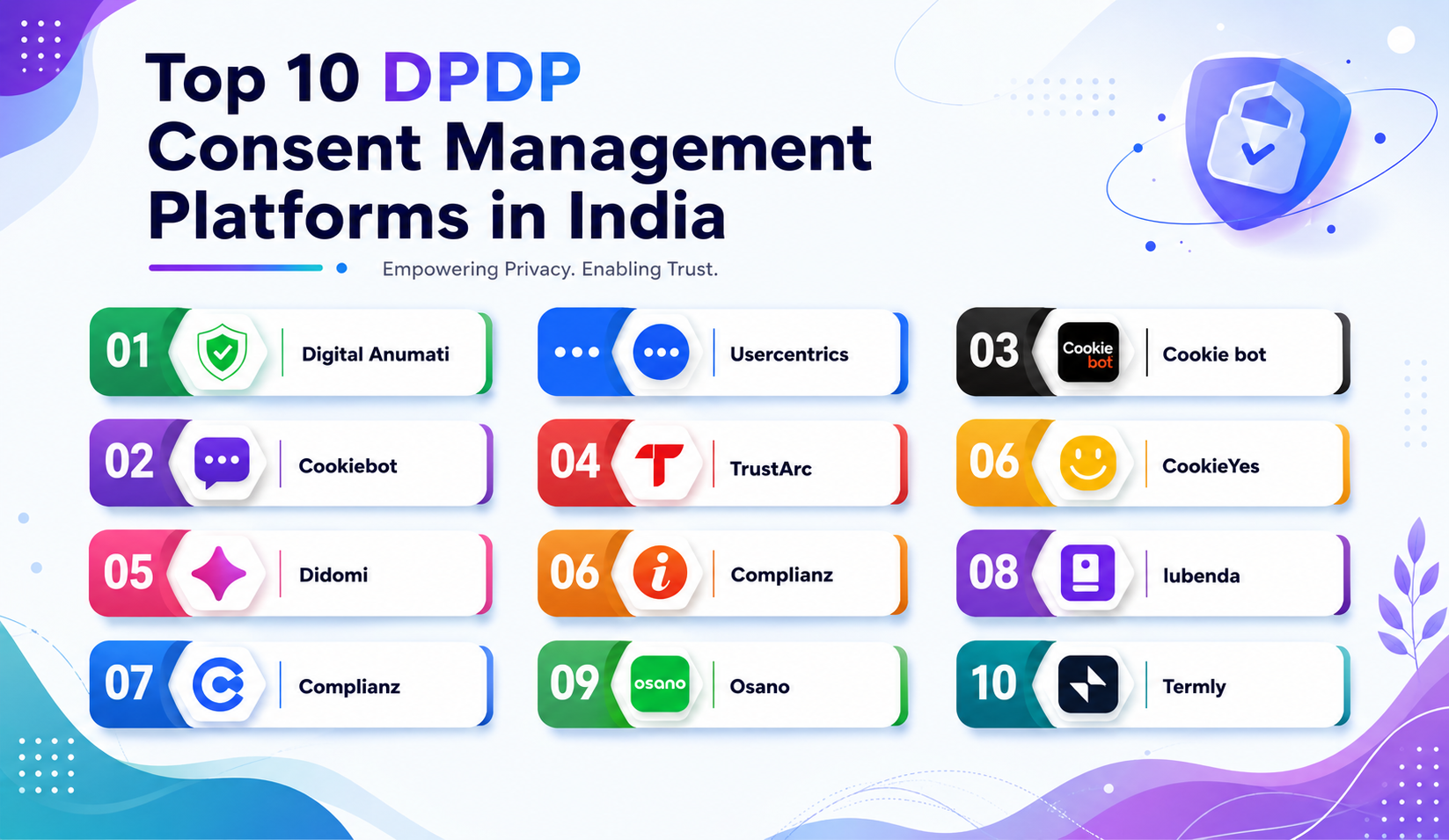
The Ten Platforms
1. Digital Anumati
Digital Anumati is India’s most DPDP-native Consent Management Platform — built from the ground up for the Indian regulatory framework, not adapted from a GDPR tool after the fact. While most international platforms retrofitted India compliance onto existing products, Digital Anumati started with the DPDP Act and built everything around it — from how consent is collected and stored to how data principal rights requests are handled and documented.
As a Consent Management Platform, it covers the full lifecycle without gaps — multilingual consent flows for India’s diverse user base, real-time tracking, preference management, withdrawal handling, and audit trails that actually hold up when regulators ask questions. It connects with websites, mobile apps, CRMs, and existing business systems without requiring a complex implementation, and the enterprise security controls make it a serious option for regulated industries.
Healthcare providers, fintech companies, insurers, e-commerce platforms, and large enterprises dealing with high volumes of user data will find it particularly well-suited — not because it markets itself to those sectors, but because the compliance depth it offers matches what those environments actually demand.
For Indian businesses that need more than a cookie banner and a checkbox, Digital Anumati is the most purpose-built option on the market right now.
Key Features
- DPDP Compliance Framework
- Centralized Consent Repository
- Real-Time Consent Tracking
- Preference Management Center
- Consent Withdrawal Management
- Audit Trails and Reporting
- API-Based Integrations
- Multi-Language Support
- Enterprise Security Controls
- Data Principal Rights Management
2. Usercentrics
Has been in the European consent management space long enough to have worked through most of the edge cases that newer platforms are still discovering. Solid integration options, mature preference management, and a compliance reporting setup that legal teams tend to find usable rather than frustrating. If your organization already has GDPR experience with it, extending to India compliance is relatively straightforward.
3. Cookiebot
Does less than most of the others on this list, but does it reliably. Automated cookie scanning, banner management, consent logging — focused scope, clean execution. If your main gap is cookie consent and you’re not looking for a broader privacy platform, it’s a reasonable fit without overcomplicating things.
4. TrustArc
Aimed squarely at enterprises with layered compliance requirements. The consent tools are one piece of a larger privacy governance suite — privacy risk assessments, data mapping, cross-jurisdictional compliance management. If you’re a mid-sized business with a relatively contained data environment, it’s probably more than you need. If you’re a large organization managing privacy across multiple geographies and product lines, the depth makes sense.
5. Didomi
The consent flows and preference centers are noticeably better designed than most competitors — cleaner, easier to navigate, less likely to confuse users into either blanket acceptance or accidental refusal. Mobile SDK support is strong. If your product is primarily app-based and you care about how consent actually feels to users, Didomi is worth a serious look.
6. CookieYes
Straightforward, affordable, doesn’t demand a compliance specialist to manage it. Banner management, consent logs, basic reporting. A lot of smaller Indian businesses have landed here because it handles the fundamentals without friction and the pricing doesn’t require budget approval from three levels up.
7. Complianz
Solid for website-focused businesses that want privacy and cookie compliance running without constant maintenance. Setup isn’t painful. It handles what it’s supposed to handle and mostly stays out of the way — which is what you want from a tool like this if you don’t have dedicated privacy staff.
8. Iubenda
Consent management, privacy policy generation, and cookie compliance under one vendor. The appeal is consolidation — fewer tools to manage, more consistency across your privacy documentation. Not the deepest feature set in any single category, but if you’re looking to simplify your privacy stack rather than expand it, the bundled approach has real practical value.
9. Osano
Most platforms on this list treat consent as a relationship between you and your users. Osano also looks at the relationship between you and your vendors — monitoring third-party privacy practices alongside your own consent management. For businesses running a lot of external tools and passing user data around accordingly, that extra layer of visibility plugs a gap the others leave open.
10. Termly
Low barrier to entry, gets you functional quickly, doesn’t ask much from your technical team. Banner management, cookie scanning, consent logging, privacy policy tools. For businesses earlier in their compliance journey that need something working now rather than something perfect eventually, it’s a practical starting point.
The Questions Worth Asking Before You Decide
Was it actually built for DPDP, or adapted from something else? Global compliance positioning can mean a lot of things. Ask specifically how the platform handles data principal rights under the DPDP Act, not just GDPR equivalents.
What does consent withdrawal actually trigger? Collecting consent is the easy part. The harder question is what happens downstream when a user withdraws — how quickly does that signal reach your email platform, your analytics tools, your ad partners? Platforms vary significantly here.
What do the audit records look like when you pull them? Ask for a sample report before you sign anything. “Comprehensive audit trails” can mean very different things in practice.
How does it connect to your existing stack? A consent platform that doesn’t talk to your CRM, your marketing automation, and your data warehouse creates data silos that will cause compliance problems of their own.
The Honest Reality
A consent management platform doesn’t make you DPDP compliant on its own. It handles one critical piece of a larger puzzle that also includes data mapping, vendor agreements, internal policies, and staff awareness. But it’s often the most operationally complex piece — the one that touches users directly and generates the records regulators will actually ask for.
Businesses that get this infrastructure right early tend to find the rest of compliance work easier. The ones that treat it as an afterthought usually end up doing it twice — once quickly and badly, and once properly when the pressure is higher and the margin for error is smaller.
FAQs:
Q1. Is a consent management platform mandatory under the DPDP Act?
A1. The DPDP Act doesn’t mandate a specific tool, but what it requires — documented consent, easy withdrawal, and audit-ready records — makes one practically unavoidable for any business handling user data at scale.
Q2. Our business is relatively small. Do we still need one of these platforms?
A2. The DPDP Act doesn’t exempt smaller businesses — if you’re collecting personal data from Indian users, the obligations apply, though platforms like CookieYes or Termly offer straightforward, affordable coverage without needing a dedicated compliance team.
Q3. We already have a privacy policy and cookie banner on our website. Isn’t that enough?
A3. A privacy policy isn’t consent and a dismissible cookie banner doesn’t qualify either — what the DPDP Act actually requires is specific, documented, and revocable consent with a working mechanism for users to act on it.