________________________________________________________________________
Best Test Automation Tools for Startups That Cannot Afford QA Teams
Hiring a QA engineer is not cheap. A QA engineer in the US is not a cheap hire. Mid-level salaries sit somewhere around $70,000 to $100,000, and for most teams that are still pre-revenue or early in their growth, that number just does not make sense yet. Testing then becomes something that gets pushed down the list, or lands on a developer who is already stretched across three other responsibilities.
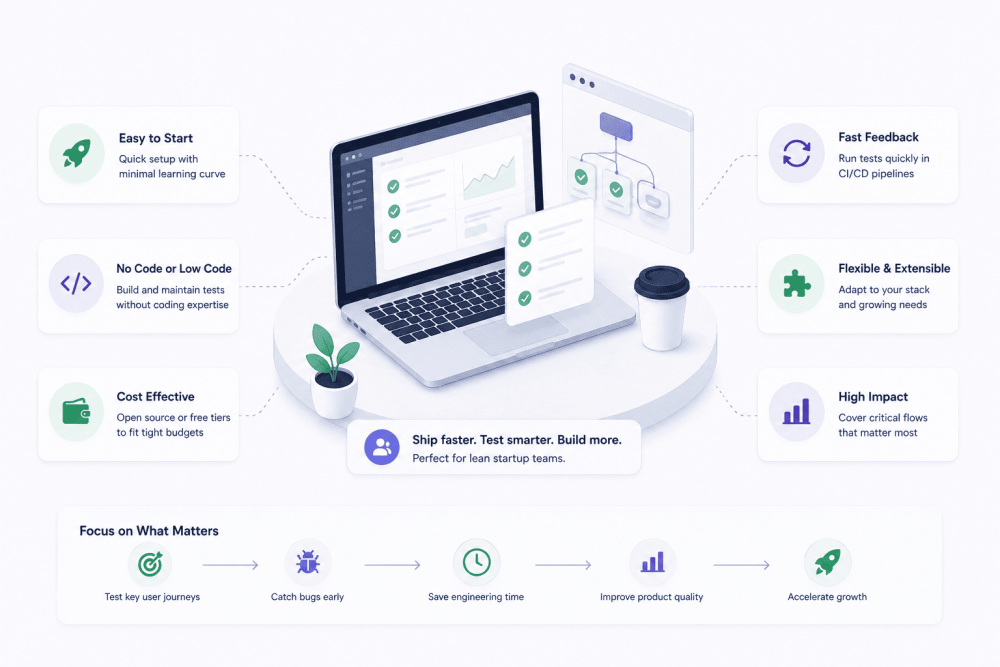
Neither situation is great. But the idea that you need a dedicated QA team to ship stable software is not really true anymore. The test automation tools available today have made it possible for a two or three-person dev team to automate the most critical parts of their testing without anyone being a QA specialist.
This guide is for the startup where the founder is still writing code, the team is small, and the goal is just to stop shipping bugs that users find before you do.
What your startup actually needs from testing
A lot of teams get this wrong at the start. Someone reads up on test coverage targets or hears about end-to-end testing frameworks, and suddenly it feels like you need a whole infrastructure in place before anything ships. That mindset tends to slow everything down without actually making the product more reliable.
What matters early on is coverage across the flows that would hurt you most if they broke. Signup, login, payment, core API calls. Those are the things that lose you users, when they fail. If your automation catches breakage in those areas before a deploy goes live, you are already ahead of most startups at your stage.
Cypress
Cypress is probably the most common starting point for small web teams, and it earns that reputation. Tests run directly in the browser, which means they reflect what a real user would actually experience. Debugging failed tests is less painful than most tools, too, since you get screenshots and step-by-step logs to look back at. A new team can usually get something running in a day.
The free tier is enough for most startups getting started. If your product is web-based and you have not set up any frontend testing yet, this is the most sensible place to start.
Keploy
API failures tend to be the sneaky ones. They often only surface when a specific sequence of calls is made in a specific order, which means manual testing misses them. Keploy is an open source API testing tool that records real traffic and auto-generates test cases from it, so you are not starting from scratch every time you want coverage on your backend.
For startups running APIs without anyone dedicated to writing tests for them, it is a practical option that does not ask a lot of you upfront to get going.
Playwright
Playwright covers similar ground to Cypress but handles cross-browser testing more naturally. Chrome, Firefox, and Safari, it manages all three without much extra configuration. Language support is broader, too; JavaScript, Python, and Java are all options, so most teams will find something familiar. If you have hit browser-specific bugs before and want proper coverage across them, Playwright is worth the extra bit of setup time.
Jest
If your codebase is JavaScript or TypeScript, Jest should already be part of your workflow. It is fast, widely used, and catches logic errors at the unit level before they become user-facing problems. The nice thing about unit tests is that they run in seconds, so developers actually run them. Tests that take ten minutes to run are tests that get skipped.
Jest works best alongside something like Cypress rather than instead of it. Unit tests tell you your functions work. They do not tell you your app works.
k6
Most teams skip load testing until something falls over under traffic. k6 lets you write load tests in JavaScript and simulate real usage patterns before a big launch or a spike you are expecting. The free version handles what most early-stage startups need. Running even a basic load test before you push a major update is the kind of thing that takes an hour and saves you from a very public outage.
Postman
A lot of developers are already using Postman to poke at APIs during development. Fewer of them know that those same requests can be turned into automated test collections without much extra work. If Postman is already open on your team’s machines, formalizing some of those calls into repeatable tests is low effort for decent coverage.
It is not a long-term replacement for proper API testing as you grow, but at an early stage it does the job.
Selenium
Selenium has a longer history than most tools on this list and the ecosystem around it shows that. It handles multiple browsers and languages and plugs into pretty much every CI setup in use today. The tradeoff is that it takes more work to set up and maintain than Cypress or Playwright.
If someone on your team has used it before, it is a solid choice. If nobody has prior experience with it, one of the newer options will get you moving faster.
What skipping testing actually costs you
It is worth being honest about what happens when teams decide to ship without any automated coverage in place.
Things usually feel fine in the beginning. Early users are forgiving. The codebase is small enough that everyone roughly knows what everything does. Then the product grows, more code gets added, and the first developer who touched certain parts has moved on or forgotten the details. A fix for one user starts breaking things for another. An API change that seemed safe takes down a feature on a Friday. The team starts spending more time fixing things than building things.
This is not a rare situation. It is a pattern that shows up consistently around the six to twelve-month mark for teams that were moving fast without testing in place. The problem is not that bugs exist. Every codebase has bugs. The problem is not having a way to catch them before they reach users.
Manual testing by developers does help, but people naturally test the happy path. They test the flow where everything goes right because that is the flow they just built. Automated tools test what is easy to forget: edge cases, error states, and what happens when a dependency returns something unexpected. That is the coverage that stops the kind of quiet regression bugs that users start noticing before your team does.
You do not need perfect coverage before you can ship. Waiting for that will just slow you down. But a basic automated check across your most important flows, running on every push, changes the feedback loop in a way that manual testing never really can.
Conclusion
You do not need a QA team to keep your product stable. You need the right tools covering the right things, wired into your deploy process so they run without anyone having to remember to trigger them. Start with whatever feels most approachable given your stack, get it running in CI, and add coverage from there. The tools are free or close to it. The hard part is just starting.