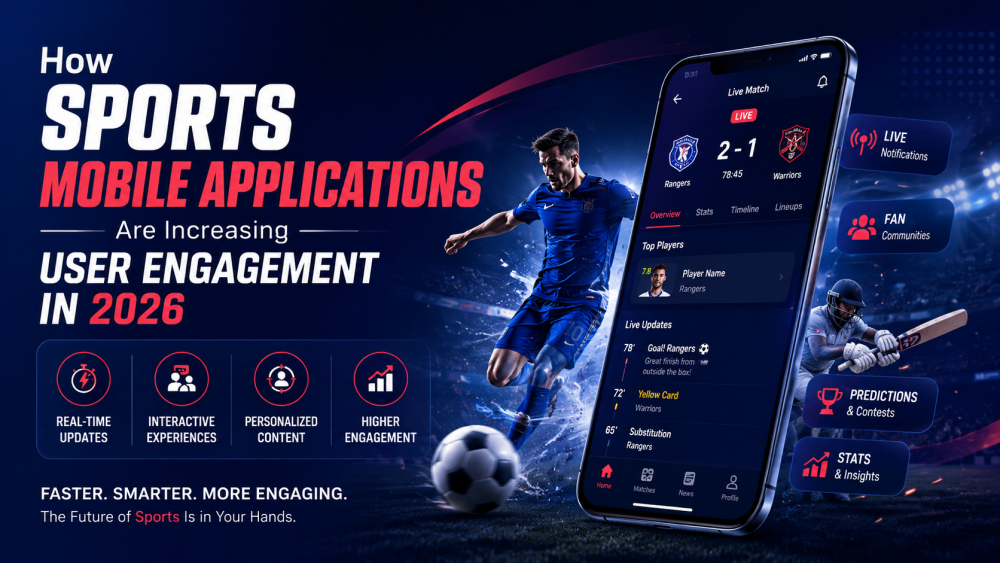
Sports apps in 2026 aren’t really just “score apps” anymore. That description feels outdated. For a lot of users, they’re basically the first place they open when something happens in a match even before social media.
This shift hasn’t happened by accident. Modern sports app development is now focused on speed, personalization, and real-time intelligence, shaping how users consume sports content daily.
People expect updates instantly now. Not “refresh and wait a few seconds” instantly more like it should already be there. That expectation has quietly reshaped how these platforms are built.
There’s also a shift in how often people open these apps. It’s no longer just during matches. Users check in throughout the day before games, during breaks, even after everything is over just to stay in the loop. That constant interaction is a big part of why engagement has grown.
Real-Time Speed Has Become the Baseline
During big moments finals, transfer deadline chaos, or sudden injury news apps get hit hard. And users don’t really think twice anymore. If one app feels even slightly slower, they’ll just move to another.
That’s why a lot of platforms now invest heavily in backend performance, real-time data pipelines, and cloud scaling. In advanced sports app development services, low-latency architecture is no longer optional it directly impacts user retention.
There’s also pressure to get notifications right. Too slow, and users miss the moment. Too many, and they turn them off completely. Finding that balance has become part of the challenge.
Personalization Is Doing Most of the Heavy Lifting
One thing that’s easy to miss is how much personalization shapes the experience now.
Two people opening the same app might see completely different things. One gets highlight clips and breaking news for their favorite club, while another sees deep stats or lineup analysis powered by sports prediction analysis models.
It’s subtle, but it changes how “relevant” the app feels. And relevance is usually what keeps people coming back.
In some cases, apps are starting to surface content before users even search for it. With the help of AI-driven prediction analytics in sports apps, platforms can suggest key moments, probable outcomes, or trending events before users even realize their importance. When that works well, it feels almost effortless.
Fans Don’t Just Watch Anymore
Sports viewing has become a lot more reactive.
During matches, people aren’t just watching they’re commenting, voting in polls, checking reactions, or jumping into live chats. It’s almost like a second layer running alongside the game itself.
And honestly, during tense moments, that’s where most of the engagement happens. A controversial decision or last-minute goal usually triggers more activity in the app than the match itself.
There’s also a growing habit of multitasking. Many users keep the app open even while watching on TV or streaming platforms, using it as a companion rather than a replacement.
You’ll notice a lot of apps now experimenting with live predictions, win chances, and fan reactions during matches. It’s not always perfect, but it definitely adds another layer to how people follow the game.
Scaling Isn’t a Side Problem—It’s the Core Problem
The hard part for these apps isn’t adding features. It’s surviving peak traffic without breaking.
A big final can bring millions of users in at once, and if the system stutters even briefly, people notice immediately. In most cases, they don’t complain they just uninstall or switch.
So companies spend a lot of effort on scaling systems: databases, caching, low-latency delivery, everything that keeps things running smoothly when it matters most.
Another challenge is handling unpredictable spikes. Not every surge is planned sometimes a single unexpected moment can drive massive traffic within seconds. That’s where scalable sports app development architecture and real-time processing systems become critical.
Final Thought
What’s interesting is that sports apps aren’t really competing on “sports coverage” anymore. Most of them already have that.
The real competition is experience how fast things feel, how personal the feed is, and how intelligently platforms can use prediction analysis in sports apps to keep users engaged.
And that bar keeps rising.
What will likely define the next phase is how seamlessly these elements come together. Users don’t think in terms of features they just notice when something feels smooth, timely, and worth returning to without effort.