If you want to set up a new water supply system for a farm or a small commercial building. You need a pump that can work reliably underwater. You have to make a choice between a single-stage and a multistage model. This choice changes how much water you get and how much electricity you use. Submersible pumps are made to push fluid to the surface, but the internal design changes significantly. Understanding the submersible parts in each pump type helps you decide the right pump for your specific project. Picking the wrong setup means your system will either lack pressure or waste energy.
What is a Single-Stage Submersible Pump?
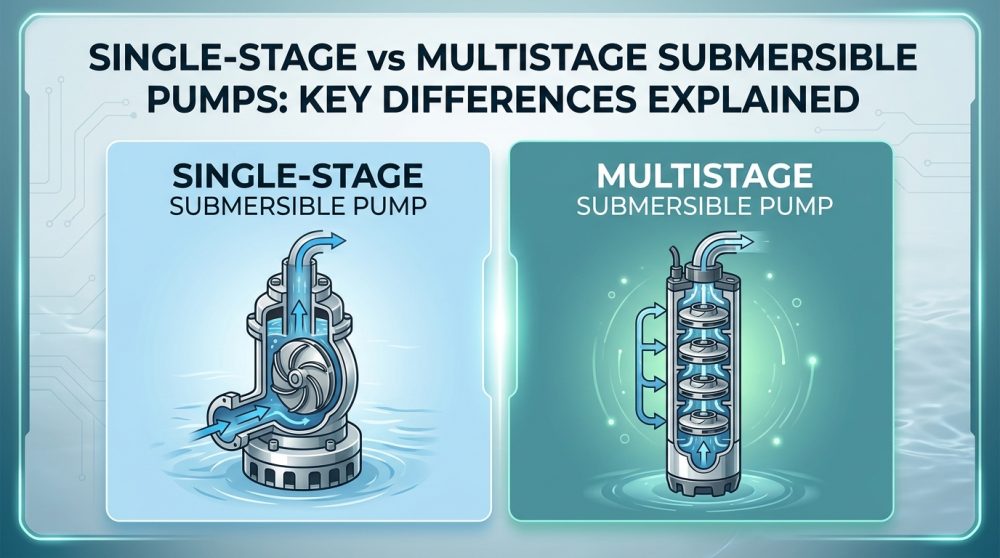
A single-stage submersible pump has a single impeller inside the casing. That impeller spins at high speed to draw water in and push it out. Because there is only one stage, this machine gives you a high flow rate but only generates low-to-medium pressure. It works well when you do not need to push water up a great vertical height. These are used for shallow wells, open-well agricultural irrigation, domestic water transfer, and to drain flooded basements or construction sites.
When maintaining this equipment, you deal with fewer components overall. Common submersible pump spare parts for this type include the single impeller, the suction case, a non-return valve, the bearing bush, and wearing rings. The simplicity means that there are fewer things in the daily operation that can break down, and troubleshooting is usually very straightforward. Normally, all you need to do is check one impeller for blockages or wear. If the pump stops pushing water.
What is a Multistage Submersible Pump?
A multistage submersible pump operates in a different way. It has multiple impellers placed in sequence on a single shaft. Water flows from one impeller to the next. Each stage increases pressure on the fluid further and further. The flow rate is controlled. This is what gives the pump enough force to push water up very high distances against gravity. This type is what you want for deep borewells, high-rise building water supplies, municipal water systems and heavy industrial processes.
Because of this complex design, there are many more submersible pump spare parts involved. You have multiple impellers, diffuser bodies, impeller sleeves, carbon spacers, and couplings. Each component must work perfectly in sequence. If one impeller fails or gets worn down by sand, the overall pressure of the entire pump drops instantly. This means maintenance requires a bit more attention to detail because you have to check multiple stages for wear.
Key Differences – Comparison Table
The table below compares how single-stage and multistage pumps work across basic operational features.
| Feature | Single-Stage | Multistage |
| Impellers | One impeller | Multiple impellers (stages) |
| Pressure Output | Low to medium | High pressure |
| Best For | Agriculture, drainage, domestic | Borewells, high-rise, industrial |
| Flow Rate | High flow | Controlled / lower flow |
| Spare Parts | Fewer, simpler | More components required |
| Depth | Shallow to medium | Deep borewell / high-head |
The pump appropriate for your job will depend primarily on the depth of your water source and the pressure required at the delivery point. If you are pumping water from a shallow river or pond or a wide-open tank to water a field, a single-stage pump will do the work. It handles a large volume of water quickly with low pressure. It is a low-cost solution for simple transferring tasks.
However, if your water is 100 feet or more underground in a narrow borewell, a single-stage unit cannot push that water to the surface. You need a multistage pump to build up the necessary pressure head to overcome the depth. Look at the total head requirements of your pipe network and the matching submersible parts before buying anything. If you try to use a single-stage pump for a deep well, it simply will not deliver any water to the top.
Why Quality Submersible Parts Matter
The long-term performance of your pumping system depends heavily on the build quality of its internal components. High pressure inside a multistage pump puts stress on components like impellers, wearing rings, bearing bushes, non-return valves, diffuser bodies, shafts and carbon spacers. It is highly recommended to buy a durable submersible pump spare. Stainless steel is great for clean water and wastewater applications because it will not rust and can better handle abrasive particles than poor-quality plastics or cast iron.
Whilst sourcing these components, you need to find reliable submersible pump spares suppliers who understand these technical demands. Getting components from a reliable source ensures that you get components built to exact technical specifications that will keep your systems running without frequent breakdowns. Good quality spares reduce premature wear and save labour costs, as pulling a pump out of a deep well for repairs is a difficult and costly process.
Conclusion
Single-stage pumps are good for shallow applications where you want a lot of flow at lower pressures. Multistage pumps have multiple impellers and are used to generate high pressure for deeper wells. The selection of submersible parts for maintenance is just as important as the selection of the type of pump. If you need to replace worn parts or just want to browse high-quality options, check out the full range of options available.