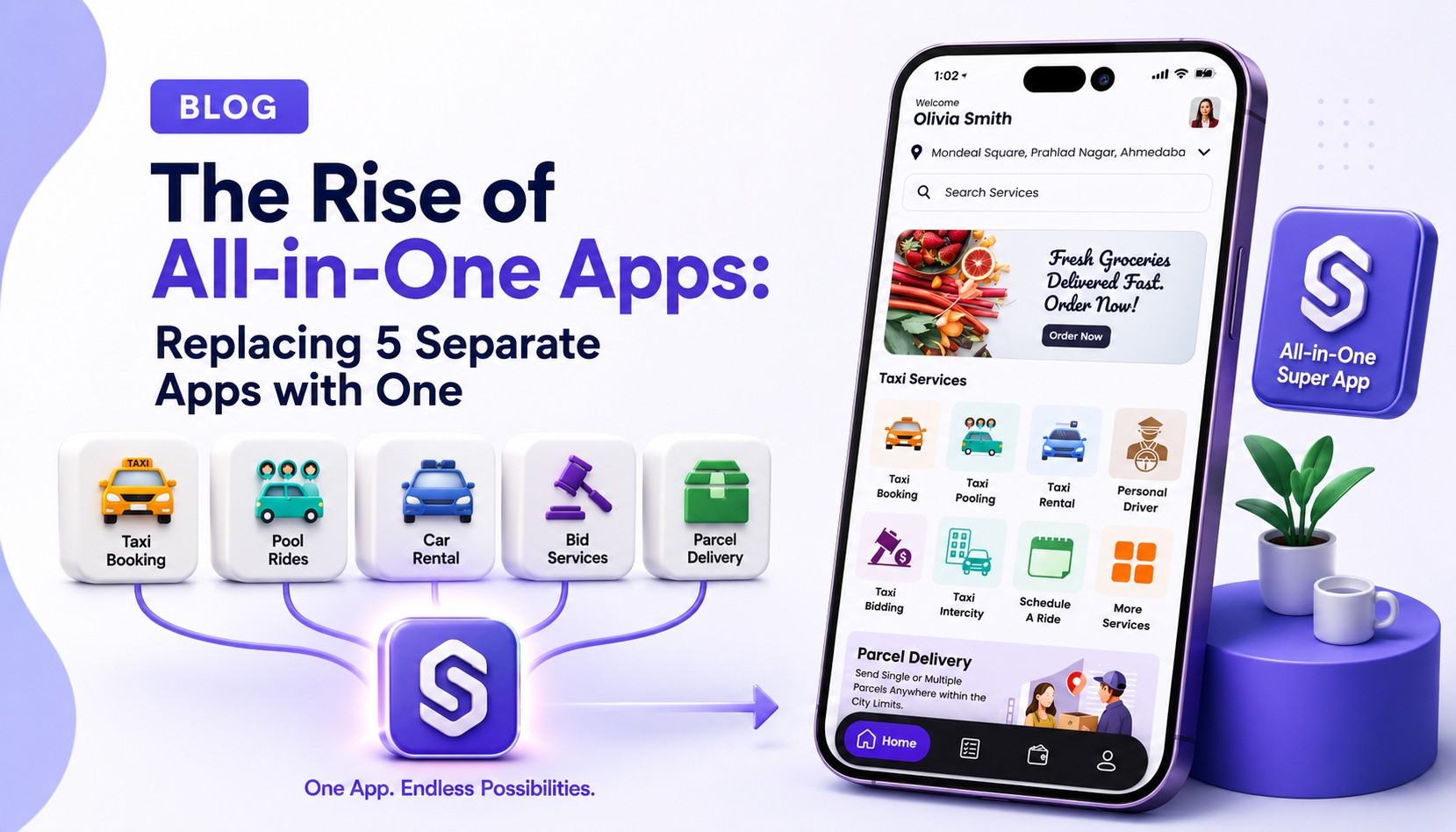
We are living in the golden age of “there’s an app for that.” Need a taxi? Tap an app. Want a sourdough pizza delivered at 2 AM? Tap another app. If you need to record the number of steps walked, manage your team’s calendar, or even pay your electricity bill, there are three other apps out there waiting for you.
The notion of building a “Single App” used to represent the epitome of innovation for a while now. The concept was quite straightforward do one thing and do it well. However, as the digital environment evolves, it becomes evident that user behaviour has changed drastically. With so many applications on the market today, users are beginning to feel overwhelmed.
As an entrepreneur, perhaps you may be wondering whether you should create a niche app or a platform. If so, the statistics are speaking volumes as far as user preferences are concerned.
In this blog, we’ll dive deep into why the multi-service model is winning the hearts of consumers and why, for your next business venture, “less” might actually be “more.”
The Hidden Cost of the “Single App” Plan
In the early days of the start-up boom, the advice was always: “Find a niche and do one thing perfectly.” This led to the birth of thousands of Single Apps. While this worked for a while, it created a fragmented ecosystem that is now slowing us down. A business owner trying to manage their operations. They use:
- App A for scheduling appointments.
- App B for invoicing and payments
- App C for customer CRM.
- App D for internal team chat.
- App E for social media marketing.
On the surface, they have a “best-in-class” tool for everything. But in reality? They have a mess. This disconnected setup forces staff members to spend their day “app hopping”. Rather than paying attention to the consumer, they are busy collecting data, entering their passwords, and remembering which app contains what data.
The outcome? They miss out on updates, make mistakes in the process, and waste thousands of billable hours. The technology isn’t the problem the lack of connection is.
Why All-In-One Apps Are Winning?
We are seeing a massive “consolidation phase” in the tech world. Popular apps that started with a single purpose are now frantically adding features to become All-In-One Apps. Why? Because they know that the stickiest app is the one the user never has to leave.
There is a massive gap when it comes to comparing a collection of specialized tools versus a unified multi-service solution. All-In-One Apps is not just about improving efficiency but the process becomes entirely new.
1. On boarding New Employees Will Be Easy As Can Be
On boarding can be a huge pain for all entrepreneurs out there. If you employ several platforms to conduct business, it means that each new employee has to undergo training multiple times. When using the All-In-One solution, employees only need to familiarize themselves with one design logic, one layout, and one functionality.
2. The “SaaS Tax” Relief
Let’s talk money. Most single-service apps operate on a subscription basis. Individually, $20 a month sounds cheap. But when you multiply that by five apps and ten employees, your “tech stack” becomes a major liability. All-In-One Apps offer a better ROI by bundling services, saving you from the “death by a thousand subscriptions.”
3. Data Harmony
When your messaging, payments, and delivery tracking all happen under one roof, the data flows perfectly. You don’t need complex integrations or third-party “bridge” software. Everything is updated in real-time, providing a “single source of truth” for your business.
Get to Know the All-in-One App Model
The first thought that crosses the mind of any savvy entrepreneur is: “Won’t this be chaotic?” You have raised a truly interesting question. Let’s explore why this is a dream, not a nightmare.
1. Categorization:
Without a doubt, manoeuvring through applications is a cumbersome process for anyone trying to operate 10 apps for different tasks. Therefore, the best step that they could take would be to use your app for delivery of all sorts. Hence, organization will become important. Delivery apps know how easy the process of categorization can be because they can do it using certain niche markets. The most common market segments that could be used for this include Groceries, Food, Flowers, and Pharmacy.
Organization helps a lot because it keeps everything neat. People can order whatever they like efficiently through this process. Categorization is highly influential and makes the app look more professional.
2. Creative Interface:
Once you realize that the app is categorized, you might feel as though your initial question has already been answered. However, an expert remains an expert precisely because they know that the solution goes beyond that. A creative interface serves as the perfect finishing touch. Having a creative user interface does not simply mean having a *different* interface one that no one knows how to use. Rather, it means simplifying the experience and making it personal.
Consider this: based on your past orders, you receive personalized options. You can save your home or office address, as well as your credit card details. Another feature allows you to mark a specific restaurant as a “favourite.” Any user interface designed creatively will always revolve around making life for its users much easier, and this definitely brings innovation into the process. If anything makes your product simpler and more usable, this is what innovation. An innovative user interface is almost everything you need to scale your delivery app at lightning speed.
Features that Speak the Language of Convenience
What actually sets an All-In-One App apart in the wild? It’s the “Quality of Life” features that Single Apps often struggle to coordinate.
- In-App Communication: Say goodbye to the hassle of having to call the driver from your phone, followed by switching to an app to share an image of your residence for guidance. With in-app chat, video, and location sharing capabilities, all deliveries are now more efficient and precise than ever before.
- In-App Wallet: This is how payments are meant to work. Efficiency and convenience in payment processing and secure transactions. It’s time to say hello to an in-app wallet, which saves the user from the trouble of looking for his physical wallet or typing out 16 digits each time he wants to purchase a beverage.
- Social Login: Face it; we cannot remember our passwords. This feature allows the application to offer social login for both the users and delivery partners and store managers.
- Multiple Languages & Currencies: The whole world is a village. With the help of AI, the best all-in-one solution translates fares and content into 25+ languages and currencies. It’s inclusive and professional.
- Push Notifications: Users love being “in the loop.” Real-time updates from “We’re preparing your order” to “Your driver is around the corner” provide a sense of control and reliability that builds brand loyalty.
Conclusion
The era of the “Single App” is fading. Users want simplicity. They want efficiency. They want one app that will understand everything about them and serve their needs without having to click five separate icons.
You must serve them by understanding their need for one digital platform to do everything. So, why wait? Reach out to a clone company, discuss your vision, and start building your All-In-One empire today. The “next big thing” is just one integrated platform away!