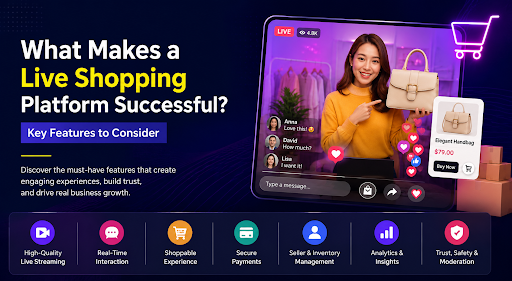
Live shopping has become one of the fastest-growing formats in e-commerce, blending real-time video, community interaction, and instant purchasing into a single experience. What began as a niche format popular with collectors and resellers has grown into a mainstream sales channel, with brands, independent sellers, and entrepreneurs building entire businesses around streaming products to an audience that can bid, buy, and interact in real time. The appeal is easy to understand: it recreates the energy of an in-person auction or a shopping-channel broadcast, but with the reach and convenience of a mobile app.
Yet not every live shopping platform succeeds. For every marketplace that builds a loyal base of sellers and buyers who return week after week, others launch, generate an initial wave of interest, and quietly fade once the novelty wears off. Some struggle with sellers who can’t keep an audience engaged. Others lose buyer trust after a handful of payment disputes or unreliable streams. In many cases, the underlying idea was sound — what was missing was a platform built with the right combination of features to sustain engagement, trust, and repeat transactions over the long run, not just during an initial launch spike.
This raises a practical question for any startup or business considering this space: what actually separates a live shopping platform that lasts from one that doesn’t? The answer isn’t a single standout feature, but a set of interconnected capabilities — streaming quality, real-time interaction, flexible purchase mechanics, seller tools, secure payments, and more — that together determine whether a platform can hold both sides of its marketplace over time.
Streaming Quality Is the Foundation
Before anything else, a live shopping platform has to deliver a stable, low-latency stream. Buyers are making purchase decisions based on what they see in real time, and any lag, buffering, or dropped connection immediately undermines confidence in the transaction. This becomes even more critical during high-value auctions, where a delayed frame or frozen stream can mean a buyer misses their chance to bid.
Businesses exploring this space often start by looking at proven formats already succeeding in the market, and the Whatnot Clone offered by Triple Minds is a common reference point. As a white-label version of the live auction and shopping model popularized by Whatnot, it reflects a feature set that has already been tested against real buyer and seller behavior at scale. Looking at what that kind of platform includes — and why — offers a useful framework for understanding what actually makes a live shopping platform succeed, regardless of which provider or build path a business ultimately chooses.
Platforms that succeed treat streaming infrastructure as core product, not a background utility. That means performance has to hold up not just during quiet, low-traffic streams, but during peak moments when thousands of viewers may be watching the same auction simultaneously. A platform that performs inconsistently at scale will lose seller and buyer trust quickly, often before it gets a chance to build a loyal base.
Real-Time Interaction Builds Trust
Unlike traditional e-commerce, live shopping is inherently social. Buyers ask questions, sellers respond on camera, and other viewers weigh in — all in real time. This interaction is what separates live shopping from a static product listing, and it’s a major driver of the trust that leads to a purchase. A platform needs chat systems fast enough to keep up with high-traffic streams, along with features like live reaction counts, follower notifications, and visible viewer numbers that reinforce a sense of active community.
This interactivity does more than support individual transactions — it’s what keeps buyers coming back. A platform where buyers feel like they’re part of an ongoing relationship with a seller, rather than a one-time purchase, tends to see significantly higher repeat engagement.
Auction and Buy-Now Flexibility
The purchase mechanics of a live shopping platform matter more than they might initially appear. Auctions create urgency, competition, and engagement — buyers stay tuned in because they don’t want to lose an item they’re bidding on. But not every buyer wants to compete for a purchase; some want the certainty of buying at a fixed price the moment they see something they want.
A successful platform supports both models, giving sellers the flexibility to run their business the way that fits their inventory. High-demand or rare items often perform best in an auction format, where competitive bidding can push the final price above what a fixed listing would achieve. Everyday or higher-volume inventory often moves faster with a straightforward Buy Now option. Platforms that only support one mechanic limit both seller revenue potential and buyer choice.
Seller Tools That Don’t Slow Sellers Down
However strong the buyer-facing experience is, a live shopping platform ultimately depends on sellers who are willing and able to run consistent, high-quality streams. That means the tools sellers use — listing products, adjusting prices, closing auctions, managing inventory — need to be fast and intuitive, especially during a live session where hesitation costs momentum.
Scheduling features matter here too. Sellers who can announce upcoming streams in advance, and have those announcements automatically reach their followers, build predictable, returning audiences rather than relying on chance discovery. Platforms that invest in reducing seller friction tend to retain sellers longer, and seller retention is often a stronger predictor of long-term platform success than raw buyer numbers.
Where Live Shopping Platform Development Gets Difficult
Much of the complexity in live shopping platform development comes not from any single feature, but from how tightly those features need to work together in real time. Streaming, chat, bidding, and checkout all have to operate in sync without one component slowing down another — a delay in checkout during a fast-moving auction can cost a seller a sale to a competing bidder just as easily as a lagging video stream can.
This is part of why so many businesses entering the space evaluate proven, already-tested platforms rather than building this coordination from scratch. Getting these systems to behave reliably together under unpredictable, high-traffic conditions takes considerable engineering effort, and any weak link tends to surface immediately in the buyer experience, which can be difficult to recover from in a trust-driven format like live commerce.
Secure, Transparent Payments
Because live shopping often involves auction-based pricing, payment infrastructure needs to handle situations a standard e-commerce checkout doesn’t. Bids need to be authorized without charging a buyer until an auction closes, and the platform needs a clear process for handling cases where a winning bidder doesn’t complete payment. Sellers, in turn, need reliable payout systems — ideally an in-app wallet that tracks earnings and allows timely withdrawals without manual back-and-forth.
Buyers are more willing to spend on unfamiliar sellers when they trust the platform’s payment and dispute handling. This trust layer is invisible when it works well, but its absence is one of the fastest ways to lose both buyers and sellers.
Discovery That Scales With the Platform
As a platform grows past its earliest sellers, discovery tools become essential rather than optional. Buyers need ways to find sellers and categories relevant to their interests, whether through browsing, search, or notifications when a followed seller goes live. Without this, growth tends to stay concentrated around a small number of early sellers, while new sellers struggle to find an audience.
Personalization — surfacing streams based on a buyer’s past behavior — extends this further, keeping buyers engaged over time rather than relying solely on new user acquisition. Platforms that plan for discovery early tend to scale more smoothly than those that try to retrofit it later.
Multi-Vendor Architecture and Category Range
A platform intended to grow beyond a single seller or narrow product category needs multi-vendor support built into its foundation. This allows multiple sellers to operate their own storefronts within a shared marketplace, each with independent inventory and analytics. Category flexibility matters as well — platforms confined to one vertical, such as collectibles or fashion, cap their own growth potential. Building the flexibility to expand into new categories without a structural rebuild is a decision that pays off well beyond the initial launch.
Admin Visibility and Monetization Options
For platform owners, a centralized admin dashboard is critical for moderating streams, resolving disputes, and tracking performance across the marketplace. This visibility allows problems — fraudulent sellers, disputes, quality issues — to be caught early rather than after they’ve damaged buyer trust.
Monetization also needs more than a single revenue stream to be sustainable. Transaction fees are the most common model, but additional options like premium seller subscriptions, featured listings, and sponsored live events give a platform more resilient income and give sellers more ways to invest in their own growth on the platform.
A Useful Way to See It in Practice
Reading through a feature list is one way to understand what a successful live shopping platform needs, but seeing these features in action often makes the picture clearer. Triple Minds has published a video walkthrough covering the core features of a well-built live shopping platform in detail — which is a useful companion to this breakdown for anyone comparing platforms or planning their own build.
The Common Thread
Across every feature discussed here, one pattern holds: none of them function well in isolation. Strong streaming without reliable payments won’t build buyer trust. Great seller tools without discovery features will plateau once early sellers stop growing on their own. The platforms that succeed are the ones built as a single, coordinated system, where every feature reinforces the others under real transaction pressure — not just a checklist assembled feature by feature.