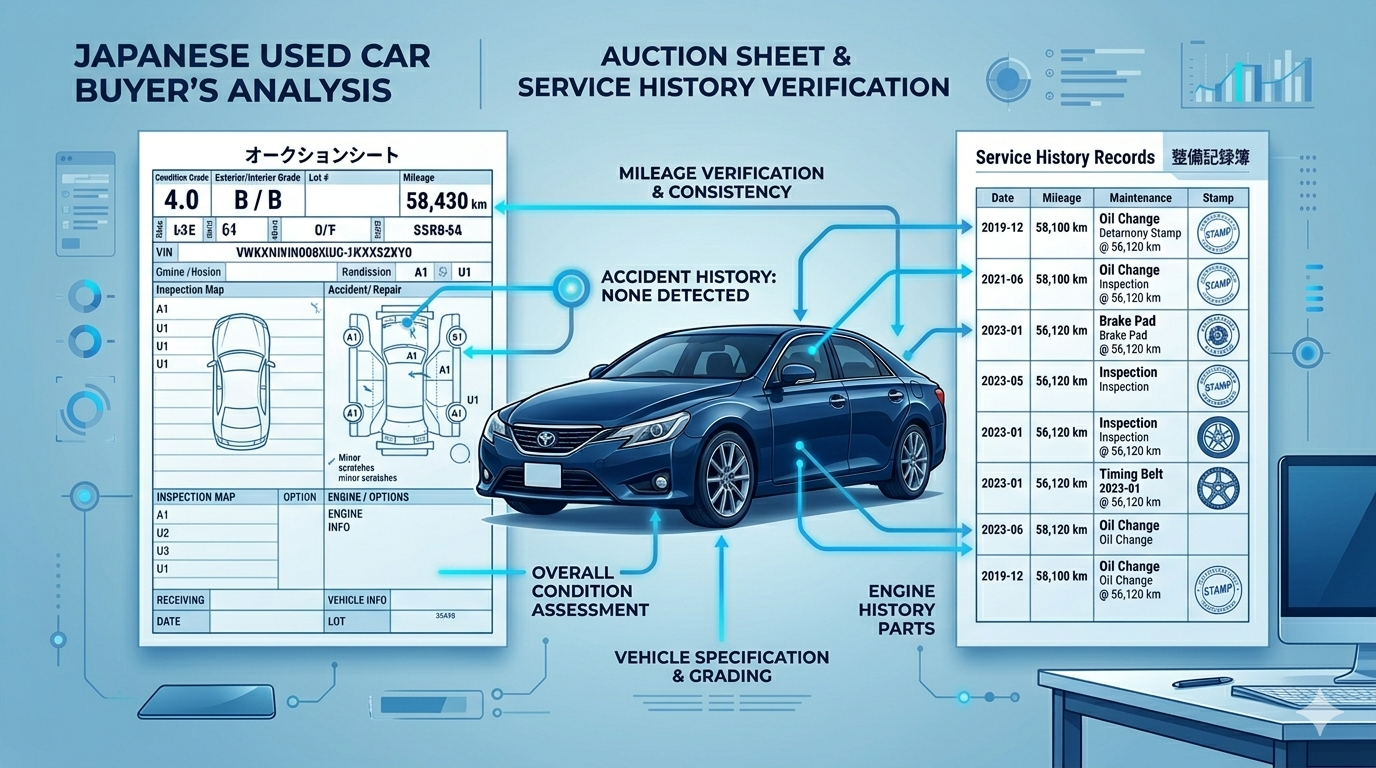
When it comes to checking Japanese used cars, buyers tend to latch onto auction sheets pretty heavily. Like, these documents kinda give you a quick snapshot of a vehicle’s state around the sale moment, showing exterior dents or scratches, interior wear, mileage, and the general grading. Even so, auction sheets are undeniably useful, but they’re just one part of the bigger thing.
If you want a really informed purchasing call, you usually need a wider angle. And that’s where Japanese service history records start to matter more and more. When you put auction sheets alongside maintenance documentation, you basically get a fuller story of what happened before. Then buyers can judge not only what you can see right now, but also how it was cared for over the years and whether it’s likely to stay dependable.
So, getting the hang of how these two sources complement each other can actually lower the risk a lot, especially when buying Japanese used cars from overseas auctions.
Understanding the Purpose of Auction Sheets
Japanese auction houses employ professional inspectors who evaluate vehicles before they enter the auction process. The resulting auction sheet summarizes key information, including:
- Exterior condition
- Interior condition
- Mileage readings
- Repair history
- Accident disclosures
- Equipment specifications
- Overall vehicle grade
For many international buyers the auction sheet kinda works as the main, go-to decision tool. It gives an objective appraisal , prepared by an independent inspector, and it allows shoppers to compare several vehicles pretty fast, in an efficient sort of way.
Still, there are drawbacks with auction sheets. They are basically made to show a general condition snapshot not a full maintenance biography or complete service record.
What Are Japanese Service History Records?
Service history records are documents that track a vehicle’s maintenance and repair activities throughout its life in Japan.
These records may include:
- Oil changes
- Brake servicing
- Tire replacements
- Transmission maintenance
- Battery replacements
- Timing belt services
- Manufacturer inspections
- Dealer maintenance records
Many Japanese vehicle owners maintain meticulous service documentation. Cultural emphasis on preventative maintenance often results in vehicles receiving regular care according to manufacturer recommendations.
As a result, service records frequently provide insights that auction sheets cannot.
The Difference Between Condition and Care
One of the most important distinctions buyers should understand is the difference between current condition and historical care, kind of a big deal honestly.
An auction sheet kinda shows how a vehicle appears, and how it performs at a specific moment in time.
Service records, on the other hand show how the vehicle has been maintained over many years, step by step.
So for example, two vehicles might both get a Grade 4 auction rating. On paper they look pretty much equally appealing, but then the reality can split. One may have extensive documented maintenance, while the other has little, or no service history we can verify at all.
In those situations the vehicle with consistent maintenance records tends to be the safer long-term buy.
Verifying Mileage Accuracy
Mileage verification is a major concern in the international vehicle market, for sure.
At auctions, inspectors write down odometer readings and they might also flag suspected mismatches. Even so, the service records bring yet another kind of assurance, and people usually trust that.
Maintenance documents often include mileage numbers from earlier checks, and from servicing visits too. Those historical entries build a sort of timeline, which can back up whether the odometer reading feels genuine or not.
So for anyone buying Japanese used cars, lining up the service history mileage with the auction sheet mileage can offer real reassurance. It’s like cross validating the evidence, in a practical way, and it tends to reduce uncertainty.
Identifying Preventative Maintenance
Many mechanical issues do not appear during a brief auction inspection.
A vehicle may receive a strong auction grade while still approaching major maintenance milestones.
Service records can reveal whether important preventative maintenance has already been completed, including:
- Timing belt replacement
- Water pump servicing
- Transmission fluid changes
- Coolant flushes
- Suspension maintenance
This information can substantially influence ownership costs after importation.
A vehicle with comprehensive maintenance records may save buyers thousands in future repair expenses.
Confirming Manufacturer Recommendations
Japanese automakers put a lot of care into how vehicles should be maintained, with pretty detailed calendars for servicing, and yeah it’s not just casual. When buyers later go through the service history records, they can pretty quickly tell if the previous owners stuck to those suggestions most of the time.
If the regular maintenance was done at authorized dealerships, that usually suggests the owner was being responsible, and paying attention in a very practical way, not just “kind of.” And it matters even more when you’re dealing with premium brands or performance oriented vehicles, because whether service was followed can have a real impact on reliability over time, and also resale value.
So for anyone looking at j p used cars , finding proof that the factory service schedules were actually followed is often seen as a strong sign, like a green light.
Detecting Long-Term Ownership Patterns
Service records can also kind of hint at who owned the vehicle, and how they tended to handle it.
If a car was maintained regularly by the same dealership for a few years, it usually points to steadier ownership, plus careful, conscientious care.
On the other hand, when the service history is hit or miss, or there are long maintenance gaps, it may be smart to do a little more investigation, not just assume.
Those small patterns are hard to catch from auction sheets alone but they start to show up once the maintenance documentation is there.
Put both pieces together and you get a fuller, more textured picture of the vehicle’s past.
Supporting Accident and Repair Analysis
Auction sheets usually disclose the accident past they already know about and which spots were reworked, sometimes it’s just shown as repaired areas or notes that feel… a bit vague. Inspectors then use diagrams with little annotations, kind of like arrows and labels, to point out what was damaged before or where repairs happened.
Also, service records can sometimes add a little extra background, like a supporting thread you didn’t get from the sheet.
For instance, the files may mention body shop work, the replacement components that were installed, or insurance-related repairs. This extra bit of info can help buyers understand more clearly, what kind of issues came up and how far the earlier incidents went.
Even so, not every repair will necessarily show up in routine maintenance paperwork. Still, if the documentation exists, it can add more confidence to the story the vehicle is giving you about its past.
Evaluating Vehicle Reliability Potential
Reliability depends on more than mileage alone.
A high-mileage vehicle that received consistent maintenance may prove more dependable than a lower-mileage vehicle with neglected servicing.
Service records offer evidence of:
- Mechanical upkeep
- Component replacements
- Fluid maintenance
- Inspection compliance
When combined with auction sheet evaluations, buyers gain a more balanced view of future reliability prospects.
This holistic approach is particularly valuable when comparing multiple japanese used cars with similar auction grades.
Improving Import Buying Decisions
International buyers often face the challenge of purchasing vehicles without physical inspection.
In these situations, documentation becomes the foundation of informed decision-making.
Auction sheets provide:
- Current condition assessment
- Damage disclosure
- Vehicle grading
Service history records provide:
- Maintenance consistency
- Repair documentation
- Ownership care patterns
- Mechanical servicing evidence
Together, they significantly reduce uncertainty and help buyers make more confident purchasing decisions.
Why Serious Buyers Review Both Documents
Experienced importers don’t really trust auction sheets on their own.
They realize a vehicle’s visible condition gives only a slice of the whole story. Service records add depth, give some context, and provide a kind of historic perspective that usually cannot be truly captured by just one inspection.
The most desirable vehicles often demonstrate both:
- Strong auction grades
- Well-documented maintenance histories
This combo kinda hints at more than current condition, it also suggests some real long-term stewardship by the previous owners.
And if you’re looking into jp used cars, checking both streams of info can give you a pretty meaningful competitive edge when you’re picking the right vehicle.
Conclusion
Auction sheets still stay one of the most valuable tools in the Japanese vehicle export industry, and they sort of give standardized condition checks that let buyers judge a car quickly. But they really work best when they are read along with Japanese service history records, not just by themselves.
Auction sheets show what a vehicle looks like right now. Service records , on the other hand, show the whole path it took. They map out maintenance routines, confirm mileage patterns, point out preventive care, and add that extra background that helps people understand long-term reliability.
If you are looking for high-quality Japanese used cars then doing both, meaning verifying the auction sheet plus service history review, usually gives a much more complete view. This two-document way reduces risk , improves transparency, and makes it more likely you will pick a vehicle that keeps running dependably for years.
So when you’re checking import options, the smartest choice often is not made by staring at one sheet only. It is more about how multiple records connect together , and how they tell the full story of the vehicle’s past.