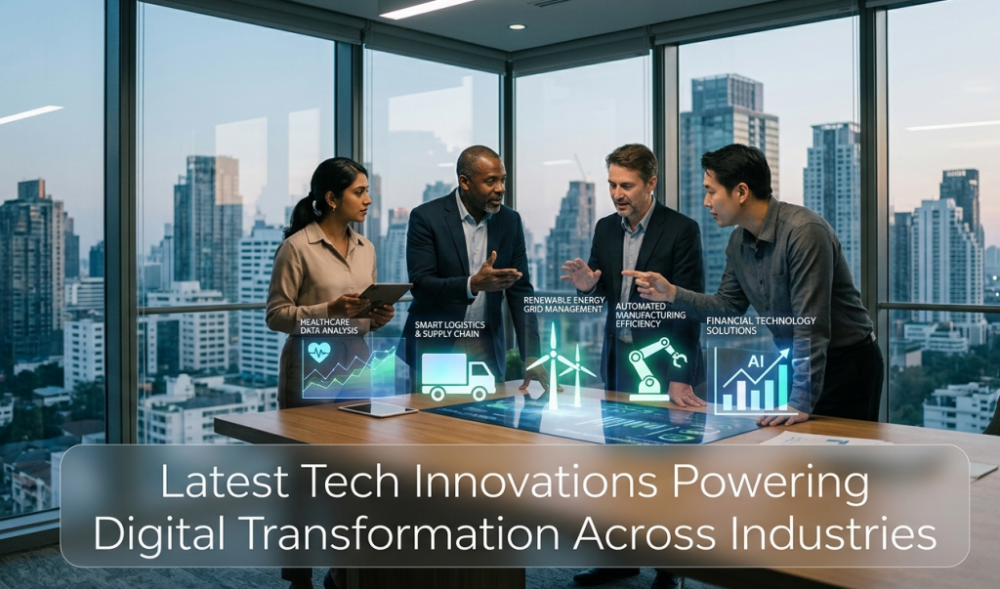
Do you want to know about the latest tech innovations powering transformation across industries? If the answer is yes, then you are at the right place. Here’s a detailed blog that offers everything you want to know about the latest tech innovations. So, let’s explore. We have listed all of them below.
Hyper-Automation
Businesses expect automation in every stage, operation, and workflow to proceed more quickly than before, therefore digital transformation without a focus on hyperautomation may not be successful.
The market for hyper automation is expanding quickly; it was estimated to be worth USD 46.4 billion in 2024 and is projected to continue increasing at a 17% CAGR through 2034.
Therefore, excessive adoption in enterprises focuses more on implementing hyperautomation in one way or another to guarantee little manual labor, lower errors, and increase productivity and speed of operation.
Cloud Services
The agility, scalability, and security provided by cloud services render them an essential element of digital transformation trends.
By 2027, over 50% of companies will utilize and deploy industry cloud platforms to enhance their business activities.
Organizations can utilize the bundled business capabilities of cloud platforms to execute unique digital initiatives and enhance time to value while steering clear of lock-in. It would encompass hosted and managed platforms, applications, and data services.
Internet of Things (IoT)
This groundbreaking technology offers outstanding effectiveness in various sectors. Additionally, digital transformation based on IoT is implemented in tangible products.
Data lies at the heart of both DX and IoT; when applied correctly, IoT technology can harness it and transform it into valuable insights for the organization. A dedicated IoT platform facilitates the digital transformation of physical goods.
Data collection also establishes a digital connection among a company, its goods, and its clients. IoT improves customer satisfaction in retail by providing immediate, actionable insights. In the healthcare field, telemedicine is thriving with enhanced IoT features.
Utilizing IoT in manufacturing enhances operations to be quick, secure, and flexible. You can collaborate with a specialized provider of IoT application development services to link users and devices.
They assist with requirement analysis, architecture development, as well as platform and app creation, extending to testing and support for your complete IoT initiative lifecycle.
The worldwide IoT market is anticipated to rise from USD 547.8 billion in 2025 to USD 865.2 billion by 2030, demonstrating a strong CAGR of 9.6%.
Quantum Computing
In 2026, we will have quantum computing, which will bring significant changes in how we use computers. It uses quantum bits also known as qubits that makes it super powerful.
Qubits has the ability to do challenging tasks much faster compared to regular computers. This ability will shake almost all the industries.
It can significantly speed up the drug discovery process, however it is not limited to that and can be used in a lot of different areas including Material Science, Financial Modeling, AI and ML, and more.
As companies and institutions begin implementing quantum computing, they need to prepare for the substantial change it introduces. They must grasp the functioning of quantum computers and seek assistance from specialists.
In this way, they can fully leverage the incredible capabilities that quantum computing provides. These emerging trends in digital transformation will result in significant shifts and generate new opportunities for advancement in technology and innovation.
Expanding Phygital Convergence
Phygital convergence, the combination of digital and physical experiences, will enhance its prominence in 2026. This movement in digital evolution entails utilizing AR, VR, and IoT to develop engaging and immersive experiences.
Augmented reality will superimpose digital content onto the physical environment, enriching real-world encounters. At the same time, virtual reality will persist in generating simulated settings, providing immersive experiences for a range of objectives.
Moreover, the IoT will broaden its scope, linking devices and facilitating data gathering for a more interconnected environment.
Companies will leverage digital convergence to create unique and captivating customer experiences, merging the boundaries of the physical and digital realms.
Agentic AI
Businesses are transitioning from fixed automation to systems that can think, make decisions, and operate independently. The effects are evident.
Reports suggest that the expanding Agentic AI market is projected to attain approximately USD 93.2 billion by 2032. A distinct movement toward autonomous workflows becoming standard by 2026.
Companies that previously relied on disjointed tools are now creating seamless, self-improving operations driven by AI agents.
Agentic AI in insurance will accelerate claims processing and enhance fraud detection to maintain risk management. Manufacturing is executing predictive maintenance, production sequencing, and quality inspections with almost no manual involvement.
Even autonomous AI in software development plays a crucial role, enhancing every phase to accelerate time to market and maintain competitive edge.
Everything as a Code
EaC is a methodology and perspective that promotes the inclusion of all facets of an application’s lifecycle. It comprises infrastructure, configuration as code, and files that are human-readable, version-controlled, and executable by machines.
Adopting a code-focused method for infrastructure and configuration management streamlines change and auditing procedures, improves collaboration, and speeds up development and deployment cycles.
IaC (Infrastructure as code) , application composition as code, workflows, configuration as code, and others enable contemporary version control systems and deployment methods.
It streamlines rollout, rollback, deployment automation, and change management in a modern software solution. This enables a rapid and secure development of software features, offering considerable advantages in time-to-value.
Extended Reality
Extended Reality improves the user experience with products, particularly in industries like retail, healthcare, real estate, and education. The various types of Extended Reality systems include Augmented Reality, Virtual Reality, and Mixed Reality.
Product development companies utilize XR for immersive design reviews, interactive prototyping, virtual testing, and customer presentations.
XR is increasingly engaged in training, remote support, and product upkeep. Regarding accessibility, it will soon become more affordable, enabling new ways of thinking, designing, and involving users in the field of product development technologies.
Final Thoughts
As the blog ends, now we know about all the latest tech innovations powering digital transformation across different industries. However, what else you should know is that you need to partner with trusted developers for reliable digital transformation. They help you get the best out of these latest tech trends.