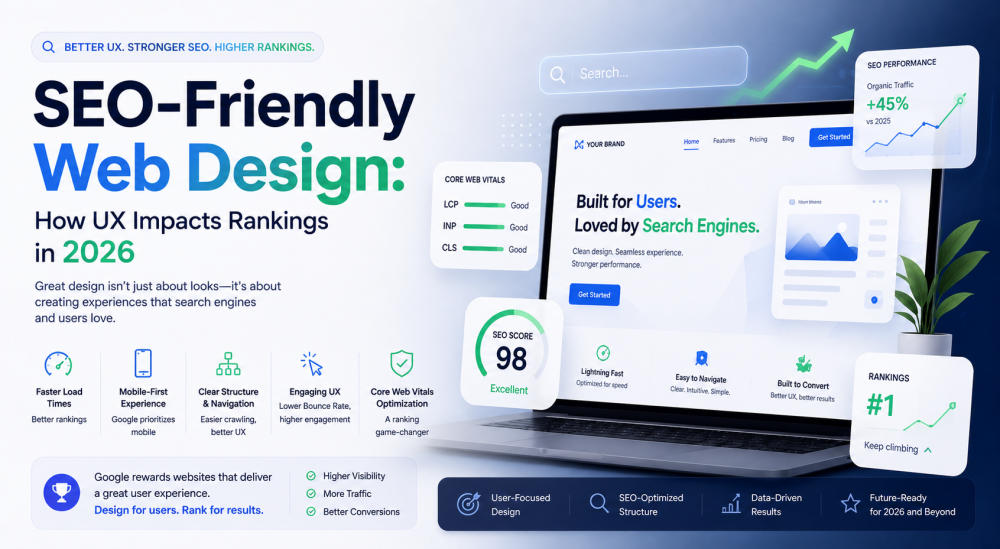
In 2026, the connection between SEO and web design has completely changed. Your new model of search engines will not rank websites just based on backlinks, keywords, and metadata. UX (User Experience) is one of the top-ranking factors for modern search engines today. Gone are the days when layers of words would lead search engine results pages (SERPs); websites that deliver seamless navigation, speedy performance, appealing designs, accessibility, and interactive experiences are in command.
Companies that treat SEO and web design as separate strategies are already losing out. SEO-friendly web design is a must for visibility, conversions & customer retention, or will you be among the millions of victims in 2026?
Google now has AI-powered ranking systems that normalize user behavior based on their actions on your website. It closely correlates to metrics such as bounce rate, dwell time, engagement patterns, page speed, mobile-first indexing, and accessibility, along with many more behavioral signals that determine rankings. That means every design decision you make improves or quietly destroys the search for your business.
Whether you manage an eCommerce business, a SaaS platform, a corporate site, or simply a blog, it is now imperative to blend your SEO with contemporary UX principles. Thus, even the most advanced eCommerce solutions, like product customization PrestaShop modules, should be proposed so that they can be easily titled and searched as well, so as to achieve maximum visibility and conversions.
In this guide, you will learn how an SEO-friendly web design affects rankings in 2026 and the things that businesses need to implement so they won’t fall behind the competition.
Why UX Has Never Been More Important in SEO
Search engine wants to provide the best possible experience to the user; that is their only goal. When visitors land on your website, and they bounce away immediately due to poor usability, slow settings load, difficult navigation, or disruptive page elements, search engines take it as low quality.
Modern ranking systems now evaluate:
- User engagement
- Navigation efficiency
- Mobile usability
- Accessibility compliance
- Content readability
- Site speed
- Visual stability
- Interaction responsiveness
- Conversion-focused layouts
Google more and more uses behavioral analytics in order to gauge user satisfaction with its AI systems. Frictionless experiences are rewarded with better ranking and visibility
Even a beautiful website without a good SEO structure will be hard to rank. Likewise, a site that is technically optimized but poor in UX will scare off both visitors and rankings as the months go by. Both, as the most successful websites in 2026, meld these together.
Essential Elements for SEO Friendly Web Design
Mobile-First Design is Mandatory
Almost all industries are now mobile traffic-driven geographies. People first browse via mobiles and tablets, and that’s why search engines mostly focus on mobile usability.
In 2026, a mobile-friendly design is:
- Responsive layouts
- Fast-loading mobile pages
- Touch-friendly navigation
- Readable typography
- Optimized image scaling
- Thumb-friendly buttons
- Minimal intrusive popups
In this way, the mobile version of the websites is prioritized by Google so that a poor mobile user experience can harm rankings.
Here, businesses on eCommerce platforms must be extra cautious. To illustrate, stores with product customisation PrestaShop features need mobile-friendly interfaces for customising the products. When customers are unable to personalize products on mobile, the bounce rate increases and ranking decreases.
Page Speed Directly Influences Rankings
2026: Speed is still one of the most important ranking factors. People expect websites to load in very little time. A delay of a few seconds can decrease engagement and conversions massively.
Slow websites negatively affect:
- Bounce rate
- Session duration
- Conversion rate
- Crawl efficiency
- User trust
Web design with modern SEO compass components focuses on:
- Optimized images
- Lazy loading
- Minimal JavaScript
- Lightweight frameworks
- Efficient caching
- CDN integration
- Clean coding practices
Web vitals continue to be a dominant factor in rankings, especially metrics like:
- Largest Contentful Paint (LCP)
- Interaction to Next Paint (INP)
- Cumulative Layout Shift (CLS)
Hyper-fast websites ensure better user experiences, which helps businesses with effective engagement and increases visitor retention period, plus their ranking as well.
The Role of Navigation in SEO Performance
Simple Navigation Improves Crawlability
A well-thought-out navigation befits not just the visitors but also aids search engine crawlers in detecting the website structure.
Bad navigation In both users and bots, is confused with poor navigation.
SEO-friendly navigation should include:
- Clear menu structures
- Logical category hierarchy
- Internal linking
- Breadcrumb navigation
- Descriptive anchor text
- Organized URL structures
Important pages should take just a few clicks to reach.
When it comes to eCommerce websites, navigation is going to be even more important. For online stores with superior functional features like product customization tools, it is important to have categories, filters, and customization pages always accessible for Google indexing.
Visual Hierarchy Enhances Engagement
Visual hierarchy is how the content is laid out across a webpage. It directs users to relevant content gracefully.
Effective visual hierarchy includes:
- Proper heading structures
- Strategic whitespace
- Clear CTAs
- Readable typography
- Organized sections
- Visual contrast
- Scannable layouts
More appealing is that if users can visually understand content quickly, they are likely to spend extra time on the site. Longer engagement indicator serves a high purpose of the optimization effect for SEO.
Smart search engines no longer just look at a website to determine whether the content being put out there is accessible and readable. A cluttered layout can hurt both usability and rankings.
How AI and the Understanding of User Intent Evolve In 2026
UX Helps Satisfy Search Intent
As time goes on and as search engines continue to evolve, the priority is placed on intent satisfaction over keyword density.
This means websites must provide:
- Relevant information
- Easy-to-understand layouts
- Fast answers
- Interactive experiences
- Helpful navigation
- Personalized journeys
They are AI powered based algorithms that observe users to see how well they perform tasks on your site.
For example:
- Can users quickly locate products?
- Is checkout friction-free?
- Can visitors easily customize products?
- Are forms simple to complete?
If users are continuously able to achieve their goals on your website, the rankings tend to improve over time.
This is particularly relevant for interactive experiences in eCommerce, especially those involving product customization prestashop solutions, where usability directly influences client satisfaction as well as search efficiency.
It´s one way SEO makes its work Excellent
Accessibility is Now an SEO Requirement
Modern SEO-friendly websites should support:
- Screen readers
- Keyboard navigation
- Proper color contrast
- Alt text for images
- Semantic HTML
- Readable fonts
- ARIA labels
If your site has equal access for all users on search engines, you are handsomely rewarded.
These accessibility improvements also tend to improve the overall UX. For instance, a cleaner look with content being the main attraction and neat syntax helps get indexed, eliminates interlinks and duplicate data, and engages users as well.
Content Design and SEO Success
Readability Affects Engagement Metrics
So on and so forth, all the quality content just goes downhill when it gets boring to read.
Modern content design principles include:
- Short paragraphs
- Clear headings
- Bullet points
- Visual separation
- Multimedia integration
- Interactive sections
Users scan through content until they decide to read on. Bad formatting raises bounce rates faster.
SEO-friendly design ensures content remains:
- Easy to consume
- Visually attractive
- Structured for scanning
- Optimized for mobile reading
Content readability directly impacts behavioral signals that influence rankings in 2026.
Multimedia Enhances User Experience
Engagement is boosted with interactive and visual content.
Examples include:
- Videos
- Animations
- Product demos
- Infographics
- Interactive sliders
- 3D previews
Multimedia needs to be tuned so as not to be detrimental to performance, however.
Interactive product experiences are the new default for eCommerce businesses. The website providing product customization PrestaShop functionality can use improved engagement and conversion rates through features such as live previews, custom design interfaces, and personalization tools.
Search engines prefer sites that offer immersion, which is still fast and usable;
Technical SEO and UX Integration
Clean Code Improves Performance
Messy structures in coding can lead to severe UX and SEO troubles.
SEO-friendly development practices include:
- Semantic HTML5
- Structured data markup
- Lightweight CSS
- Optimized scripts
- Efficient rendering
- Secure HTTPS implementation
- Clean code improves:
- Page speed
- Crawlability
- Security
- Accessibility
- Cross-device compatibility
Technical optimization is no longer in contrast to UX optimization. They now function together as one ranking system.
Structured Data Enhances Visibility
Search engines use structured data to further validate this information about the contents of a webpage.
Benefits include:
- Rich snippets
- Enhanced SERP appearance
- Better indexing
- Improved click-through rates
- Common schema types include:
- Product schema
- FAQ schema
- Review schema
- Breadcrumb schema
- Organization schema
Product schema is particularly essential for eCommerce websites such as product customization PrestaShop, because they allow search engines to better comprehend product variations, price, reviews, and customization.
Rich snippets enhance exposure and provide opportunities for organic traffic.
UX Signals That Influence Rankings
Bounce Rate and Dwell Time
This allows the search engines to see what users do after someone clicks on a result.
Negative signals include:
- Immediate exits
- Short session durations
- Low engagement
- Poor interaction rates
- Positive UX encourages:
- Longer sessions
- More page views
- Higher interaction
- Increased conversions
An interface designed sufficiently well holds the user’s attention effortlessly.
Conversion Optimization Supports SEO
It is really easy to forget for most of the businesses that the ultimate measure of success in SEO is based on the happiness of users and conversions.
Conversion-focused UX includes:
- Clear CTAs
- Simple checkout processes
- Trust indicators
- User-friendly forms
- Transparent navigation
- Personalized recommendations
If users take these desired actions, search engines will perceive your website to be valuable and relevant.
Why did SEO and CRO become closely linked in 2026?
We have AI-Powered Search Experiences
AI Crawlers Study How Real Users Interact
AI models used in modern search engines replicate how people browse.
These systems analyze:
- Scroll behavior
- Click patterns
- Interaction delays
- Navigation flow
- User frustration signals
This ensures that tricks related to SEO manipulation become less effective.
And this is where websites need to actually deliver great experiences (instead of pretending).
Most businesses that are aware of the importance of good UX design, paired with a focus on other aspects such as content marketing and intent optimization, began to outrun competitors who relied heavily on only traditional SEO practices in 2023.
Personalization Improves Engagement
User input on the results of personalization, not surprisingly, is that it has a positive effect on their satisfaction.
Examples include:
- Dynamic recommendations
- Personalized product suggestions
- Location-based content
- AI chat assistance
- Behavioral targeting
Personalization can have a significant impact on engagement and conversions for online stores.
Offer a wholly customized shopping experience. A store utilizing product customization PrestaShop features can offer highly customized shopping experiences that resonate with the trends of modern consumers.
In addition to its long-term SEO value, personalization promotes return visits.
Voice Search and UX Optimization
Conversational Interfaces Matter
Voice search is on the right expansion in 2026.
Websites must optimize for:
- Conversational queries
- Natural language
- Quick answers
- Featured snippets
- Mobile usability
UX should enable quick information discovery and simpler interactions.
Voice users have this expectation to receive immediate answers without any friction.
The Most Important Coming Trends In SEO-Friendly Web Design
Minimalist Design is Winning
All modern users like a clean and distraction-free experience.
Minimalist design improves:
- Speed
- Readability
- Navigation
- Mobile usability
- Accessibility
Complexity usually results in confusion and performance issues.
In many industries, fast but simple layouts are now performing better than slow but flashy websites.
Dark Mode and Adaptive Interfaces
These days, adaptive UI experiences are widely used.
Users now expect:
- Dark mode support
- Device-based customization
- Reduced eye strain
- Responsive interactions
Dark mode in itself is not a ranking factor, but improved usability leads to positive behavior metrics.
Privacy-Focused UX Builds Trust
Privacy regulations continue evolving globally.
Users expect:
- Secure browsing
- Transparent data handling
- Cookie control
- Secure payment systems
User behavior & conversions are greatly impacted by trust signals.
Websites that look unsafe or intrusive have a higher likelihood of abandonment and lower scores.
Best Practices for SEO-Friendly Web Design in 2026
Here are the strategies that businesses need to implement if they want to stay relevant:
- Prioritize Mobile Experience
Create every single page for mobile users first.
- Improve Core Web Vitals
Continuously optimize speed and responsiveness.
- Use Clear Navigation
Understand site structure to aid users and search engines.
- Optimize Accessibility
Create inclusive and user-friendly experiences.
- Design for Readability
Write Scanable Content
- Implement Structured Data
Improve visibility in search results.
- Reduce Visual Clutter
Keep layouts clean and conversion-focused.
- Enhance Engagement
Use interactive content strategically.
- Focus on User Intent
Design pages that solve real user problems quickly.
- Optimize eCommerce UX
This is especially true for stores that use sophisticated solutions like product customization PrestaShop modules.
Common Mistakes That Hurt SEO and UX
However, there are still many sites that make critical design blunders that harm rankings.
These include:
- Slow-loading pages
- Intrusive popups
- Poor mobile responsiveness
- Confusing navigation
- Thin content
- Unoptimized images
- Excessive animations
- Weak accessibility
- Broken internal links
- Poor visual hierarchy
If you want healthy organic visibility, avoiding these problems is a must.
The Future of SEO and Web Design
SEO today is all about the sites that prefer a human experience.
Search engines are getting more advanced at understanding:
- User satisfaction
- Behavioral patterns
- Content usefulness
- Interaction quality
SEO that is solely focused on optimizing for keywords back in the Days now wholly inadequate.
Businesses must create:
- Fast websites
- Helpful experiences
- Interactive journeys
- Accessible interfaces
- Trustworthy environments
And nine wacky predictions that will have an impact on ranking past 2026:UX and SEO merge UXAI – An experimental approach to AISEO accessible to allPersonalization
Conclusion
Today, SEO-friendly web design is among the essential parts of digital triumph in 2026. Over time, search engines continue to reward sites providing the highest level of user experience with strong technical optimization.
Every UX element is now a contributor to search visibility — mobile responsiveness, fast loading speeds, and accessibility on top of that list, followed by personalization and intuitive navigation.
Today, modern type styles need to meet website design from a user standpoint, but also from a search engine standpoint at the same time. For those businesses that continue to ignore UX optimization, they will likely find their rankings and traffic impacted negatively, as well as their trust with customers.
Particularly, eCommerce brands can use wider product customization PrestaShop functionality along with an amazing usability as a simple solution offering to gain a competitive advantage in terms of search results.
The divide between SEO and UX will be bridged in the coming years. Those that provide the best truly digital experiences will win out in the rankings.
The future belongs to the companies that use web design focusing on users.