Launching a digital business used to take patience, money, and a fairly high tolerance for delays. You needed developers, designers, testers, revisions, more revisions, and then the kind of timeline that quietly stretches from three months to nine. Sometimes longer.
For entrepreneurs trying to move quickly, that process can be frustrating. Markets shift fast. Customer preferences change fast. Competitors appear even faster. By the time a product launches, the opportunity may already look different.
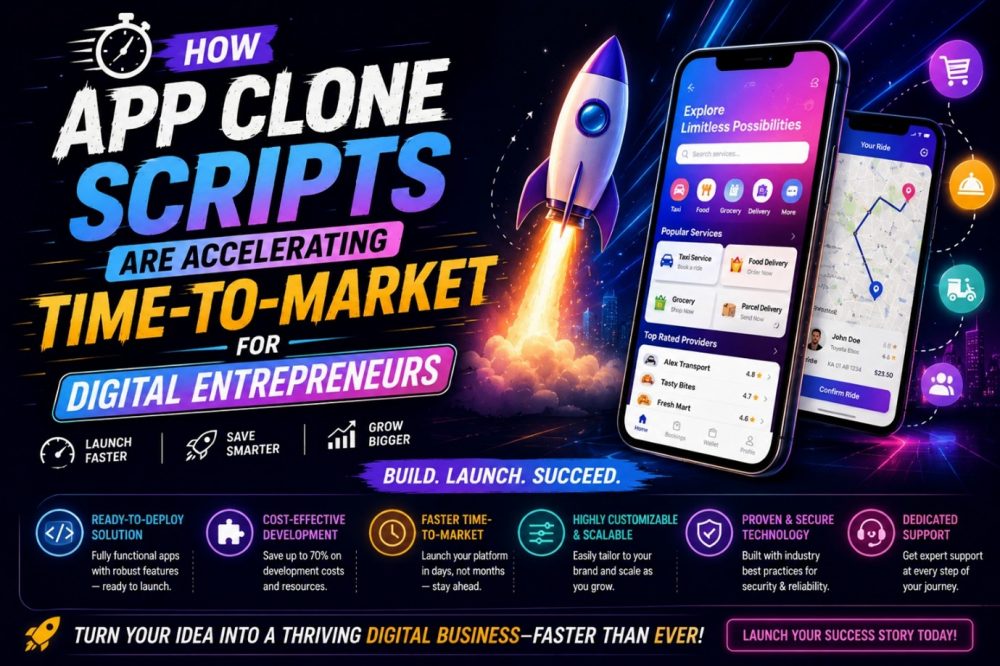
That is one reason app clone scripts have become so popular. They help founders launch proven business models faster, with lower upfront effort, and without building every feature from scratch.
Some people dismiss them too quickly, but they are solving a real business problem: speed.
What App Clone Scripts Actually Are
Despite the name, clone scripts are not about copying a business blindly. They are ready-made software frameworks inspired by successful app categories such as food delivery, ride booking, e-learning, marketplace platforms, streaming services, or on-demand home services.
They provide core features already built. User login systems, payment gateways, dashboards, notifications, search tools, admin panels, and vendor management modules often come included.
Instead of starting with a blank screen, founders begin with a functioning base and customize from there.
That difference saves enormous time. Blank screens are expensive.
Why Time-to-Market Matters So Much
In digital business, timing can matter as much as the product itself. Launch early with a useful service and you can capture attention before the market gets crowded. Launch too late and you may spend heavily just to be noticed.
Many entrepreneurs do not need perfection on day one. They need a usable version in the market, real customers, and honest feedback.
Clone scripts support that approach because they allow businesses to test demand quickly. If customers respond well, the platform can be improved and expanded. If not, adjustments can be made before burning huge budgets.
That is a much healthier way to learn than spending a year building features nobody asked for. Happens more often than people admit.
Lower Development Complexity
Custom development can become complicated fast. One feature leads to another, then another, and suddenly a simple idea has become a technical maze.
With clone scripts, many common functions are already structured. Entrepreneurs do not need to reinvent booking flows, checkout systems, review modules, or account settings.
This reduces project complexity and makes planning easier. It also helps non-technical founders who understand business opportunities but do not speak fluent developer.
There are many smart founders like that, by the way. Business skill and coding skill are not the same thing.
Customization Still Matters
A common mistake is assuming clone scripts should remain unchanged. That usually creates forgettable businesses.
The smarter approach is to use the script as a starting engine, then build a unique brand around it. Improve design, adapt features for a niche audience, simplify the customer journey or solve a regional problem better than global players do.
For example, a delivery platform in one city may need local payment options, multilingual support, or neighbourhood logistics features larger apps overlook.
That is where entrepreneurs can win. Not by copying, but by localizing and improving.
How No-code AI Platforms Add More Speed
Another interesting shift is how No-code AI Platforms are working alongside clone scripts. Founders can now add chat support, recommendation engines, automated onboarding, analytics dashboards, and workflow tools without hiring a large technical team.
That means a startup can launch using a clone script and then layer intelligent features quickly through no-code systems.
In plain terms, one small team can now do work that previously needed multiple specialists.
That changes the economics of launching a company quite a bit.
Better for MVP Thinking
Many successful startups begin as MVPs, minimum viable products. Not glamorous, but practical.
The goal is to launch something functional, gather feedback, and improve based on real behavior rather than assumptions. Clone scripts fit this model naturally because they provide enough structure to go live without waiting for perfection.
Users often reveal priorities faster than internal planning meetings ever will. Sometimes brutally fast.
You may think customers want ten advanced features. They may only care about fast checkout and reliable support. Useful lesson.
Cost Efficiency Helps Survival
Early-stage businesses often fail from running out of resources before gaining traction. That makes development efficiency extremely important.
Clone scripts usually reduce initial cost compared with fully custom builds. Money saved can go toward marketing, customer support, operations or product refinement.
Those areas are often ignored while founders obsess over software details. Understandable, but risky. A beautiful app no one knows about is still a problem.
Not Every Use Case Fits
To be fair, clone scripts are not perfect for every business. Highly innovative products with unusual workflows may still need custom development. Some low-quality scripts also create security or performance headaches.
So selection matters. Entrepreneurs should evaluate code quality, scalability, vendor support, update history, and customization flexibility before buying anything.
Cheap software that breaks under growth is not really cheap.
Final Thoughts
App clone scripts are growing because they match what many entrepreneurs actually need: faster launches, manageable costs, and a realistic path to market testing.
When combined with smart branding, customer insight, and tools like No-code AI Platforms, they can help founders compete surprisingly quickly.
Success still requires execution, of course. There is no shortcut for that.
But getting to market faster? That part has become much more achievable than it used to be.