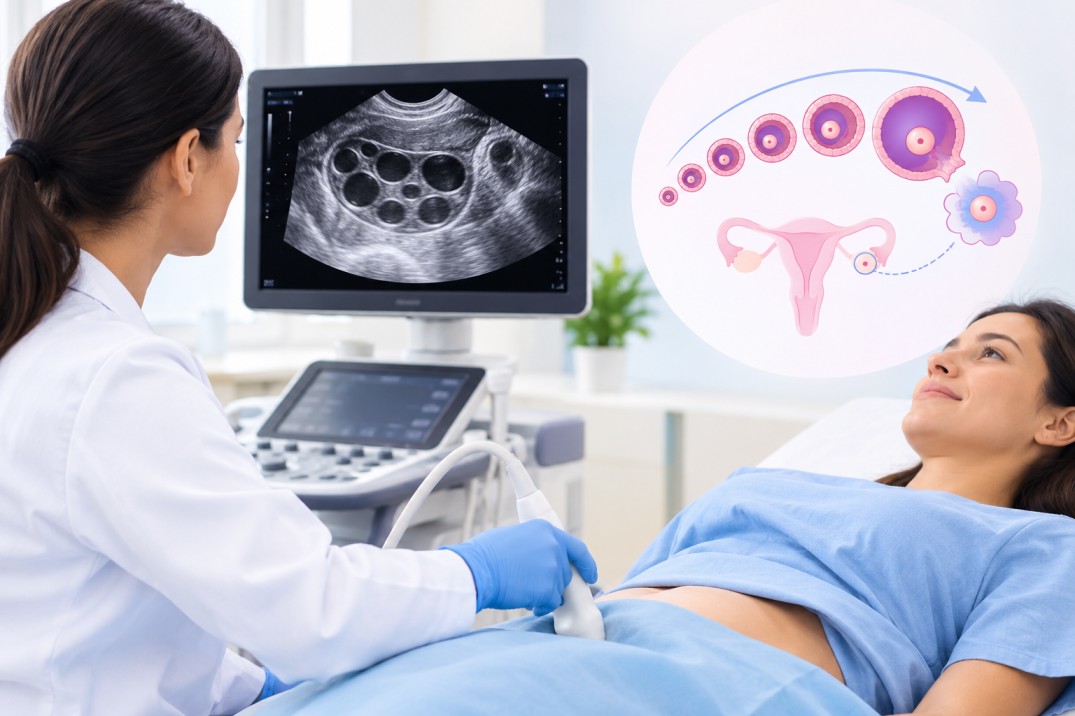
Conception becomes guesswork when ovulation runs late, runs erratically, or does not run at all. Three things have to be established for a couple trying to conceive. When ovulation occurs. Whether it is occurring normally. Whether the uterus is ready to receive an embryo. None of that is supplementary detail. It is the base every effective fertility plan is built on. A follicular scan, also called follicular monitoring, supplies all three at a precision no home ovulation kit or basal body temperature chart can reach.
What Is a Follicular Scan?
A follicular scan is a series of transvaginal ultrasound examinations, performed at set points across a woman’s menstrual cycle. A single ultrasound produces a snapshot. Follicular monitoring repeats the examination, usually from around day 9 to 10 of the cycle and then every one to two days, so that follicle growth in the ovaries is observed as it occurs. The follicle is the fluid-filled sac holding a mature egg and eventually releasing it. Which follicles develop, which becomes dominant, and when it ruptures are all visible to the clinician. Ovulation is watched directly rather than inferred.
What Does the Scan Actually Measure?
Two measurements are taken at each session. Between them, they establish the ideal timing for conception or for treatment.
- The dominant follicle: one follicle outgrows the others in a normal cycle. Maturity sufficient to rupture and release a viable egg requires a diameter of approximately 18 to 22 millimetres. A follicle that reaches this size and is absent from the next scan has ovulated. A follicle that fails to grow adequately, or that grows without rupturing, indicates luteinised unruptured follicle syndrome, known as LUF. Neither pattern is detectable on a home test.
- The endometrial lining: thickness and pattern of the uterine lining are measured at the same time. Successful implantation requires the endometrium to reach 8 to 12 millimetres, with a trilaminar or triple-layer pattern, by the time ovulation occurs. A thin or poorly developed lining accounts for a proportion of failed conceptions in women whose ovulation is otherwise normal.
Who Needs Follicular Monitoring?
Several clinical situations call for it:
- Irregular cycles, and polycystic ovary syndrome in particular, produce ovulation that is unpredictable or absent. Serial scanning separates the ovulatory cycles from the rest. It also fixes the point at which intercourse or insemination should be timed.
- Ovulation induction using letrozole or clomiphene is monitored by scan for three reasons. To confirm the medication is working. To prevent an over-response. To time the trigger injection, ordinarily an hCG shot, which controls the exact moment of ovulation.
- IUI and IVF cycles carry follicular monitoring as a core component of the protocol. Multiple follicles are stimulated simultaneously in IVF, and the daily or alternate-day scans guide the medication dose and fix the egg retrieval date.
- Unexplained infertility, where every initial investigation returns normal, frequently involves a subtle ovulatory dysfunction that only monitoring exposes. LUF syndrome, a short luteal phase and poor endometrial development, does not necessarily appear on a standard hormone blood test. All three are clearly visible on serial scanning.
What Happens If the Scan Reveals a Problem?
Confirming normal ovulation is half of what follicular monitoring is for. The other half is identifying precisely what is not working where conception has not occurred. A dominant follicle that fails to reach adequate size means the ovulation induction medication is adjusted. An endometrial lining that remains thin despite ovulation means targeted treatment with oestrogen supplements. A trigger injection required to produce ovulation at a precise time for IUI means the scan establishes exactly when it is administered.
The treatment plan changes directly as a result. Couples are not left uncertain about timing.
How Many Scans Are Typically Needed Per Cycle?
Two to four scans cover most monitoring cycles, starting around day 9 and running until ovulation is confirmed. Each session is short, ten to fifteen minutes as a rule, and done transvaginally because that gives the clearest image of the ovaries and uterus.
For women undergoing a follicular monitoring test in Delhi, how experienced the clinician reading those scans is matters a great deal, because follicular measurements drive clinical decisions in real time.
At Sehgal Nursing Home, follicular monitoring sits inside a full fertility assessment and treatment pathway, with scans read by experienced gynaecologists who use what they find to shape each patient’s plan individually. To schedule your follicular monitoring or fertility consultation at Sehgal Nursing Home, visit www.sehgalnursinghome.com or call +91 7827219633.
This article is for general educational purposes and is not a substitute for personalised medical advice from a qualified healthcare professional.