Words 1195 Characters 7600
Do you also sometimes get stuck on the gemstone cut selection for jewelry design? Understanding how each cut will perform is essential for making the right choice. The appearance, value, and brilliance of the jewelry design are partially derived from the well-cut gemstones used in it. Among the many gemstones cut available, Cabochon and faceted cuts are the most popular choices.
Both cuts bring timeless beauty and uniqueness to the gemstone, but they create totally different looks, feels, and visual experiences. They both differ in many ways than just clarity and smoothness, like both gemstones cut has its own design, feel, durability, production process, and retail value.
Keep reading this blog to understand both types of gemstone cuts, including the key factors to consider when selecting the right cut for any jewelry style. After reading this, half of your query about whether to go with a cabochon or faceted for your next jewelry style will be resolved.
What are Faceted and Cabochon?
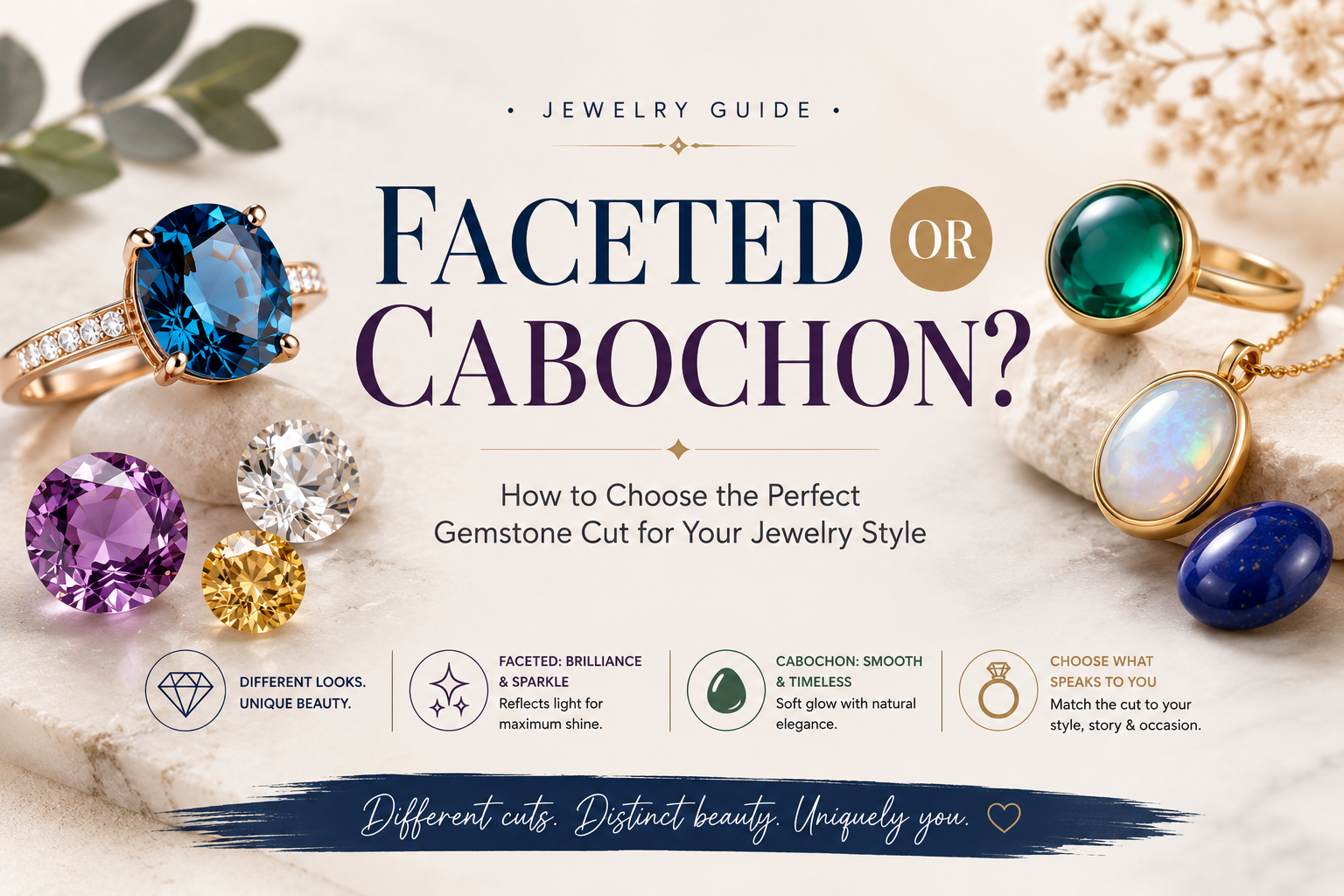
Faceted Gemstone- It is a stone cutting style where a gemstone is shaped with multiple flat, polished surfaces called facets. Rather than being added just for decoration, these facets act like small mirrors or lenses that are positioned carefully to maximize how light enters, reflects, and bounces back off the stone. When cut correctly, they enhance the brilliance, create sparkle, and reveal the gemstone’s color from different angles.
Faceting is the process that requires the science and technical work of grinding and polishing the flat surfaces of a raw gemstone. In this process, every decision affects the stone’s final appearance. This process helps in making a rough and dull gemstone into a sparkling one for fine jewelry. It is mainly used for transparent stones like diamonds, rubies, and sapphires.
Mostly faceted gemstones are either see-through or partially see-through, shiny, and made to do light work perfectly. These are generally used in jewelry where light and sparkle are the most important, like luxury collections, engagement rings, and bridal designs.
Cabochon Gemstone- It is a traditional stone cutting technique that is used to shape and polish the gemstone into a smooth, rounded dome with a flat or slightly curved bottom. This cut is mainly reserved for gemstones that are opaque, translucent, or phenomenal. This cut helps the stone to highlight internal light effects as well as reveal the natural color bands.
Cabochons mainly highlight gemstone textures, inclusions, and color variations instead of focusing on brilliance. By this, it preserves the organic beauty of the gemstones and helps to reflect light softly. These are very popular in artisan jewelry, bohemian designs, healing, and spiritual jewelry, in which a stone narrates a story and meaning.
Cabochons can be available in many shapes, such as oval, round, square, and in free form. Almost any mineral can be cut in this way, but some gemstones are exclusively found in cabochons like opal, moonstone, and turquoise.
Key Factors to Consider When Choosing a Gemstone Cut
1. Transparency and Optical Effect
Gemstone cut directly indicates how it interacts with light, and it is one of the most important factors when selecting a cut for any jewelry design. Some gemstones are prized for their sparkle, while others are valued for their unique optical effects and natural textures. If you want your gemstone to display fire and brilliance, then you should choose a faceted cut, as it maximizes light reflection and makes your jewelry piece more unique.
On the other hand, if your goal is to reflect the gemstone’s natural beauty and unique characteristics, such as color, inclusions, and patterns, then you should prefer cabochons. It shapes the gemstone into a smooth dome that enhances phenomena like adularescence, labradorescence, play-of-color, and asterism. Gemstones like moonstone, labradorite, opal, and turquoise often perform best as cabochons.
2. Gemstone Types & Natural Features
Before selecting a cut, understanding which type of gemstone will be used for the design is a very important step. Each gemstone holds different features and uniqueness, like some outstand the jewelry when they sparkle, and some provide the best result in a smooth shape with a natural pattern. The gemstone itself often determines which cut will suit it best.
When design needs transparent gemstones like sapphire, garnet, citrine, and amethyst, they are commonly faceted because their clarity allows light to move through the stone and create fire and brilliance. On the other side, for gemstone which are opaque or translucent materials like turquoise, lapis lazuli, and malachite are often cut as cabochons to highlight their rich color, patterns, and natural character.
3. Jewelry Style and Design Goal
When you have a specific design and goal in mind, selecting a cut is much easier. When the design needs to showcase the high-glamour, luxury sparkle, then go faceted. And when the design requires showcasing an earthy, vintage, or bohemian look, choose cabochons.
When designing a piece, decide whether the goal is sparkle and sophistication or color, texture, and individuality. Faceted gemstones are mainly used for wedding, luxury, and formal event designs, whereas cabochons are used for those jewelry styles in which the gemstone itself is the main element. Most common cabochons used in artisan, bohemian, vintage-inspired, and nature-focused jewelry designs.
4. Durability
Understanding how consistently the design will be worn in the lifestyle can help determine whether brilliance or durability should take priority. One of the most important considerations when choosing a cut is whether the design is intended to be worn for everyday use or for special events.
To choose between the two cuts, check the gemstone’s hardness. Faceted stones are more fragile and have vulnerable edges and corners where chipping can easily occur if the stone receives any kind of hard knock, requiring more careful setting, handling, and day-to-day care. While cabochons have high durability as it does not have sharp corners and thin edges. It works well in everyday and casual jewelry styles.
5. Construction and Setting Style
In the jewelry makers, designers, and artisans point of view, choosing the construction method early before the design process can help to ensure both the beauty and the durability of the finished piece. Selecting cut is mostly depends on the physical traits of the final gemstone, and how it will be set can also influence the ideal cut.
Faceted stones are generally used in prong, halo, and other open settings, while cabochons are used for bezel setting, handicraft pieces, and wire-wrapped designs.
Conclusion
Selecting between the cabochon and faceted gemstone cuts for jewelry style ultimately comes down to what you want to showcase and the qualities of the gemstone. Both cuts enhance the natural beauty of the stone; the cabochon adds depth, brings out the natural beauty, and provides a vintage look. On the other side, faceted enhances stones sparkle, fire, and transparency that easily catch people’s attention. By considering factors such as transparency, durability, gemstone natural characteristics, and setting requirements, you can select the right cut with more confidence that will allow the stone’s natural qualities to shine in the way you envision.
Ready to explore the Sparkling Faceted and cabochon Gemstone Collection? If you are creating luxury fine jewelry or artisan design, discover our cabochon and faceted gemstones for sale collection at GemstonesForSale.