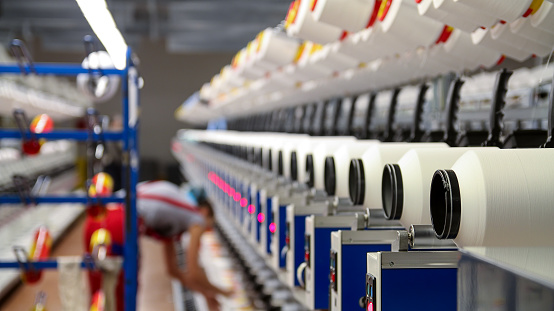
Dimethylformamide does not show up in the final yarn, but it decides how that yarn behaves long before winding. Inside a fiber plant, it sits in tanks, pipelines, spinning lines, and recovery columns. It is heated, cooled, circulated, stripped, and reused. Nothing dramatic happens in one step. The change builds slowly. A line that was running stable starts needing small corrections. Viscosity drifts. Filament break frequency rises. Operators adjust, compensate, move forward. The root sits upstream.
This is where plants prefer to work with dimethylformamide suppliers India that deliver the same material every time, not just something that passes a lab sheet once.
What Actually Happens Inside a Fiber Line
In acrylic or elastane production, polymer is dissolved into DMF to form a spinning solution. This is not a dilute mix. Polymer concentration can sit between 22% and 30%. At that level, the liquid behaves more like a controlled mass than a free-flowing solvent.
The solution moves through metering pumps into spinnerets with holes sometimes below 80–100 microns. Any shift in viscosity shows up immediately at the nozzle. A 5% rise does not sound serious, but it changes flow rate through each hole. That turns into uneven denier across filaments. That turns into variation in strength and dye uptake later.
Viscosity here is not controlled only by polymer loading. It reacts to water content and trace compounds inside the solvent. A change from 0.03% to 0.08% moisture is enough to alter the flow behavior of the dope. That is why teams dealing with Dimethylformamide chemical suppliers India do not stop at purity numbers. They watch how the solution behaves in motion.
Solvent Behavior During Spinning
Once the solution exits the spinneret, it enters a coagulation zone. In wet spinning, this is usually water or a water-rich bath. DMF starts moving out. Water moves in. The polymer solidifies.
The speed of that exchange decides internal fiber structure. Too fast, and a skin forms early, trapping solvent inside. That leads to voids. Too slow, and the filament deforms before setting.
The Role of DMF in fiber production sits right here. It must diffuse at a predictable rate. That rate depends on composition. If the incoming solvent already carries extra water, the driving force for exchange drops. Diffusion slows. Structure changes.
No alarms go off. The fiber still forms. But tensile strength shifts. Elongation changes. Uniformity slips. These are not sudden failures. They are slow drifts.
Plants that work with dimethylformamide suppliers India track this behavior over time because it does not show up in one batch. It shows up across weeks.
Where The Solvent Gets Used
The Dimethylformamide uses in the textile industry sit mostly in synthetic fiber segments. Acrylic fiber is the largest block. Polyacrylonitrile does not dissolve easily in many solvents. DMF handles it well and allows stable spinning.
In elastane production, DMF carries polyurethane chains during solution spinning. The solvent allows chain extension and alignment before solidification. Mechanical properties like stretch and recovery depend on how stable that environment remains.
There are also coating applications where DMF carries polymers onto fabric surfaces. Here, evaporation matters. If heavier fractions remain, drying becomes uneven. If lighter fractions dominate, flash-off becomes too fast, affecting film formation.
Across all these uses, the solvent is not just present. It controls the process window. That is why Industrial DMF suppliers India are judged on repeatability rather than peak purity.
Recovery Is Where Problems Start to Show
No plant throws DMF after one use. Recovery systems pull it back through distillation. Typical recovery sits around 92–96%. The rest stays behind with heavy residues.
Each cycle adds something small. Polymer fines, degradation traces, absorbed moisture. Nothing large enough to stop production. Enough to change behavior slightly.
Cycle after cycle, those small additions stack up. Viscosity response shifts. Boiling range widens a bit. Residue after distillation increases.
At this point, fresh solvent is added to balance the system. If that fresh input is not consistent, the system does not stabilize. It keeps moving.
This is where dependency on Dimethylformamide chemical suppliers India becomes visible. Stable supply keeps recovery under control. Variable supply amplifies drift.
Numbers That Actually Matter on The Floor
Purity above 99.9% looks good on paper, but floor-level decisions rely on smaller numbers.
Water below 0.05% is usually needed for stable spinning. At 0.1%, differences start appearing in coagulation behavior.
Dimethylamine in tens of ppm can influence reaction residues or interact with polymer chains. It does not stop production, but it shifts consistency.
Boiling range tightness matters during drying. If fractions spread out, some solvent leaves early, some stays longer. That creates uneven evaporation.
These are not theoretical concerns. They show up as line adjustments, not lab failures. Plants that work with dimethylformamide suppliers India monitor these parameters continuously because they translate directly into process control effort.
Storage And Movement Change the Solvent
The solvent that leaves a production unit is not exactly the same when it reaches the spinning tank.
Transfer through pipelines exposes it to air. Storage tanks breathe. Temperature changes during the day. Each of these adds a small variation.
Moisture creeps in. Oxygen reacts slowly. Nothing dramatic. Enough to move numbers slightly.
If storage temperature rises above 30°C regularly, minor degradation speeds up. Over time, this adds to impurity load.
This is why coordination with Indian DMF exporters and suppliers goes beyond dispatch. Transport conditions, tank design, and handling practices all affect what finally enters the process.
Export Supply and Demand Pressure
India supplies DMF to both domestic textile plants and export markets. Production volumes are large enough to support both, but consistency becomes the differentiator.
Export buyers look for repeatability. Not just one good shipment. Multiple shipments that behave the same way.
This has pushed Indian DMF exporters and suppliers to tighten process control, especially around distillation and storage. Variability that might pass locally does not pass in export markets where long-term contracts depend on stable performance.
Safety And Loss Control
DMF is not handled casually in textile plants. Closed systems are used because of its toxicity and cost. Vapor recovery units capture losses. Distillation columns reduce waste.
Loss of even 2–3% over time is significant at scale. That loss often links back to volatility variation or handling inefficiencies.
Better solvent control reduces both loss and exposure. Plants that work with dimethylformamide suppliers India often align with suppliers who maintain consistent volatility profiles because that directly affects emission control systems.
Why Consistency Wins Over Everything Else
A slightly cheaper solvent that behaves differently every batch creates more cost than it saves. Adjustments consume time. Off-spec material increases waste. Recovery systems struggle.
A consistent solvent reduces intervention. Lines run longer without correction. Output stays within range.
This is why procurement decisions shift toward reliability. Plants prefer to work with dimethylformamide suppliers India who can deliver the same composition repeatedly, even if the headline purity difference is small.
Practical Supplier Evaluation Metrics Used on the Plant Floor
Most supplier comparisons do not happen in meeting rooms. They happen quietly on the production floor over weeks of running material. Operators and process engineers start noticing patterns. One supplier’s solvent needs more correction. Another one runs stable without intervention. These observations are rarely written formally, but they decide long-term sourcing.
When plants work with dimethylformamide suppliers India, they do not rely only on COA values. They track how the solvent behaves across cycles, especially in spinning stability, recovery efficiency, and evaporation consistency. The differences become measurable when linked directly to production output.
Below is how these parameters translate in real operation:
| Parameter Observed In DMF | Typical Acceptable Range | What Happens If It Drifts | Visible Impact On Fiber Line |
| Water Content | ≤ 0.05% | Slows diffusion in coagulation | Irregular filament formation, variation in denier |
| Dimethylamine (ppm) | < 50 ppm | Alters chemical environment of polymer | Slight drop in tensile strength, inconsistency in elongation |
| Boiling Range | Tight near 153°C | Broadens due to mixed fractions | Uneven drying, residual solvent in fibers |
| Non-Volatile Residue | < 0.01% | Builds up in recovery cycles | Increased fouling in distillation, reduced recovery efficiency |
| Color / Clarity | Clear, low APHA | Indicates degradation or contamination | No immediate failure, but long-term instability |
| Odor Shift | Mild amine note | Indicates decomposition onset | Early signal before measurable impurity rise |
None of these parameters alone shuts down a line. The issue starts when two or three begin drifting together. That is when correction frequency increases. Pumps need recalibration. Coagulation conditions get adjusted. Recovery columns need tighter control.
This is where consistency from Dimethylformamide chemical suppliers India becomes visible in operational terms. A stable supplier reduces these corrections. A variable one increases hidden workload.
Plants do not always reject a batch when variation appears. Instead, they adapt. But adaptation has a cost. More monitoring, more manual correction, more variability in output.
Over time, these small differences decide supplier preference. Not because one sample failed, but because one system ran smoother than the other.
What This Means in Practice
Dimethylformamide is not visible in the final textile product, but it leaves its mark everywhere in the process. Fiber strength, uniformity, elasticity, and finish all trace back to how stable the spinning environment was.
That environment depends on the solvent.
Small changes do not stay small. They accumulate. They pass through pumps, spinnerets, baths, dryers, and recovery systems. By the time they show up, they look like process variation.
In reality, they started at the source.
So, the decision to work with dimethylformamide suppliers India is less about buying a chemical and more about controlling a system that runs continuously, where stability is built one batch at a time, and lost the same way.