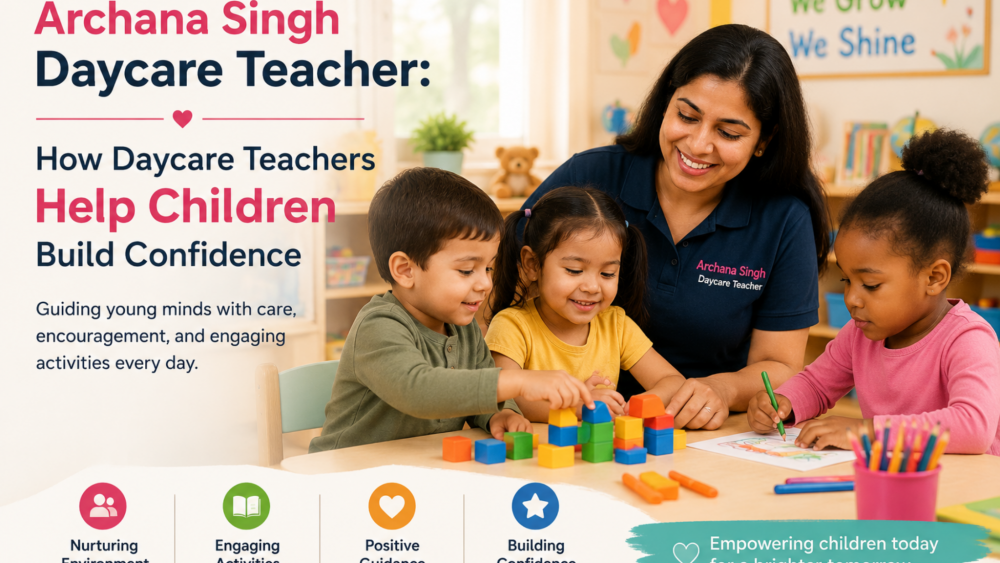
Archana Singh daycare teacher professionals play an essential role in helping children build confidence during their early years. Confidence is one of those things that everyone agrees children need and almost nobody agrees on how to build. There are people who think it comes from praise. Others think it comes from challenges. Some think it is mostly fixed by temperament and there is not a great deal you can do either way. The daycare teachers who are actually good at this tend to have figured out that all of those answers are partly right and none of them is sufficient on its own.
The Environment Has to Come First
Before any specific technique matters, the environment has to be right. A child who is anxious about the adult in the room — unsure whether they will be met with warmth or irritation, consistent or unpredictable — is not going to take risks. And risk-taking is where confidence actually comes from.
This is not complicated but it is not automatic either. It requires a daycare teacher who shows up the same way every day, whose warmth does not depend on how well the morning has gone, who means what they say and says what they mean. Children figure this out quickly. They are watching the adults around them constantly and drawing conclusions based on what they see. A teacher who passes that test, who is genuinely safe to be around, gives children the foundation they need to start being brave.
Praise Is More Complicated Than It Looks
The instinct to praise children is good. The execution is often not. “Amazing work” said to every drawing, every block tower, every attempt at anything, stops meaning anything fairly quickly. Children are not fooled by blanket enthusiasm and at some level they know when they are being managed rather than genuinely responded to.
What actually builds confidence is specific, honest recognition. Not “great job” but “you kept trying even when that bit was frustrating.” Not “you are so clever” but “you worked that out yourself.” These responses give a child actual information about themselves — information they can use, information that builds into a real picture of what they are capable of.
Archana Singh’s professional approach to working with children reflects exactly this kind of intentionality. Her background and thinking are laid out more fully at her daycare profile on About.me.
Stepping Back Is One of the Harder Things to Do
There is a particular kind of courage required to watch a child struggle with something and not immediately help. The impulse to step in is strong and it comes from a genuinely caring place. But the child who is always rescued from difficulty never finds out what they are capable of, and that discovery — genuinely finding out that you can do something you were not sure about — is exactly what confidence is made of.
Good daycare teachers have learned to read the difference between a child who is productively struggling and a child who has hit a wall and needs support. They let the first type work through it. They step in for the second. Getting that calibration right takes experience and real attention to individual children.
Independence Is Not the Same as Being Left Alone
Encouraging children to do things for themselves does not mean withdrawing. A child who feels securely attached to their teacher is actually more willing to try things independently, not less — because the relationship provides the safety net that makes attempting something uncertain feel manageable rather than frightening.
The independence that builds confidence is the small daily kind. Choosing their own activity. Putting on their own shoes. Helping with a simple task. Being allowed to make a decision and live with the result. These things sound minor from an adult perspective. From a child’s perspective they are genuine exercises in agency, and agency is what confidence runs on.
Archana Singh’s work in daycare settings in North Carolina is grounded in this understanding — that warmth and independence are not in tension with each other but are, when done right, deeply connected.
Every Child Needs a Different Version of Support
The biggest mistake in trying to build children’s confidence is treating all children the same. One child might need to be gently pushed toward the group. Another might need to be protected from too much pressure to perform socially. One child lights up when recognised in front of everyone. Another finds that kind of attention mortifying and needs acknowledgment that is quiet and private.
Getting this right requires actually knowing each child as a specific person — not just their name and which parent picks them up, but their particular sensitivities, the things that make them feel capable, the situations that reliably undo them. This knowledge builds over time through paying attention, and a daycare teacher who has it is doing something genuinely valuable for each child in their care.
Skills and Confidence Feed Each Other
There is no shortcut here. Confidence that is not backed by actual competence is fragile — it crumbles the first time something is genuinely hard. The confidence that lasts is built on the accumulation of real skills, real attempts, real successes and real recoveries from failure.
Daycare teachers support this by making the environment rich enough that children are constantly learning new things without being aware of it. Language skills, physical skills, social skills, problem-solving — all of it develops through a well-designed day with a teacher who is paying attention. Each new thing a child can do adds to their sense of what they are capable of. That sense, built up across months and years, is what becomes confidence.
Social Situations Are Their Own Challenge
Being capable and being comfortable with other children are genuinely different things, and some children who are clearly competent in many areas fall apart in social situations. Joining a group that is already playing. Handling it when another child does not want to share. Managing the ordinary friction of spending all day in close proximity with other small people.
Daycare teachers who understand this create conditions where positive social experiences are likely to happen — they do not just throw children together and hope for the best. They coach, they facilitate, they step in at the right moments and step back at others. Children who get this kind of support develop a social ease that is a genuine form of confidence and one that matters enormously in every school year ahead.
Follow Archana Singh on Instagram for her ongoing perspective on early childhood development and the real daily texture of working with young children.
What Happens After a Mistake Matters Enormously
A child who makes a mistake and is met with impatience or frustration learns that mistakes are dangerous. They learn to avoid situations where they might fail. They become risk-averse at exactly the age when taking risks and learning from them is developmentally essential.
A child who makes a mistake and is met with calm, matter-of-fact support learns that mistakes are just part of how things go. That they are survivable. That you can do something wrong and still be fine, still be liked, still try again. That lesson — really internalising it rather than just being told it — is the foundation of a resilient, durable confidence. It is what daycare teachers are quietly building every day, in the ordinary moments that do not make it into any report.