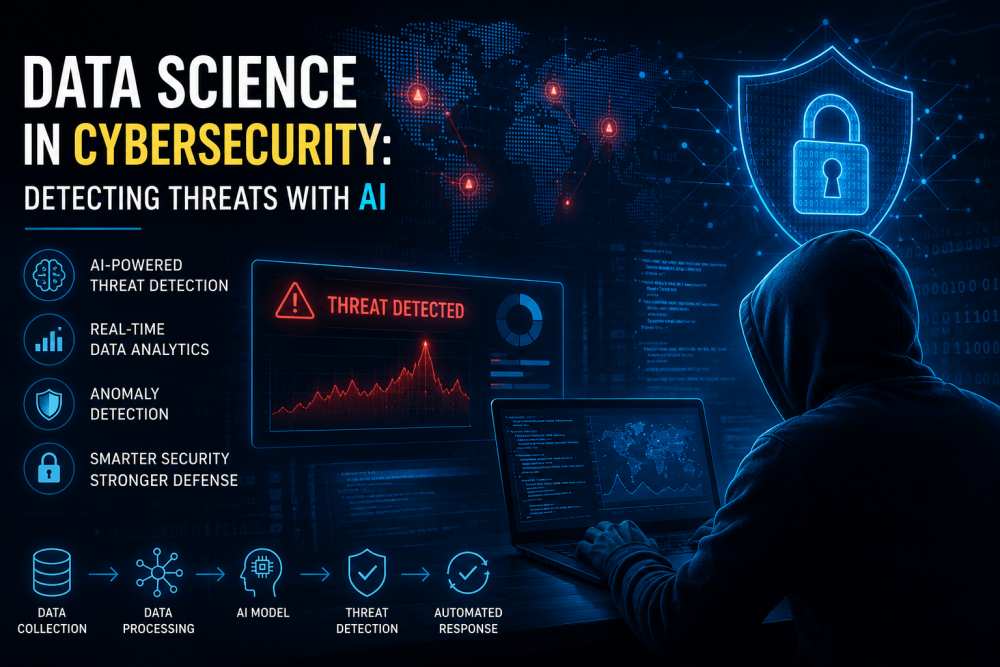
Most security teams aren’t losing to smarter attackers. They’re losing to volume. There’s simply more traffic, more logins, more endpoints, and more noise than any group of analysts can watch by hand and that gap is exactly where data science has started to earn its place in the security operations center.
Attackers know this too. Reconnaissance is automated now. Infrastructure gets rotated before it can be blacklisted. And a lot of the more damaging activity doesn’t look like an “attack” at all; it looks like someone logging in with the right password at the wrong time. Rule-based tools were never built to catch that. They can only flag what someone already told them to flag. Data science and machine learning exist, in large part, to cover what rules can’t.
What Is Data Science in Cybersecurity?
Strip away the buzzwords and it’s really just statistics, machine learning, and log analysis working together to catch and ideally predict threats, instead of relying on a static list of known bad signatures. The question changes, too. A signature-based tool asks “have I seen this exact thing before?” A model asks something closer to “does this look like how this user, this device, this network normally behaves?” That shift, small as it sounds, is what lets it catch things nobody’s written a rule for yet.
That distinction matters more than it sounds. A mid-sized company can generate millions of log events a day across cloud apps, endpoints, and internal systems far more than a human team could ever read line by line. Data science expertise is what turns that pile of logs into something an analyst can actually act on: a short list of things worth their attention, instead of an inbox full of alerts.
Why Traditional Tools Keep Missing Things
Signature-based tools really only do one thing well: recognize a threat that’s already been named and catalogued somewhere. The moment something genuinely new shows up, it walks right past them, undetected. That covers a lot more ground than people expect things like:
- Zero-day exploits with no signature to match against
- Polymorphic malware that rewrites its own code to dodge detection
- Insider threats, where the person doing the damage has completely legitimate credentials
- Slow, quiet attacks designed to stay just under the alert threshold
I’ve watched teams run a well-maintained SIEM for years and still get caught off guard by something that, on paper, followed every access rule they had. Nothing was technically broken. The problem was that no rule had been written for that exact sequence of events because nobody could have predicted it in advance. That’s the specific hole AI-driven anomaly detection is built to fill: catching the thing nobody thought to write a rule for.
How AI and Machine Learning Actually Catch Threats
Strip away the complexity underneath, and the actual idea is pretty straightforward: figure out what “normal” looks like for a given network, then keep an eye out for whenever something starts drifting away from that baseline.
Anomaly detection. Models build a baseline for login times, data transfer volumes, and access patterns. A login from an unfamiliar location at 3 a.m., followed by a large export, doesn’t need a signature to raise a flag, it just needs to look different from that user’s usual routine.
Behavioral analytics (UEBA). This tracks patterns tied to a specific account or device over time, which is what makes it useful against insider threats and stolen credentials. The access itself is legitimate. The behavior around it isn’t.
Predictive threat intelligence. By studying historical attack data, models can estimate which attack types are more likely to hit a given industry or system, which helps teams decide where to put their defenses before something happens rather than after.
NLP for phishing. Language models look at email content, sender history, and writing patterns to catch phishing including business email compromise attempts that do a decent job of mimicking how an executive actually writes.
Automated threat hunting. Rather than sitting and waiting for an alert to fire, models actively dig through historical and live data looking for indicators of compromise, often cross-referenced against a framework like MITRE ATT&CK to identify known attacker tactics.
Traditional Security vs. AI-Driven Security
| Factor | Traditional Rule-Based Security | AI/Data Science-Driven Security |
| Detection Method | Known signatures and static rules | Behavioral patterns and anomaly scoring |
| Zero-Day Threats | Little to no coverage | Can flag unusual behavior with no prior knowledge |
| False Positives | Often high rules are rigid | Drops over time as the model learns context |
| Response Speed | Manual triage | Can trigger automated response workflows |
| Adaptability | Needs manual rule updates | Learns continuously from new data |
| Insider Threat Detection | Weak | Strong, through behavioral baselines |
Where This Shows Up in Practice
Financial services. Banks lean on anomaly detection to catch fraudulent transactions as they happen, weighing velocity, location, and device fingerprint together rather than one factor at a time.
Healthcare. Hospitals use behavioral analytics to catch unauthorized access to patient records, a place where early detection isn’t optional given how strict compliance requirements are.
E-commerce. Retailers use machine learning to spot account takeovers by noticing login patterns that don’t match how a customer normally behaves.
Enterprise IT teams tend to run AI-enhanced SIEM and SOAR platforms for one main reason: correlating alerts across thousands of endpoints by hand just isn’t realistic. The real value isn’t the tech itself, it’s what it saves analysts from: getting buried under noise that would otherwise drown out the alerts that actually matter.
Getting Started: A Practical Framework
- Audit what you already have. Most companies collect more log and telemetry data than they realize before buying anything new.
- Let the model learn before you trust it. Give it time to build behavioral baselines for users, devices, and applications before you start acting on its alerts.
- Plug it into your existing stack. AI models do their best work feeding into your current SIEM, EDR, or SOAR setup not sitting off to the side as a separate tool nobody checks.
- Tune for fewer false alarms. Sit down with your security team and calibrate thresholds so analysts aren’t drowning in noise during the early weeks.
- Keep a human in the loop. Let the model flag and prioritize. Let trained analysts make the final call on anything that actually matters.
- Retrain on a schedule. Threats evolve. A model trained on last year’s patterns will quietly get worse over time if nobody refreshes it.
What to Plan For (Because It Won’t Be Frictionless)
- Data quality. A model is only as good as what it’s fed. Gaps or inconsistencies in logging show up directly as gaps in detection.
- Alert fatigue early on. Expect more false positives than you’d like while the baseline settles this is normal, not a sign the tool is broken.
- Skill gaps. Reading model output well takes analysts who understand both security operations and enough data science to know when to trust or question a result.
- Adversarial adaptation. Attackers who know detection models exist will study them and adjust their behavior to blend in, which means the model can’t just be trained once and left alone.
Key Takeaways
- Machine learning and behavioral analytics catch what signature-based tools were never designed to see.
- The biggest wins show up against zero-days, insider threats, and slow-moving attacks that stay under the radar.
- Success depends less on the model itself and more on data quality, integration, and keeping analysts in the loop.
- Finance, healthcare, e-commerce, and enterprise IT are already running this in production; this isn’t a future-state idea.
- AI doesn’t replace the analyst. It just clears enough noise that their judgment actually gets used where it counts.
FAQ
Here’s the FAQ section rewritten with more natural variation different answer lengths, a bit of personal phrasing, less symmetrical “textbook” structure:
How does AI catch cybersecurity threats?
It watches what’s normal for a given network or user typical login times, usual data flow and flags the moments that break that pattern. Under the hood that’s a mix of anomaly detection, behavioral analytics, and pattern recognition working together, but the short version is: it notices when something’s off.
Where does data science actually fit into cybersecurity?
Think of it as the translation layer. Your systems generate an overwhelming amount of raw log data. Data science is what turns that into something a person can actually use: risk scores, flagged patterns, a shortlist worth looking at instead of a wall of noise.
Does machine learning replace the tools we already have?
No and honestly, that’s not
the goal. It sits on top of your existing setup and catches the stuff signature-based tools were never going to see in the first place. Think addition, not replacement.
So how accurate is it, really?
That depends a lot on your data and how well the model’s been tuned. Give it good data and time to learn, and false positives drop off noticeably. That said, I wouldn’t let it make the final call on anything serious without a person double-checking.
Is this realistic for a smaller business, or just enterprise-level stuff?
It used to be mostly an enterprise thing, but that’s changed. A lot of cloud security platforms now have AI detection built right in, so a small or mid-sized team can get the benefit without hiring a data science department.
What’s actually different between anomaly detection and signature-based detection?
Signature-based detection is basically a lookup that checks activity against a list of known bad patterns. Anomaly detection doesn’t need that list; it just notices when something deviates from what’s normal, which is exactly why it can catch things nobody’s ever seen before.
How long before this is actually working well?
Somewhere between a few weeks and a few months, in my experience it comes down to how much data you’re feeding it and how mature your infrastructure already is. Don’t expect it to be reliable on day one; the baseline needs time to settle.
Do we need to hire a data science team to do this?
Not necessarily. A lot of vendors already build AI detection into their platforms, so you’re not starting from scratch. Bigger companies tend to get more out of having dedicated analysts on staff, but it’s not a prerequisite to get going.
Conclusion
None of this replaces a good security team, it just gives that team a fighting chance against a volume of activity no human group could review alone. As attacks keep getting more automated and harder to catch with static rules, behavioral Data science companies are one of the more practical ways to catch problems earlier and respond before they spread. The organizations building this now are the ones that won’t be scrambling when the next attack doesn’t follow any rule they’ve written yet.