Introduction
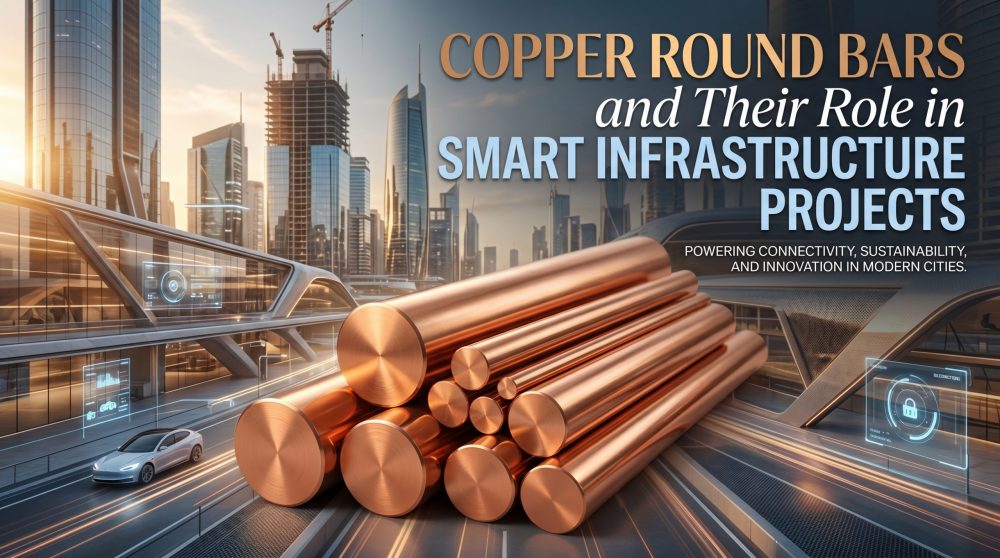
Copper round bars are used in some of the most important work in modern infrastructure. As cities grow smarter and power systems grow more complex, the materials that carry electricity must be reliable, efficient, and built to last. Copper bars for electrical infrastructure have become a cornerstone of this evolution, from smart grids and metro systems to EV charging networks and renewable energy plants. Rapid urbanisation is accelerating demand, and engineers and procurement teams worldwide are specifying copper more than ever.
What Are Copper Round Bars?
Copper round bars are solid cylindrical copper products manufactured in a range of diameters for use across electrical, mechanical, and industrial applications. They’re machined, formed, or directly installed as conductors, connectors, and structural components in power systems. ETP copper round bars, where ETP stands for Electrolytic Tough Pitch, are the most commonly specified grade for electrical work. The ETP designation indicates high-purity copper with oxygen content controlled to a level that gives it excellent electrical conductivity. ASTM B187 copper round bars define the standard for copper bars, rods, and shapes used in industrial applications, covering dimensional tolerances, mechanical performance, and material consistency. Most electrical-grade copper round bars in professional procurement channels are specified to this standard.
Why Copper is Preferred in Smart Infrastructure
High-conductivity copper bars carry electrical current with minimal resistance loss, and in smart infrastructure, every watt matters. Smart grids need to transmit power efficiently over long distances and through complex switching networks. Renewable energy systems, including solar farms and wind installations, generate electricity that must reach distribution points without excessive loss in transit. Data centres run on power and cooling, both of which depend on copper’s dual performance in electrical and thermal conductivity. Urban electrical networks must handle increasing load without bottlenecks. Copper handles all of this dependably. It doesn’t just perform well on day one; it stands up to years of service with consistent conductivity and without the degradation issues that affect some alternatives.
Role of Copper Round Bars in Electrical Infrastructure
Copper bars for electrical infrastructure appear at virtually every stage of a modern power system. Here’s where they do their most critical work:
- Power distribution systems: Copper round bars are an important part of busbars in switchboards and distribution panels, carrying high currents efficiently between connection points
- Electrical grounding systems: Earthing conductors manufactured from copper round bars provide low-resistance paths to ground, protecting equipment and people from fault currents
- Busbars and connectors: Switchgear, panel boards and power distribution units use busbars made from copper bar stock to connect multiple circuits; copper’s conductivity helps to prevent heat build-up
- Switchgear components: Contact arms, arcing tips, and current-carrying parts in medium and high-voltage switchgear rely on copper’s conductivity and wear resistance
- Transformer manufacturing: Winding connections and tap changers in transformers rely on copper bar stock because stable conductivity across temperature cycles is non-negotiable
- EV Charging Networks: Copper round bars are the usual choice for DC fast chargers and high power charging stations requiring copper conductors to carry high continuous current without overheating
ETP Copper Round Bars and Their Industrial Importance
ETP copper round bars are the standard of electrical engineering. ETP copper is a high-purity composition, with one of the greatest electrical conductivity ratings offered in a commercial metal, meaning that current passes through it with relatively little energy lost as heat. In power systems, that means efficiency and reliability directly. ETP copper machines cleanly and forms without cracking, making it practicable to fabricate into connectors, contact tips, busbars and precision components. Reliability in power systems is not only a performance measure but also a safety necessity. ETP copper is a high-quality, reliable product with consistent performance over decades of use without substantial degradation.
ASTM B187 Copper Round Bars Standards
ASTM B187 copper round bars are manufactured to a specification that covers copper bar, rod, and shapes intended for electrical and industrial applications. The standard provides dimensional tolerances, mechanical properties and chemical composition requirements, all of which are important when specifying material for critical infrastructure work. Procurement teams and engineers can be assured that what arrives on site is what was specified with certified ASTM B187 material. Industrial compliance is not a bureaucratic formality, but the difference between a system that functions as intended and one that introduces unpredictable risk. For smart infrastructure projects where long-term reliability is a design requirement, sourcing ASTM-certified copper bar stock is a basic professional standard.
Copper Round Bars in Smart City Projects
Smart cities rely on infrastructure that operates discreetly and all the time. Copper round bars help with this in a couple of direct ways. In smart power grids, copper busbars and conductors are used to control load distribution and switching in complex metropolitan networks. To move trains and protect passengers, metro rail systems depend on copper conductor rails and earthing systems. Copper conductors are needed for renewable energy infrastructure from the site of generation to the distribution network. Smart buildings employ copper for main electrical risers, busbar trunking systems and earthing grids. The communication infrastructure, including 5G base stations and data centres, uses copper to deliver power and signal connections. EV charging stations across urban centres each require reliable copper conductors rated for continuous high-current operation. They are all copper-based.
Advantages of High Conductivity Copper Bars
High-conductivity copper bars offer a combination of properties that no single alternative matches across all these applications.
| Property | Benefit |
| High Conductivity | Efficient power transfer with minimal energy loss |
| Corrosion Resistance | Longer service life with lower maintenance cost |
| Thermal Conductivity | Better heat dissipation, keeping systems cooler |
| Machinability | Easy fabrication into precision components |
| Durability | Reliable long-term performance in demanding environments |
Copper Round Bars vs Other Conductive Materials
Copper isn’t the only conductive material available, but for infrastructure applications, it consistently comes out ahead where it counts.
| Material | Conductivity | Durability | Cost Efficiency |
| Copper | Excellent | High | High long-term value |
| Aluminium | Moderate | Moderate | Lower initial cost |
| Steel | Lower | High strength | Limited conductivity |
Copper is the preferred material when both conductivity and reliability are important. Aluminium is reasonable at the outset, but its conductivity is lower, so to carry the same current you need larger cross-sections, and its connections need to be more carefully maintained. Steel is a structural material but not a serious conductor for power applications. Smart infrastructure values long-term efficiency over short-term savings and copper’s performance over a full lifecycle continues to support its specification.
Industrial Applications of Copper Round Bars
Smart city infrastructure is just one of many industrial settings where copper round bars are used.
- Electrical panels: Used as busbar material and link connections in distribution boards and control panels; the conductivity of copper helps to keep the temperatures in the panels under control
- Power Generation Systems: Generator terminals, excitation systems and output connections. Copper bar stock for reliable, low-resistance transfer of current
- Earthing systems: Buried Earth Electrodes and Earthing Conductors in Industrial Plants and Substations are made of copper round bars. Corrosion Resistance ensures their reliability underground
- Industrial machinery: Copper bars are used in high-current machinery contacts, collector rings, and winding connections to guarantee a stable and long-term electrical performance
- Renewable energy equipment: Copper round bars are standard for inverter connections, DC busbars in solar arrays and wind turbine generator terminals
- Telecommunications infrastructure: Copper performance (electrical and thermal) is critical to power supply bus systems and earthing networks in telecoms installations and data centres
Conclusion
Copper round bars are essential to the infrastructure on which modern cities are built. High conductivity, thermal stability, corrosion resistance, and long service life make them the reliable choice across power distribution, smart grids, renewable energy, and EV charging systems. ETP copper round bars deliver the conductivity performance that electrical applications demand, and ASTM B187-compliant material gives procurement teams the quality assurance that critical infrastructure requires. With the rapid development of smart city construction, the demand for high-quality copper infrastructure materials will gradually increase. RK Copper & Alloy LLP has been a supplier of copper products since 1991. Contact our team to discuss specifications and availability when sourcing copper round bars for your next project.