Picking the wrong AI solutions partner is one of the more expensive mistakes a business can make in 2026. Not because AI is risky by nature — but because the gap between a firm that understands your business and one that just sells you a stack of tools has never been wider.
The market is crowded. Every vendor promises transformation. Most deliver a demo.
So how do you actually tell the difference? Here’s what to look for — and what to walk away from.
Start with the problem, not the technology
The first thing a real AI solutions partner does is ask about your business — not pitch you a product. If someone walks into your first conversation already explaining which models they use or which platforms they prefer, that’s a sign they’re selling a solution in search of a problem.
The better question is: what’s slowing you down? Where does your team lose time, miss opportunities, or operate on bad data? A capable partner maps the AI solution to the answer — not the other way around.
This sounds obvious. In practice, most vendor conversations skip straight to capabilities.
Evaluate depth of delivery, not breadth of claims
Any firm can list “machine learning,” “natural language processing,” and “computer vision” on their website. What you want to know is whether they’ve actually built something in your industry — and whether it worked.
Ask for case studies with specifics: what was the problem, what was built, what changed after deployment, and what the client had to do to maintain it. Vague answers here are telling. If a firm can’t explain the outcome in plain language, they probably didn’t drive one.
This matters more than credentials. Certifications and partnerships with cloud providers don’t tell you much. Documented results do.
The 2026 market has raised the bar — use that to your advantage
According to Choosing the Right AI Consulting Partner: A 2026 Market Perspective, the AI consulting market has matured significantly — which means buyers are in a stronger position than ever. There are more providers, more competition, and more published outcomes to benchmark against.
That report is worth reading before you start any vendor evaluation. It outlines what separates firms that help businesses build durable AI capability from those offering one-time implementations that don’t evolve.
The short version: the best partners build for the long run. They’re thinking about your data infrastructure, your team’s ability to work alongside AI systems, and what happens when your needs change in 18 months.
Know the difference between a vendor and a partner
A vendor sells you a tool and moves on. A partner stays involved.
For most mid-to-large businesses deploying AI solutions in 2026, the deployment phase is where value is created or lost. Models need fine-tuning. Integrations break. Data pipelines need adjusting. Use cases evolve. If your provider is unreachable after go-live, you’re on your own with a system you didn’t build.
When evaluating firms, ask directly: what does post-deployment support look like? Who is the point of contact when something goes wrong? What’s the process for retraining models as your data changes?
A firm that gives confident, specific answers to those questions is one that’s been through it before.
Five things to check before you sign
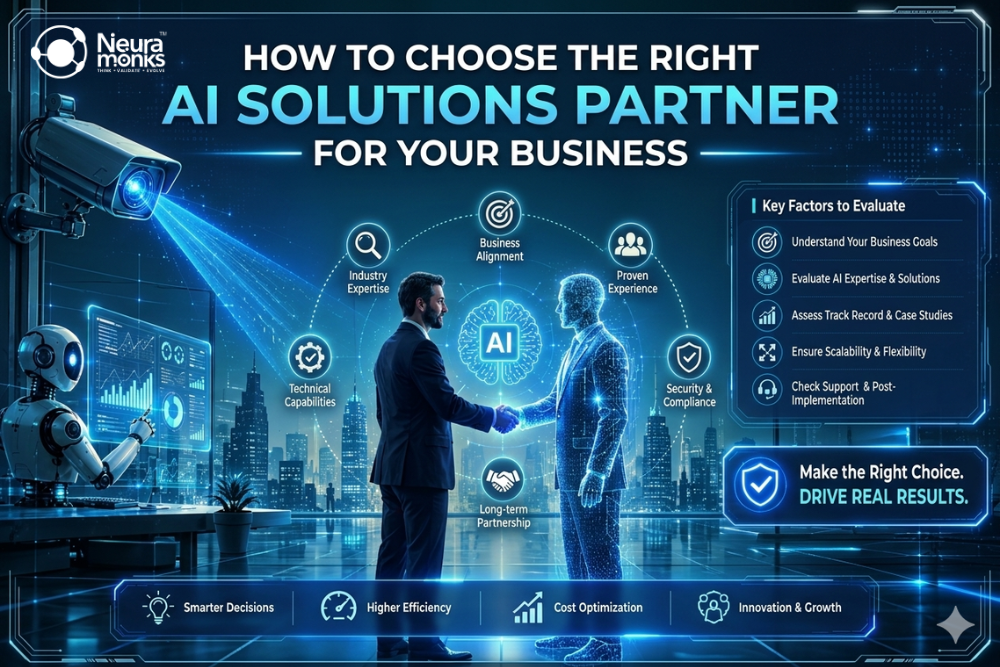
1. Do they ask more questions than they answer in the first meeting?
Good partners diagnose before they prescribe.
2. Can they show you a comparable implementation?
Not just a logo slide. An actual case study with outcomes.
3. Do they have in-house AI engineering or are they reselling another firm’s work?
Firms that own their delivery can move faster and debug more effectively.
4. What does the handoff look like?
If there isn’t a defined plan for training your team and transferring knowledge, you’ll be dependent on them forever.
5. Are they honest about what AI can’t do?
Any firm that doesn’t acknowledge limitations isn’t being straight with you.
What this looks like with a firm like Neuramonks
Neuramonks works with businesses that need AI solutions built around specific operational problems — not generic platforms dropped into an existing workflow.
The process starts with understanding your data, your team’s capabilities, and the workflows where AI can generate measurable return. From there, Neuramonks designs and delivers implementations that your team can actually own and operate. It’s the difference between buying software and building capability.
As an AI development company, Neuramonks also handles the technical complexity that stops most internal teams — model selection, training pipelines, deployment infrastructure, integration with existing systems — so your team can focus on using the output rather than managing the machinery.
Neuramonks has worked across industries including sales, healthcare operations, and enterprise workflow automation. Each engagement is scoped based on what will move the needle, not what fills a statement of work.
The question to ask yourself before you start
Before you evaluate a single firm, be clear on what success looks like in 12 months. Not in vague terms — specific ones. Revenue impact, time saved, decisions improved, costs reduced.
If you can define that clearly, you can hold any AI solutions partner accountable to it. If you can’t, you’ll end up evaluating proposals without a way to compare them.
Get clear on the outcome first. Then find the firm that can deliver it.
Ready to find the right fit for your business?
Book a free consultation with the Neuramonks team and walk through your use case before you commit to anything: Schedule your consultation