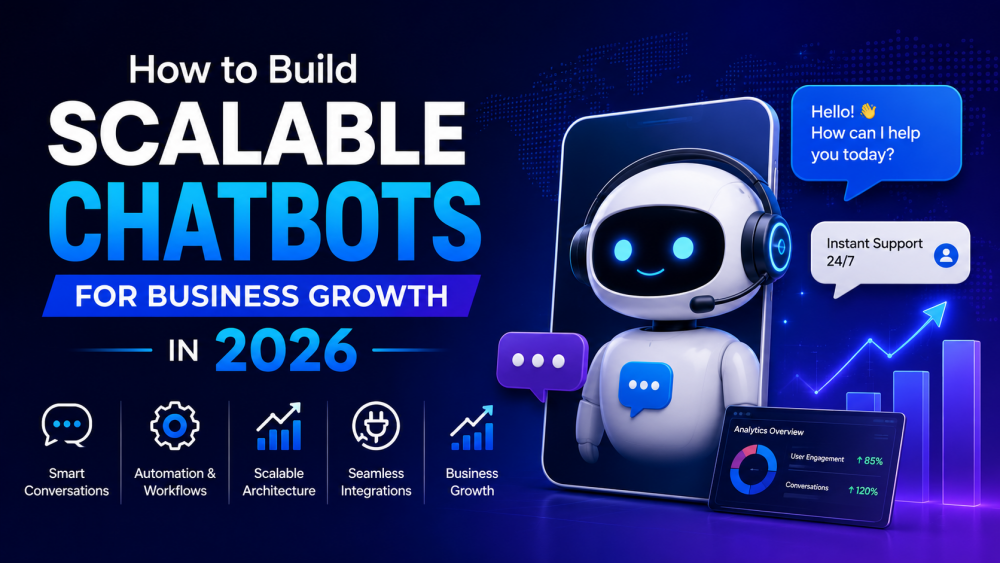
In 2026, chatbots have evolved far beyond simple scripted responders. They are now intelligent digital systems that power customer engagement, automate decision-making, and even assist in real-time business operations.
For startups and enterprises alike, chatbots are no longer optional — they are becoming a core part of digital infrastructure. However, while building a chatbot is relatively straightforward, creating one that can scale with your business growth is where real value lies.
As businesses expand, user interactions increase, workflows become more complex, and expectations rise. A chatbot that cannot adapt to this growth quickly becomes a bottleneck instead of an asset.
What is a Scalable Chatbot?
A scalable chatbot is designed to grow alongside your business without losing efficiency, speed, or accuracy.
Unlike basic bots that rely on fixed rules and limited responses, scalable chatbots are built with intelligent systems that can:
- Handle thousands of simultaneous interactions without lag
- Adapt to increasing user queries and dynamic inputs
- Integrate with multiple backend systems and tools
- Support real-time decision-making and automated actions
These bots function more like intelligent assistants, capable of executing tasks, analyzing inputs, and responding instantly — similar to how advanced automation systems operate in high-performance environments.
Why Scalability Matters for Business Growth
When businesses grow, the volume and complexity of user interactions increase significantly. A chatbot that works well for 100 users may fail when handling 10,000 users.
Scalability ensures that your chatbot remains reliable and efficient, even under pressure.
It supports business growth by:
- Maintaining fast response times during traffic spikes
- Reducing dependency on human support teams
- Enabling 24/7 interaction across global markets
- Supporting complex workflows and automated processes
In many modern platforms, scalable chatbots are also used to manage real-time operations and user-triggered actions, making them critical components of business ecosystems rather than just support tools.
Key Components of a Scalable Chatbot
Building a scalable chatbot requires a combination of strong architecture, intelligent processing, and seamless integrations.
1. Robust Backend and Cloud Infrastructure
The foundation of any scalable chatbot lies in its backend architecture.
Modern systems rely on:
- Cloud-based infrastructure for elasticity and scalability
- Microservices architecture for modular development
- Distributed systems to handle large workloads
- Load balancing to manage traffic spikes efficiently
This type of infrastructure allows the chatbot to operate smoothly even during high-demand situations, ensuring uninterrupted user experience.
It also enables real-time processing capabilities, where user inputs can trigger automated responses or actions instantly.
2. AI, NLP, and Intelligent Decision Systems
To scale effectively, chatbots must go beyond predefined responses and understand user intent.
Advanced chatbots incorporate:
- Natural Language Processing (NLP) for human-like understanding
- Machine Learning models that improve over time
- Context-aware responses for personalized interactions
- Intelligent decision engines that trigger actions based on input
These systems allow chatbots to behave more like automated decision-making tools, capable of executing tasks dynamically rather than just responding.
3. Multi-Platform and System Integration
Users today interact across multiple platforms — websites, mobile apps, messaging apps, and more.
A scalable chatbot must integrate seamlessly across:
- Web and mobile applications
- Messaging platforms (WhatsApp, Telegram, etc.)
- CRM and business management tools
- Payment and transaction systems
This creates a unified ecosystem where the chatbot acts as a central interaction layer, connecting users with backend processes.
4. Automation and Real-Time Execution Capabilities
One of the most powerful aspects of scalable chatbots is their ability to automate tasks in real time.
Beyond answering queries, they can:
- Execute user-triggered actions instantly
- Process requests based on predefined logic
- Trigger workflows across systems
- Provide real-time updates and responses
This level of automation closely resembles advanced automation engines used in high-speed digital platforms, where actions are executed based on data inputs without manual intervention.
5. Data Processing and Performance Optimization
Data is the backbone of chatbot scalability.
A scalable chatbot continuously learns and improves by:
- Analyzing user interactions and behavior patterns
- Identifying frequently asked queries
- Optimizing responses based on performance metrics
- Enhancing accuracy through continuous feedback loops
Over time, this results in a smarter, faster, and more efficient system.
Steps to Build a Scalable Chatbot
Building a scalable chatbot requires a structured, long-term approach rather than a quick deployment.
Step 1: Define Clear Objectives and Use Cases
Start by identifying the primary role of your chatbot.
This may include:
- Customer support automation
- Lead generation and qualification
- Workflow automation
- Real-time user assistance
Clearly defined objectives help in designing a focused and scalable system.
Step 2: Choose a Scalable Technology Stack
The choice of technology plays a crucial role in long-term scalability.
Key considerations include:
- Cloud platforms for flexibility and scaling
- AI/NLP frameworks for intelligent processing
- APIs for seamless integration
- Secure backend systems for data handling
A well-chosen tech stack ensures that the chatbot can evolve without major restructuring.
Step 3: Design Intelligent Conversation Flows
A chatbot’s effectiveness depends on how well it communicates.
Focus on:
- Clear and structured conversation paths
- Context-aware responses
- Error handling and fallback mechanisms
- Smooth transition to human support when needed
Well-designed flows improve both user experience and system efficiency.
Step 4: Implement Advanced Automation Logic
To truly scale, chatbots must go beyond static responses and incorporate dynamic automation.
This includes:
- Trigger-based actions based on user behavior
- Rule-based and AI-driven workflows
- Real-time execution of tasks
- Integration with external systems for automated processes
This transforms the chatbot into a functional automation engine, capable of handling complex operations efficiently.
Step 5: Continuous Testing, Learning, and Scaling
Scalability is not a one-time achievement — it’s an ongoing process.
Businesses should:
- Test chatbot performance under different loads
- Analyze user behavior and interaction patterns
- Continuously improve response accuracy
- Expand features based on business needs
This ensures that the chatbot evolves alongside the business.
Common Challenges in Scaling Chatbots
Despite their advantages, scalable chatbots come with challenges that must be addressed early.
These include:
- Handling complex and unpredictable user queries
- Maintaining accuracy as interactions increase
- Integrating with legacy systems
- Ensuring data privacy and security
Addressing these challenges requires careful planning and robust system design.
Future Trends in Scalable Chatbots
The future of chatbot development is closely tied to advancements in automation and intelligent systems.
Emerging trends include:
- AI-driven conversational intelligence
- Voice-enabled and multimodal interactions
- Hyper-personalized user experiences
- Real-time automation across digital platforms
These trends indicate a shift toward chatbots becoming central control systems for digital operations, rather than just communication tools.
Final Thoughts
Building a chatbot today is no longer just about automating conversations — it’s about designing intelligent systems that can support business growth at scale.
A scalable chatbot brings together automation, real-time processing, and intelligent decision-making to deliver consistent, high-quality user experiences. As businesses grow, these systems evolve into more advanced digital layers that not only respond to users but also execute actions, manage workflows, and optimize operations in real time.
With the increasing demand for automation-driven platforms and intelligent systems, many technology providers are focusing on building scalable chatbot solutions that integrate seamlessly with broader digital ecosystems. These systems often share similarities with trading bot development models, where real-time data processing, automated execution, and intelligent decision-making play a critical role in delivering faster and more efficient user interactions.
Organizations that invest in scalable chatbot development and automation technologies today are not just improving operational efficiency — they are laying the foundation for future-ready platforms that can adapt, automate processes, and grow without limitations.