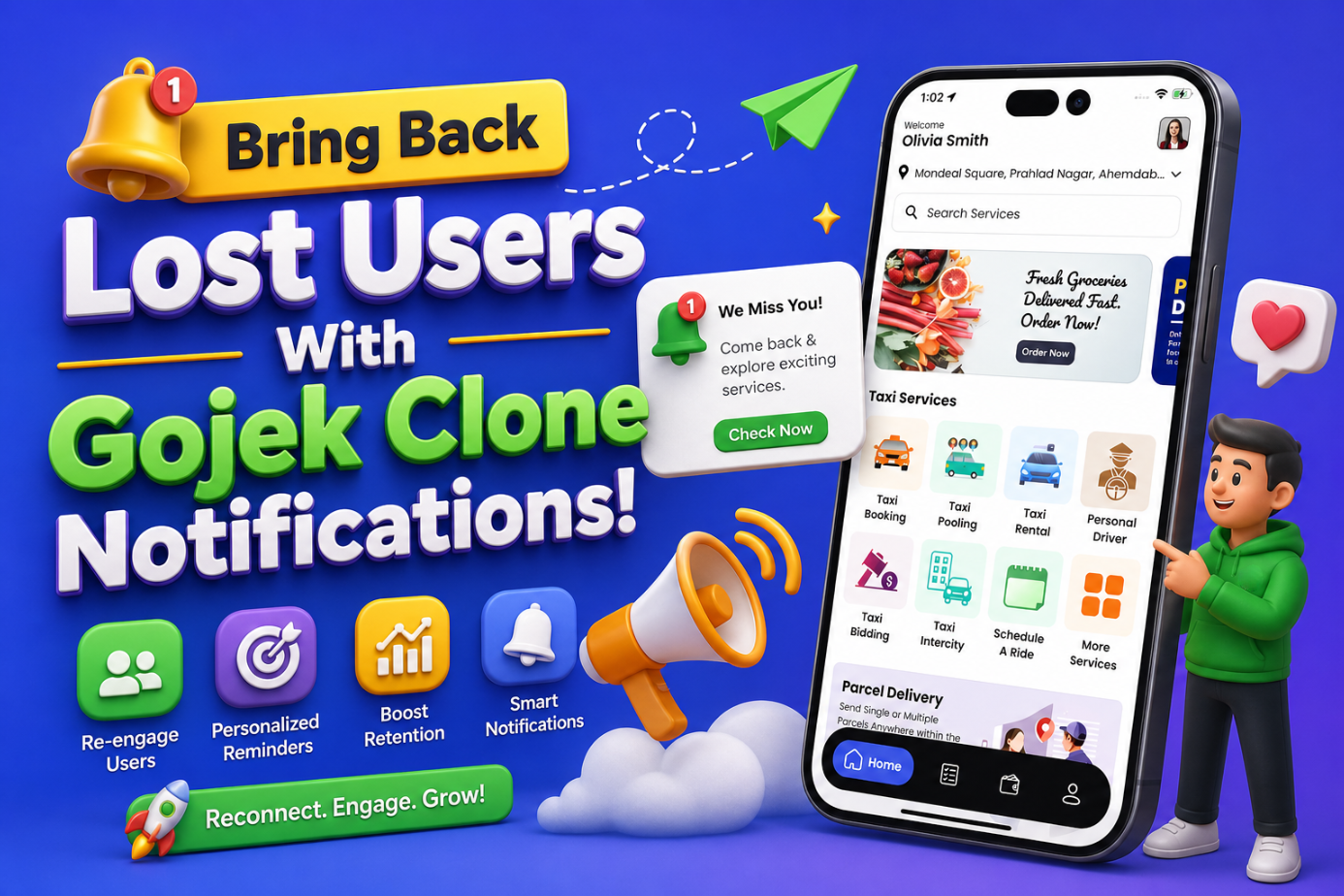
Push notifications, honestly, are one of those things that most app operators set up once and then basically forget about. They configure a welcome message, maybe a promo code alert or something, and then just leave it running in the background while wondering why retention numbers aren’t really moving in the right direction.
The thing is, in a Gojek clone app that runs over 101 services at the same time, push notifications are not just a marketing feature or anything like that. They are, generally speaking, the primary mechanism through which repeat bookings actually get generated across services that users might otherwise completely forget exist on the platform.
Why Push Notifications Work Differently in a Multi-Service App Like a Gojek Clone
Single-service apps, like a standalone food delivery app or a ride-hailing-only platform, send notifications about one category of thing. There’s a promo on food, there’s a driver nearby, that kind of thing. The notification strategy is basically flat because the product is flat.
A Gojek clone app, on the other hand, runs what the platform describes as 4 base components and 14 additional components, covering services from taxi booking and store deliveries to on-demand beauty, medical appointments, pet care, and video consultations with doctors or lawyers or fitness experts or whoever the user needs.
That is, roughly speaking, 18 different service categories that each have their own booking cycle, their own frequency pattern, and their own moment when a push notification actually makes sense to send.
How Push Notifications Actually Drive Repeat Bookings in a Gojek Clone App
1. Ride Booking Reminders
The taxi booking component in a Gojek clone supports standard rides, scheduled rides, intercity trips, pool rides, two-wheeler bookings, and rental by the hour, among other things. Each of those booking types has a different relationship with timing. A user who books intercity rides, for instance, tends to plan a few days ahead.
A notification that arrives two days before a typical travel window, generally speaking, lands better than one that arrives during the morning commute when the user is already managing their day.
2. Promo Codes and Referral Rewards
The Gojek clone app supports promo codes and referral rewards as part of its standard feature set. The timing of when those codes get pushed is, actually, more important than the discount amount itself or anything like that. A promo code sent immediately after a booking completion has a reasonably low redemption rate because the user just finished a transaction and is not mentally in shopping mode.
The same code sent approximately 48 hours later, when the user has had time to move on from that booking and is starting to think about their next need, tends to perform better.
3. Cross-Service Discovery Notifications
This is where a lot of Gojek clone operators leave real commission revenue on the table. A user who only uses the taxi component has no particular reason to think about grocery delivery or beauty services unless something draws their attention to it.
A push notification that says something like “did you know you can also book a home cleaner through the same app” is, generally speaking, more effective when it arrives after the user has completed a taxi booking and is in an active mindset about the platform, rather than arriving cold on a Tuesday afternoon.
4. Store Delivery and Grocery Notifications
Grocery delivery, flower delivery, pharmacy orders, bottled water, and food, all of which fall under the store deliveries component of a Gojek clone app, have something in common that taxi bookings generally do not. They are repeating needs. A user who orders groceries on a Sunday has a reasonable chance of needing groceries again the following Sunday, or thereabouts.
5. On-Demand Service Notifications
On-demand services in a Gojek clone app cover over 52 categories, including plumbers, electricians, painters, carpenters, babysitters, maids, pest control operators, and dog walkers, among others. These are not daily needs. Most of them are periodic or seasonal. A notification strategy that treats them like taxi reminders, which is to say frequent and short-cycle, is going to feel intrusive and probably result in the user turning off notifications entirely.
6. Video Consultation Notifications
The online video consultation component of a Gojek clone app allows users to book video appointments with doctors, lawyers, astrologers, tutors, yoga instructors, and fitness coaches. Bookings in this category tend to follow a different pattern from most others on the platform.
A user who consulted a doctor once may need a follow-up. A user who booked a fitness session may want to continue on a weekly schedule. A user who spoke with a lawyer about a specific matter may return once that matter progresses.
What Gojek Clone App Development Companies Provide to Support This
A white-labeled Gojek Clone can go live in 7 to 14 days from purchase. The localization decisions covered in this article do not extend that timeline. They happen during white-labeling. That is the difference riders notice. And in the early weeks, when every first impression either builds a booking habit or breaks one, it tends to be the only difference that holds.
Bug support is included for the first year after launch, and annual upgrades come with major packages. A Non-Disclosure Agreement (NDA) is signed before purchase, which means the notification strategy and any custom logic built on top of the platform stays with the operator and does not get shared with competitors or disclosed publicly or anything like that.
Final Thoughts
Push notifications, honestly, are not complicated. What makes them work in a Gojek clone context is not the technology. It is the decision to think about each service category separately and ask when, roughly speaking, does a user of this specific service most need to hear from the platform.
That question, asked and answered for taxi, grocery, beauty, handymen, video consultations, and the other services the platform carries, is the difference between a notification strategy that quietly drives repeat bookings every week and one that users disable after the third irrelevant message.