Though clean and pristine, even clear water holds risks down the road. Bits of dirt, silt, sand, and even rust have a way of sneakily finding their way into water streams. These substances may seep into water systems via pipes, storage tanks, or various industrial treatments and, over time, can lead to the disruption of a water’s purity and damage pumps, membranes, and other water treatment devices.
A sediment filter commonly serves as pre-filtration on the most basic or simplest of filtration set-ups. Its job is to trap the largest suspended particles in water, so it has the least impact on the water and doesn’t contaminate and ultimately shorten the lifespan of any following filtration stages.
What Is a Sediment Filter?
A sediment water filter works by physically removing unwanted sediment from the water. In contrast to a filter that will remove or neutralize bacteria or chemicals, sediment filtration removes visible components such as soil, rust, silt, or sand.
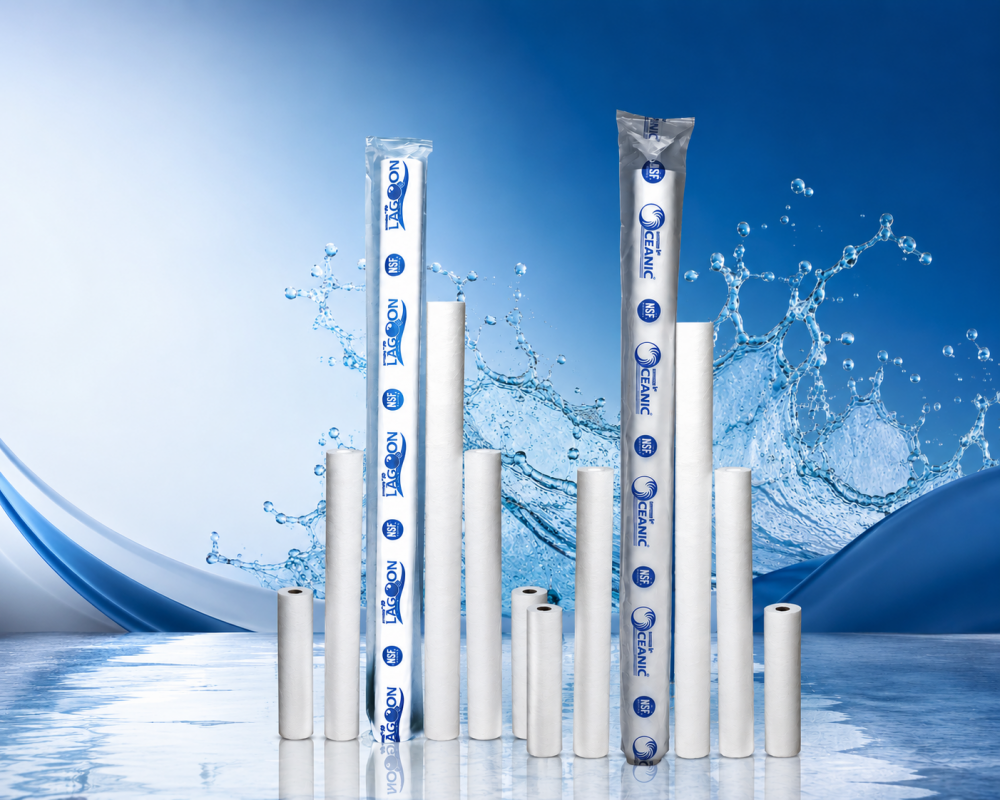
Central to many water filtering systems is the filter element, specifically the sediment filter cartridge. Within the filter media is a framework of tiny pores. Water can enter, but bigger, undesirable material is held within the media and/or on its surface, determined by cartridge design and rating.
Thus, a water filter cartridge can fulfill the vital first step of the filtration process for an apartment, an office, and an industry before the water enters the next-stage filter system.
How Does a Sediment Filter Cartridge Work?
The sediment filter cartridge goes in a compatible filter housing. The water is passed through the cartridge as sediment becomes captured on the media surface or in the filtration media itself. Gradually, the filter fills up with sediment, which explains why sediment filter cartridges are monitored.
Another popular choice is the PP Sediment Filter Cartridge, made with polypropylene filter material. Polypropylene offers good chemical and mechanical resistance while maintaining high performance with regard to particle retention in many applications for water filtration.
The manufacturing process of the cartridge is important as well. Some cartridges have an internal PP core structure that offers some sort of protection for the cartridge to stay in shape throughout its operation time. It may seem quite minor for cartridges; however, PP core contributes to its overall consistency.
The exact construction of a sediment filter cartridge depends on the application, filtration rating, flow requirement, water quality, and operating environment.
Why Sediment Filtration Is Important
Particulate contamination may seem harmless when present in small quantities, but its impact can increase when water continuously passes through a system.
A well-selected sediment filtration system can help:
- Reduce suspended particles in incoming water
- Protect downstream filtration equipment
- Minimize clogging and fouling
- Improve the performance of subsequent treatment stages
- Support more consistent water quality
- Reduce unnecessary maintenance
This is particularly applicable to RO systems. Adequate pre-filtration minimizes suspended solids to the RO membrane, contributing to smooth operation and possibly to a longer service life of later treatment stage components.
For this service, an appropriate water filter cartridge would be essential by providing particulate removal down to the point needed for sensitive stages of water treatment.
Where Are Sediment Filter Cartridges Used?
Sediment filtration applies to many applications. Water treatment equipment for homes and businesses often includes a sediment filter cartridge to capture visible dirt and suspended contaminants in the intake water.
Large, industrial-scale water filtration systems may include sediment cartridge(s). Industries typically involved include food and beverage, pharmaceuticals, industrial manufacturing, chemical processing, hospitality, and process water in general.
It is also important to understand that not every water filter cartridge can perform to the same level under any water conditions and at any operational condition. A cartridge intended for light industrial, domestic, or commercial water filter systems will likely not meet your system performance in a high-volume industrial environment.
Choosing the Right Sediment Filter Cartridge
Several factors should be considered when selecting a sediment filter cartridge.
Filtration Rating
The micron rating is the approx size of particles a cartridge is intended to trap; the choice is dependent on the volume and form of sediment.
Material and Construction
Polypropylene, as the material for filtration media, offers many advantages for its wide use. In the case of PP Sediment Filter Cartridge, its performance and service life would vary depending on the fiber’s density, internal arrangement, density structure, the PP core, etc.
Flow Rate
The cartridge has to give you good filtration but without too restrictive a flow rate. Hence, working flow rate and working pressure should be taken into consideration before choosing a water filter cartridge.
Water Quality
Knowledge of the nature and concentration of particulate matter present in raw water allows us to design the most suitable cartridge type and filtration level and to estimate the service life.
The Importance of Choosing the Right Manufacturer
Filtration cartridge quality and consistent performance significantly affect the efficiency of your filtration system. An established sediment filter manufacturer can work to develop cartridges around the needs of your particular water application.
If you’re sourcing products locally, you’re less likely to encounter language barriers, cultural issues when interacting for commercial talks, complications during technical discussions for products, as well as more consistent product availability because of the partnership made with your sediment filter cartridge manufacturer in India.
Some important characteristics to look for in a seasoned PP sediment filter cartridge manufacturer include consistent manufacturing quality, reliable and durable cartridge construction, a selection of filtration grades, and available technical assistance. This last feature is an important one, especially if you need a specific PP sediment filter cartridge, PP core type, or filtration quality.
A reliable sediment filter supplier can also save a business’s production, as there will always be a supply of replacement parts and therefore no danger of stopping filter systems.
Maintaining an Effective Sediment Filtration System
An otherwise excellent sediment filter cartridge has limited life. With the media becoming clogged with sediment, the pressure drop through the filter will gradually rise, and so the water flow rate should gradually fall.
Tracking these pressures, flow rates, and the condition of the cartridge can tell a lot about when the water filter cartridge needs to be changed. Continuously using an overloaded cartridge can decrease the efficiency of the system and potentially overwork the pumps and other parts.
Proper upkeep guarantees the continuing efficacy of the sediment filtration system to offer continuous safeguarding to downstream equipment in your system.
Conclusion
It is important to understand that removing sediment (otherwise known as physical removal of solids) is an inherent and crucial step in water treatment. With the right sediment filter cartridge, a water filter will be able to capture solids and protect the later-stage equipment, ensuring consistent operation.
Whether your needed item is PP Sediment Filter Cartridge, a common type of water filter cartridge, a whole sediment filtration system, or something else. You should also consider the actual condition of water quality, pressure head required, filter rate, structure material, and environmental conditions when choosing. The specification, like PP core, could also have the affect towards the cartridge’s stability and strength.
Through partnering with a trusted sediment filter manufacturer or sediment filter supplier, businesses are able to have consistent access to suitable filtration products and stable water treatment operations.